 Antaryami
Tarot card meanings
Wheel of Fortune tarot card: meet a changing season without surrendering your choices
You can prepare carefully and still find that the situation has changed by the time you arrive. A project gains an unexpected opening, a familiar routine stops working, or someone else's decision changes the options in front of you. Wheel of Fortune gives that experience a memorable image: movement around a centre that does not belong entirely to you. Nitish Raj Walia explores this Antaryami card guide through changing conditions, opportunity and the difference between adaptability and fatalism. The wheel is not a machine that calculates your luck. It is a symbolic invitation to notice what is moving and decide how you want to respond.
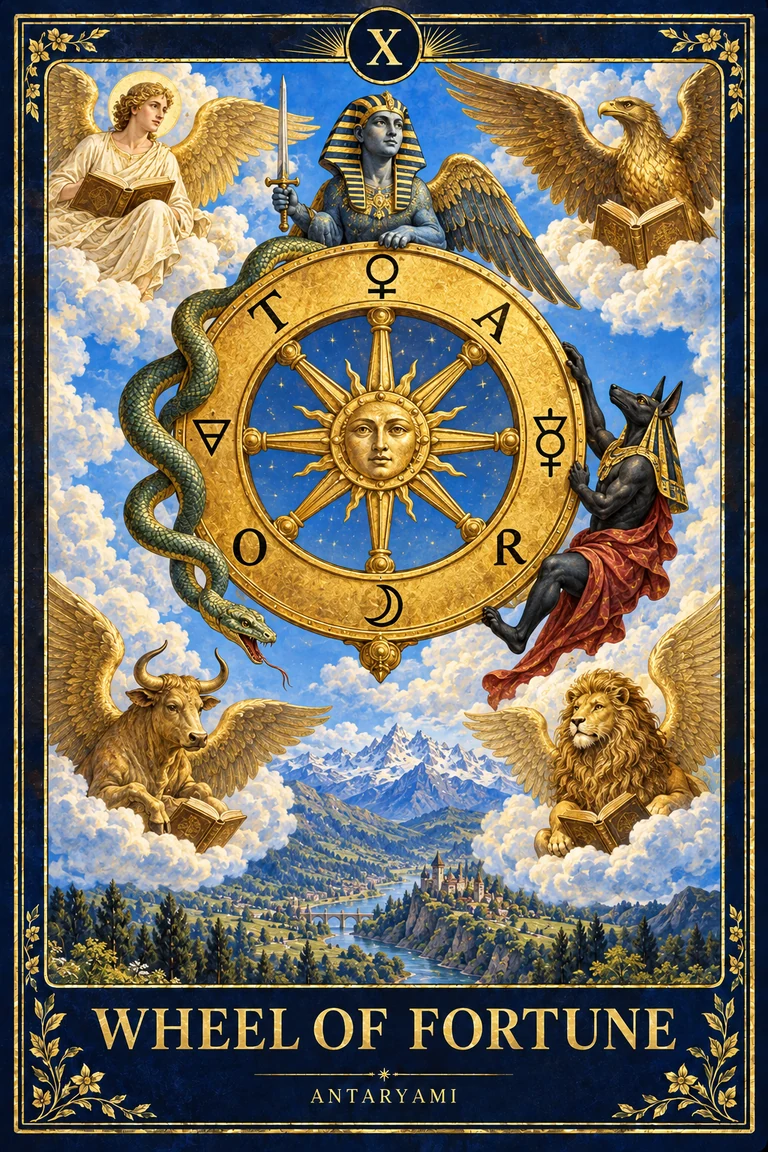
Wheel of Fortune meaning: circumstances move, but your response still matters
In contemporary tarot vocabulary, Wheel of Fortune often brings together cycles, turning points, changing circumstances and the experience of opportunity or setback. That does not require believing that every event has been arranged specifically for your benefit. Some changes are welcome, some are inconvenient, and some are genuinely difficult. A reflective reading can acknowledge all three without turning the card into a promise that the next phase will automatically be better. The useful question concerns your relationship to a situation that is no longer exactly as it was.
Think of a community workshop that has slowly attracted interest. One participant recommends it to a larger group, and suddenly the organiser receives more requests than the current room can accommodate. The change is positive in one respect, but it introduces practical decisions about capacity, fairness and quality. A Wheel-themed reflection might ask what should expand and what should remain protected. Calling the development lucky does not answer those questions. The organiser still needs to consider the real conditions before accepting every opportunity that arrives.
The spread position helps determine which part of change deserves attention. In an external-influence position, the card may frame circumstances you cannot fully control. In an action position, it might prompt a flexible plan or a way to preserve options. It should not erase responsibility for decisions that remain yours. Nor should it assign blame for difficulties outside your control. Wheel of Fortune is most useful when it allows two truths to coexist: conditions can shift unexpectedly, and a thoughtful response can still make a meaningful difference.
The wheel, sphinx and corner figures: movement beside a stable reference
Antaryami's original portrait places a golden wheel amid clouds, surrounding figures and four winged creatures in the corners. A sphinx occupies the upper part of the composition. Look first at the contrast between rotation and the frame around it. You can use that visual contrast to ask which values or commitments should remain reliable while an arrangement changes. This is an interpretation of our artwork, not a claim that its symbols physically influence events or identify the exact stage of your personal future.
Waite explains that his design draws on Eliphas Levi and combines several symbolic traditions. He associates the wheel with movement in human life and the sphinx with equilibrium. Importantly, he says that using Egyptian imagery does not establish an Egyptian origin for tarot. That is a useful historical distinction: a later deck can borrow a symbol without proving that the entire practice began where that symbol originated. The page linked below records his explanation; our practical examples are contemporary applications rather than quotations of his occult doctrine.
The lettering and creatures can reward close visual study, but you do not need to decode every detail before using the card thoughtfully. Begin with something observable in your own circumstances: a repeating pattern, an unexpected change or an opportunity with a limited window. Then ask what evidence confirms that it is happening. A compelling image may help organise attention; it cannot replace that evidence. Avoid confusing an occult correspondence with an astronomical measurement, a probability calculation or a verified reason why a particular event occurred.
Sources: Waite: Wheel of Fortune symbolism and the distinction between imagery and origin
Upright: recognise an opening without treating it as a guaranteed result
An upright Wheel reflection may concern an opening that changes what is possible. Perhaps a course becomes available locally, a collaborator has time to help, or a cancelled commitment creates space for something you wanted to attempt. The constructive response is not necessarily to say yes immediately. Examine the opening: what does it require, what would you gain, and what would you have to set aside? An opportunity becomes workable through that assessment, not because the card has certified it as a favourable intervention from the universe.
Consider an invitation to present your work. You may be excited, but the preparation time overlaps with an existing obligation. A useful reading could lead you to clarify the deadline, negotiate a smaller contribution or decline a format that would damage both commitments. Flexibility might preserve the opportunity without accepting its first proposed shape. This is different from assuming that a good-looking card means the cost will somehow resolve itself. The actual invitation, available resources and your ability to deliver remain more important than a symbolic prediction of success.
Another upright theme is recognising that an unhelpful pattern can change. A routine that seemed permanent may be open to adjustment after circumstances shift. Ask what is genuinely different now, rather than making the same attempt and expecting a new result simply because the card appeared. A changed schedule, clearer information or a willing participant may create a practical opening. The wheel can remind you to notice it. You still need a specific next step and a way to assess whether that step is producing the improvement you hoped for.
Reversed: look at friction, repetition and the limits of your control
Reversed Wheel of Fortune is often read through disruption, resistance to change or an unwelcome repetition. It should not be used to announce a period of cursed luck. That interpretation can make an ordinary difficulty feel more frightening while giving the reader nothing useful to do. Instead, identify the actual pattern. Are appointments repeatedly missed because the schedule is unrealistic? Does a project stall whenever approval is needed? Naming the mechanism creates more possibilities than attaching a supernatural explanation to a sequence of frustrating events.
A repeated problem may contain both an external constraint and a choice you can alter. For example, transport delays may be outside your control, while the amount of contingency time you leave may be adjustable. This does not mean everyone can solve a constraint through better planning; resources and circumstances differ. The card should not become a lecture about personal responsibility detached from reality. It can support a modest distinction between what you can influence, what requires help and what must be accommodated because it cannot currently be changed.
Sometimes the reversed theme is your wish to keep a phase that is ending. A familiar way of working may have served you well and still no longer fit. You can value what it provided without preserving it unchanged forever. Write down what you would lose by adapting and what you are already losing by refusing to adapt. Those questions do not make the decision easy, but they make it clearer. Reversal is an alternative angle for reflection, not a timetable for misfortune or an instruction to wait passively for luck to improve.
Relationships: a changing rhythm needs a conversation, not a fate story
Relationships change when work, residence, health, family responsibilities or personal priorities change. Wheel of Fortune can frame the adjustment required when the old rhythm no longer works. Two friends may care about each other while having less overlapping time than before. A couple may need a new division of tasks after a schedule changes. The card does not determine whether affection remains. The more useful question is which expectations should be discussed openly rather than silently carried forward from a different set of circumstances.
Suppose a friend cancels several meetings during a demanding period. A fate-based interpretation might tell you that the connection is destined to disappear, or that you must wait because reunion is inevitable. Neither statement is established by a card. You can ask what kind of contact is realistic now, explain what matters to you and hear the reply. Perhaps a shorter call works better; perhaps the relationship needs a boundary. The answer comes from the interaction and its pattern over time, not from the wheel's position in a reading.
Changes can also reveal how much an arrangement relied on one person's invisible work. If that person becomes unavailable, everyone may suddenly notice tasks that were taken for granted. A constructive reflection would ask how responsibility can be shared more fairly. It would not tell the person who has been doing the work that their hardship is a karmic test they must accept. The wheel can help you recognise a transition while preserving the dignity, consent and practical needs of the people who are actually living through it.
Career and money: preserve options when conditions are uncertain
In a career context, Wheel of Fortune may prompt a review of assumptions that depend on conditions staying the same. A team might rely on one supplier, one person with essential knowledge or one anticipated deadline. The card can provide a memorable reason to ask what happens if that condition changes. A contingency is not pessimism; it is a practical acknowledgement that a plan exists in an environment. Documenting an alternative, sharing knowledge or checking a dependency can make the work less brittle without pretending to remove uncertainty entirely.
For someone considering a new role, the wheel's opportunity language should not replace questions about duties, compensation, support and the organisation's actual position. An exciting invitation can still be unsuitable. You might compare the offer with your needs, request missing information and speak with appropriate advisers before deciding. Tarot cannot verify an employer's claims or promise that taking a chance will advance your career. Let the card stimulate a better set of questions, then use real answers to make the decision.
The word fortune is particularly easy to misread around money. This card does not predict a windfall, choose a winning bet or establish that an investment is about to rise. Do not increase financial exposure because a symbolic wheel looks favourable. If a change in income or expense has already occurred, practical budgeting and qualified advice may be relevant. The educational theme can help you think about adaptability, but the amount you can afford to risk and the evidence behind a proposal must be evaluated independently of the reading.
Wheel of Fortune, Death and The Tower describe different kinds of change
Several Major Arcana cards involve change, but they do not need to collapse into the same message. Wheel of Fortune can focus attention on changing conditions, cycles or an opening that alters your options. Death, in our contemporary reflective framework, concerns an ending and the transition that follows it. The Tower concerns disruption to an assumed structure. These are interpretive distinctions, not scientific categories into which every life event can be sorted. Their value is in making your question more precise rather than in labelling your future.
Imagine that a venue becomes unavailable for a planned event. A Wheel question could ask how the changed circumstances affect your choices. A Death question could ask which version of the event must now be relinquished. A Tower question could examine why the whole plan depended on that venue without an alternative. One real situation can support several questions. You do not need another draw to discover the single correct label. You can compare the angles and use whichever helps you address the actual problem more clearly.
Likewise, a repeated card does not prove a cycle has supernatural significance. Selection methods, deck size and ordinary repetition can produce familiar images. Record what you asked and what you learned instead of inventing a fixed number of days or a hidden warning from repetition alone. If the wheel's theme remains relevant, explore the real pattern it brings to mind. If it does not, you can move on. A thoughtful tarot practice allows an image to be evocative without demanding that every appearance must reveal a secret message.
An Antaryami change map: separate the event, your interpretation and your next step
When Wheel of Fortune appears in an Antaryami reading, begin by retaining the actual card orientation and position shown. Ask about an observable change rather than requesting a lucky date or a guaranteed outcome. You could explore what needs to remain steady while a project changes, or which alternative would preserve flexibility. If you seek an explanation through Ask, avoid supplying another person's private documents or assuming that the card authorises the app to invent details about their motives. Keep the exercise anchored in information you can responsibly discuss.
Make three short notes: the event that happened, the story you have attached to it and the action available now. For example, the event may be a delayed reply; the story may be that an opportunity is permanently lost; the action may be a polite follow-up after an appropriate interval. Separating those notes can reveal where uncertainty has been converted into certainty without evidence. You do not have to force optimism. You are simply giving yourself a chance to respond to what is known instead of to an untested explanation.
This Antaryami Journal article is presented by Temior Technologies Pvt Ltd with Nitish Raj Walia's byline, AI-assisted writing and the existing original Wheel of Fortune portrait. Check the current app page for availability and access details rather than treating a guide as an entitlement. The wheel's most useful invitation is neither to worship good luck nor fear bad luck. It is to notice movement, protect what matters and choose a response that can adapt when the world does not follow the plan you first made.
Choose your angle on a changing situation
An unexpected opportunity has appeared
Check its conditions before accepting. Name what it requires, what it displaces and which details are still missing. The wheel can frame an opening, but it cannot certify that the opening is suitable or promise a favourable result.
A frustrating pattern keeps repeating
Describe the repeated mechanism without calling it a curse. Separate external constraints from choices you can influence, then consider one realistic adjustment. A reversed wheel is a reflective angle, not a verdict that misfortune must continue.
Astrological interpretations are for reflection, not a diagnosis, a guaranteed prediction or a substitute for professional advice. Journal guides are prepared with AI assistance; they are educational content, not individual consultations.


