 Antaryami
App walkthroughs
Open the ladder: learning mahadasha, antardasha and pratyantar in Antaryami
A row of planetary names can seem to promise a timetable for your whole life. Before reading it that way, open the working. Antaryami's inspected Timing screen exposes a Vimshottari ladder with nested periods and a note about the balance at birth. The interaction is valuable because it makes the chronology visible instead of asking you to accept a mysterious age range. In this walkthrough, Nitish Raj Walia follows the real fictional-profile preview and explains how to read the levels. A calculated period boundary is not an appointment at which a job, wedding or personal transformation must occur.
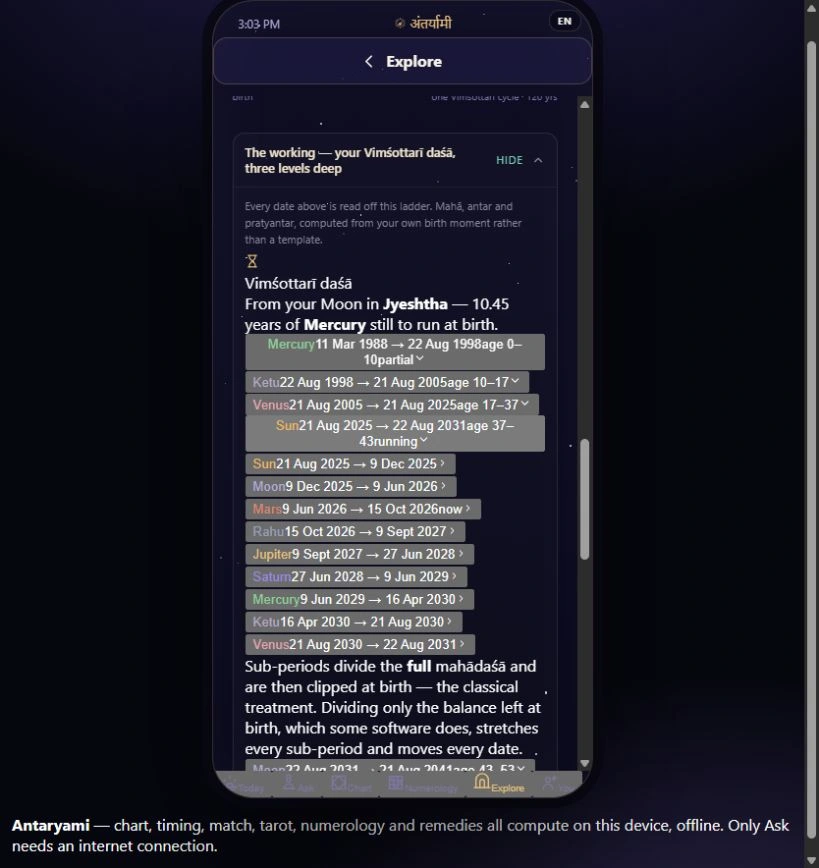
The levels sit inside one another
Mahadasha is the major period in the displayed Vimshottari structure. Antardasha names a sub-period within it, and pratyantar provides a further subdivision. The source app's working panel supports this nested view rather than placing all three types of period in one undifferentiated date list. Open a major period, then inspect the sub-period rows associated with it. Understanding the parent-child relationship between rows is more important than memorising the entire sequence on your first visit.
Think of the ladder as a way of organising the method's chronology, not as a calendar of guaranteed incidents. A short sub-period does not become more certain merely because its boundaries are finer. Nor is the biggest period the only part a traditional reading might consider. The useful first question is structural: which row contains this row, and what dates define each interval? You can learn that organisation before attaching any life theme to the planet named beside it.
The first displayed period may be partial
The fictional preview states a remaining balance associated with the natal Moon's nakshatra. That explains why the first visible major period can be a remainder rather than a complete standard period starting neatly on the birth date. A birth record locates the person within the method's cycle. It does not restart the whole cycle at the beginning of a full planetary duration just because the chart is new. Read the balance statement before deciding that a shorter first row must be an error.
This distinction matters when comparing period tables. A program that divides a remaining balance as though it were a new full period can produce a different sub-period structure. The inspected app's working note describes subdividing the full major period and then clipping the chronology at birth. That is an implementation explanation worth retaining with a comparison. It should not be turned into an unsupported claim that every other product is wrong. First check which convention, inputs and boundaries the other result actually uses.
Opening a row makes the date hierarchy visible
The screenshot shows a major period opened to display its sub-periods. In the app, the further working supports another level beneath those dates. Expand deliberately and read the start and end of the enclosing interval before focusing on one shorter row. A current or running label identifies where the chosen time sits within that calculation. It does not tell you that the associated symbolic quality is the only thing influencing your current situation, or that every part of life should be interpreted through that planet alone.
The same planetary name can appear at more than one level. That repetition is part of the nested sequence, not necessarily a duplicated interface entry. Keep the level with the name when you discuss a row: a Sun major period and a Sun sub-period are not identical intervals. If you take a screenshot for your own review, retain enough of the surrounding heading to show what level you opened. Context makes a later comparison clearer and reduces the temptation to treat an isolated date as a prediction you once received.
A precise-looking boundary still depends on the input and engine
The date calculation begins with the natal Moon and the selected method. Birth-time uncertainty and differences in the position calculation can affect a boundary. The inspected preview includes an offline-engine uncertainty note; it must not be hidden simply because a date is printed to a particular day. This guide does not reproduce its internal accuracy statistics as independently certified evidence. The sensible reading habit is to preserve the uncertainty and avoid treating a fine display format as proof of an exact future event.
When checking another table, hold the birth details, time handling, ayanamsa, engine and period convention as steady as the products allow. If the input time is approximate, state that rather than repeatedly revising it until a desired date appears. A comparison can reveal an implementation or settings difference, but agreement between two tables does not validate a personality interpretation or event forecast. The chronology and the meaning attached to it remain different types of claim, even when both are shown on one polished screen.
Let a period raise a question without rewriting your memories
- Read the initial balance statement and identify the major-period row.
- Expand one period and distinguish its nested levels by their headings.
- Keep birth-time and calculation uncertainty with any date comparison.
- Use a theme to frame a practical question, without promising an event on a boundary.
You may notice a theme in a traditional period description that resembles something you experienced. Explore that connection carefully rather than forcing every memory into the same explanation. Ask for examples that fit and examples that do not. A broad theme such as responsibility can be relevant to many stages of life, so a feeling of recognition is not by itself evidence that the period caused the events. Your circumstances deserve to remain specific, including the people, opportunities and constraints that were actually involved.
For a present interval, choose an ordinary question you can work on: what needs sustained attention, which skill you are practising or what conversation requires preparation. Do not postpone a necessary decision until a period changes or assume that its end will automatically resolve a difficulty. The method can be an optional frame for reflection. Real deadlines, professional advice and the rights of other people remain outside the authority of a planetary row. A useful reading leaves you more able to act thoughtfully, not dependent on the next boundary.
The benefit is being able to inspect the working
A transparent period panel lets you ask how a displayed life window relates to the underlying chronology. That is more informative than a sentence announcing a favourable age without showing its context. You can learn the structure, compare it with care and decide whether its traditional interpretation is useful to you. The feature's value does not depend on claiming that all 120 years of a symbolic cycle will become a reliable forecast of someone's lived future.
Antaryami is an experience introduced by Temior Technologies Pvt Ltd, and this guide by Nitish Raj Walia uses a fictional source preview rather than a customer's chart. Check current app access and calculation labels before expecting a personal result. The website can teach the ladder; it cannot activate an entitlement through an article or make uncertainty vanish through a screenshot. Open a row, understand what contains it, and keep the dates in their proper role: boundaries within a named method, not commands issued to your life.
Which part of the ladder needs explaining?
Why is the first major period shorter?
Read the birth-balance note. The displayed chronology can begin partway through a period rather than restart a full period at birth.
Does a finer sub-period guarantee a more exact event?
No. A nested calculation refines the method's intervals; it does not establish that a particular personal event must occur within them.
Astrological interpretations are for reflection, not a diagnosis, a guaranteed prediction or a substitute for professional advice. Journal guides are prepared with AI assistance; they are educational content, not individual consultations.


