 Antaryami
App walkthroughs
Arrived, now, moves on: what Antaryami's transit dates are actually showing you
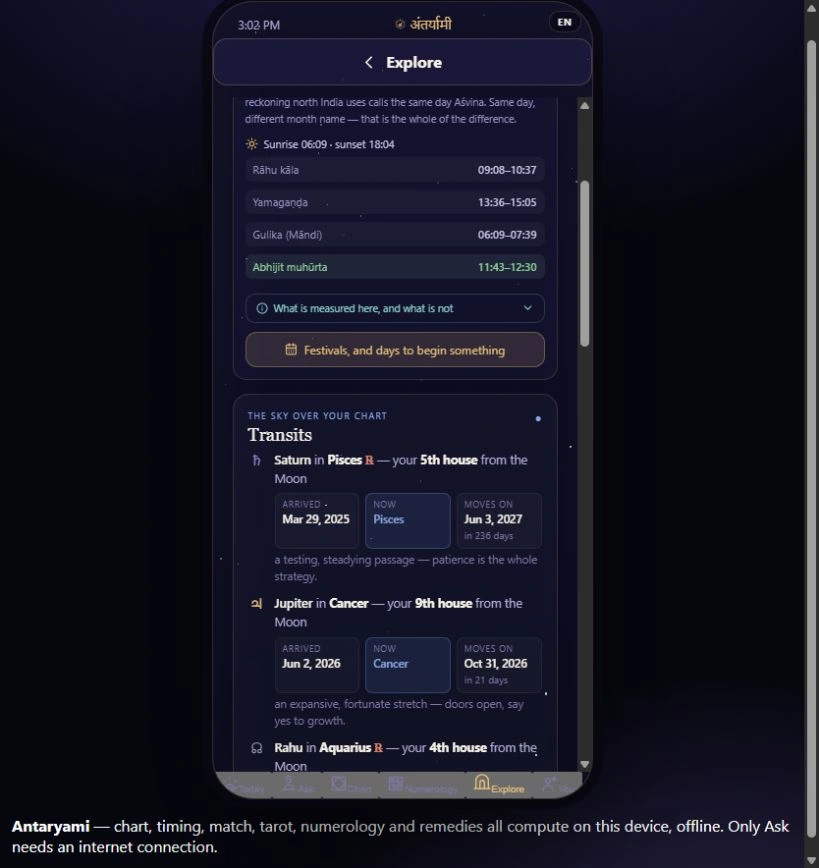
You open a transit screen today and notice a date from last year beside a date next year. At first glance, that can look like the app has failed to update. The real Antaryami preview gives those dates separate labels: Arrived, Now and Moves on. They describe different points in a sign passage rather than three competing versions of today's date. This walkthrough by Nitish Raj Walia helps you read that structure, identify the chart reference and keep the numerical timeline separate from its traditional interpretation. The screenshot belongs to a fictional demonstration profile, so it is an example of the interface, not your personal transit calendar.
Three labels describe one passage
Read the transit row horizontally before interpreting its note. Arrived refers to an entry into the sign, Now identifies the currently displayed sign, and Moves on refers to a following sign change in that calculation. A planet that remains in a sign across a long interval can naturally have dates on either side of the current day. The presence of an older entry date is therefore not enough to diagnose stale data. What matters is whether the row's time reference, method and boundaries are correct for the calculation being inspected.
The screenshot is itself historical once captured. Its dates teach the arrangement but do not continue to update as you read this article. Return to the current app feature for a present calculation when that feature is available. Do not forward the image as a fresh sky update without saying that it is an example. A durable product guide explains what the labels mean; a current ephemeris result supplies the actual positions and dates. Those are complementary uses of information, not interchangeable ones.
The displayed house count starts from the natal Moon
The inspected Timing surface names the house from the Moon. That reference is different from assuming every displayed house is counted from the ascendant. In this traditional transit reading, the natal Moon's sign supplies the starting point for the count. A visitor who learned houses from a birth-chart layout can otherwise wonder why the same moving planet appears associated with another house number. Before comparing results, read the reference explicitly rather than treating "house" as a word that always means one identical frame.
You can understand the distinction without declaring either frame a rival truth. They are different questions within the product's stated conventions. The natal chart describes placements associated with birth inputs; the transit panel relates a later sky position to a selected natal reference. If you compare another service, establish whether it is using Moon-referenced signs, ascendant-referenced whole-sign houses or some other system. A difference in the reference can change the interpretation without proving that either product has calculated the current sign incorrectly.
The explanatory sentence is not the position itself
A transit row can include both a sign and language about patience, growth or other themes. The sign and date are calculated information under a method. The theme belongs to traditional interpretation. Reading them together is convenient, but their proximity should not convert the theme into an independently demonstrated outcome. A correct position does not prove that a door will open, that a disagreement will occur or that a person should make a particular commitment during the passage.
Use a theme as a prompt for something you can examine. If a note raises patience, ask where you currently need a realistic timetable. If it raises visibility, ask whether there is work you are ready to share and feedback you are willing to hear. Those questions remain connected to your circumstances. Do not infer that the moving planet knows what your manager thinks or whether another person intends to cooperate. A symbolic prompt can organise reflection without supplying facts about people whose intentions still need an actual conversation.
Retrograde and engine settings belong in the comparison
The preview can mark retrograde beside a transit. That label describes apparent motion in the calculation context, not moral failure, a reversal of your value or a command to stop ordinary life. Sign passages may also need to account for a return across a boundary rather than a simple one-way progression. A product guide should therefore explain the row's structure without promising that a single average duration will reproduce every displayed date. The relevant method and the position calculation need to remain visible.
Antaryami includes different runtime calculation paths, so a source preview should not be advertised as proof that every surface currently uses Swiss Ephemeris. Founder-confirmed licensing and the exact engine used for a particular result are separate evidence. Read the current method label, and treat a disagreement between that label and the actual source path as a product issue for review. The supplier's technical documentation describes astronomical calculations; it does not certify an app's interpretation, a user's birth input or a prediction about a future personal event.
Check a transit before using its theme
- Verify the profile, current calculation date and natal-Moon reference.
- Read Arrived, Now and Moves on as separate fields.
- Keep method settings and any retrograde label with a numerical comparison.
- Translate a traditional theme into one grounded question, not a guaranteed event.
Begin with the selected person, the relevant date and the natal reference. Then locate one planet's row and separate its entry date, present sign and next boundary. Only after that should you read the interpretation. This order makes the screen less mysterious. It also helps you recognise when two apparent contradictions actually concern different dates or references. A useful support question can name the exact field that differs instead of saying the entire forecast feels wrong.
End with a practical observation rather than a commitment justified by the chart alone. You might review a deadline, practise a conversation or choose a manageable piece of work. An entry or exit date is not a deadline for marriage, health treatment or a financial decision. If the interpretation leaves you distressed or repeatedly checking for certainty, step away and consider the real concern underneath the checking. The appropriate help may come from a trusted person or qualified professional, not from another transit comparison.
The benefit is a readable time context
The transit surface can make a broad idea of changing sky conditions more inspectable. Instead of an isolated sentence called today's luck, you can see a passage with labelled dates and a named reference. That gives you something concrete to learn and question. It does not require believing that each interval controls your life. The instrument is most useful when you understand the frame well enough to recognise which statements are calculations and which are an interpretive conversation around them.
Nitish Raj Walia's Antaryami Journal introduces this product from Temior Technologies Pvt Ltd with fictional screenshots and AI-assisted educational writing. It is not a substitute for a current personal reading, a verified ephemeris comparison or professional advice. Explore the structure here, check the app's actual availability and method when you use it, and keep your own evidence in the conversation. A date spanning the past and future can make sense without becoming a promise about either.
What might explain the apparent mismatch?
The row shows a date from last year.
Read its label. An entry date can precede today while the sign passage continues; a captured screenshot is also not a live update.
The house differs from my birth-chart screen.
Check the reference. This transit view counts from the natal Moon, which is not automatically the same frame as ascendant-based houses.
Astrological interpretations are for reflection, not a diagnosis, a guaranteed prediction or a substitute for professional advice. Journal guides are prepared with AI assistance; they are educational content, not individual consultations.


