 Antaryami
App walkthroughs
Drekkana D3 in Antaryami: explore effort without turning siblings into stereotypes
A difficult phone call, a skill you keep postponing, a complicated conversation with a sibling: courage often arrives in ordinary clothing. Antaryami includes Drekkana, labelled D3, among its chart divisions. Its traditional theme connects siblings, courage and effort, but that does not make it a character certificate for your family. Nitish Raj Walia explores the inspected app implementation here as a way to understand what the instrument changes, what it leaves alone and how its language might lead to a more thoughtful next step. The example is fictional, and your own relationships remain bigger than any diagram.
Start with the division name, not the most dramatic placement
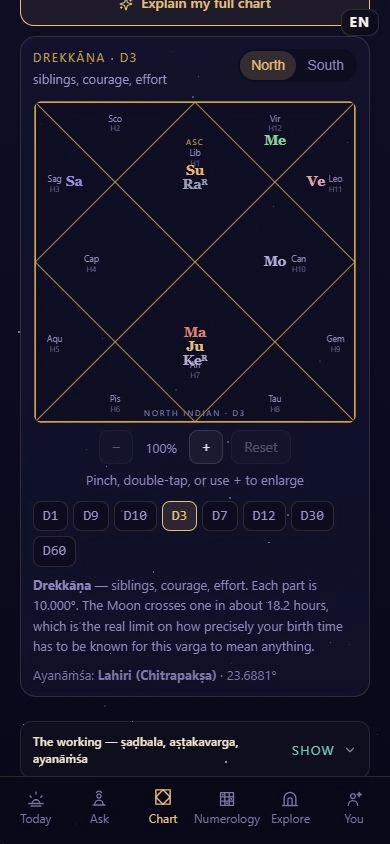
The Chart section contains a divisional panel with D3 alongside D1, D9 and other choices. Selecting D3 changes the mapping used in that panel; it does not replace the original birth data or physically move a planet. The selected division also clears the previously selected house, which helps prevent an explanation from one view being mistaken for a detail from the next. Read the title again before interpreting the new arrangement. A familiar abbreviation alone cannot tell you which chart layer is open.
North and South are presentation options within the same panel. Choose whichever arrangement you can follow, then use enlargement if a label needs attention. Do not switch between divisions simply because one pattern feels more encouraging. The useful comparison keeps the person and input constant while identifying exactly which mapping changed. If you are discussing a screenshot with somebody, include D3 in your description rather than calling it only your chart. That small habit makes the conversation clearer from its first sentence.
The arithmetic divides a sign, not your family into three types
In the inspected engine, D3 divides each thirty-degree sign into three ten-degree portions. The first portion maps to the original sign, the second to the fifth sign counted from it and the third to the ninth. These are rules applied to supplied sidereal longitudes. They are not a count of siblings, an observed measure of courage or proof that three kinds of personality exist. Keeping that distinction visible lets you appreciate the calculation without assigning it a power the arithmetic itself cannot demonstrate.
Suppose a supplied position lies thirteen degrees into a sign. It falls in the second portion under this implementation. You can follow that mapping even if you have no opinion about its traditional interpretation. Near a boundary, a changed longitude can produce a different mapped sign, so the quality of the original input still matters. This guide documents the product's selected rule, not a claim that every practitioner interprets D3 identically. A checkable transformation and a meaningful life explanation are two different kinds of statement.
Turn a courage theme into a small, observable action
You might come to this instrument while learning to drive, preparing to speak in public or returning to a practical skill. Instead of asking whether the chart grants courage, ask what effort would look like in your actual situation. A ten-minute rehearsal is observable. A conversation you have avoided can be scheduled. The traditional theme can provide a vocabulary for reflection, while the evidence of progress comes from what you practise and what changes. That is a more useful relationship with a tool than waiting for permission to begin.
Write down one obstacle and one manageable response before reading a long interpretation. If the obstacle is lack of instruction, find instruction; if it is an unsafe environment, do not confuse risk-taking with bravery. The D3 panel cannot assess those circumstances for you. You can revisit the same question later and compare the action you took with the action you intended. Nothing in this walkthrough establishes that a mapped placement predicts success, but the question it prompts can still help you describe where your attention needs to go.
Let relatives speak for themselves
A chart associated with siblings can easily become a shortcut for explaining another person's behaviour. Resist that shortcut. The selected profile belongs to one person, and its traditional family themes are not consent to analyse, blame or rank relatives. If you want to understand a recurring disagreement, begin with what was actually said, what each person needs and what boundaries are appropriate. A house explanation can be an invitation to examine your part in a relationship, not a verdict on somebody else's intentions.
For example, two adults may disagree about sharing care responsibilities. Calling one person difficult because of a D3 placement adds a label without solving the workload. Listing the tasks and discussing availability gives the conversation something concrete. Keep family birth details out of public posts while seeking a general explanation of the feature. You do not need to publish somebody's private record to learn what the D3 button means. The respectful use of a relationship instrument starts with respecting people who are not present in the room.
Read one layer at a time, then return to the larger picture
- Confirm D3 and the selected adult example before inspecting a house.
- Separate the ten-degree mapping from the interpretation of effort.
- Choose a practical action you can evaluate without astrological permission.
- Discuss relatives through their real words and boundaries, not a placement label.
D3 is derived from the same supplied chart positions used elsewhere in the app. Compare a selected planet with its D1 position, and note whether you are asking about a calculation difference or a traditional theme. The divisional ascendant is mapped when available; otherwise the implementation uses the divisional Moon as a house reference. That reference changes how house numbers should be understood. A house number without its reference is incomplete information, particularly when the original birth time or place is uncertain.
The interface's general Moon-travel estimate is not a complete sensitivity analysis for the ascendant or every placement. Do not read it as a guarantee that an approximate time is adequate. Keep the profile's certainty label with the discussion, and avoid correcting a time simply to obtain a preferred arrangement. You can learn the mechanics before deciding whether the data is strong enough for a detailed personal reading. Understanding the limit is part of understanding the instrument, rather than an interruption to an otherwise attractive experience.
A product guide should leave you more capable, not more dependent
This walkthrough verifies the D3 mapping and the surrounding controls from the app source. It does not establish a live consultation, a purchased entitlement or an empirically validated prediction about your family. The accompanying capture is intended to document the actual preview with fictional adult data, not a customer's private reading. Available features and official access routes must still be checked in the current product. A beautiful instrument should not be used to imply services that have not been verified as ready.
Antaryami, from Temior Technologies Pvt Ltd, gives you a structured place to explore traditional ideas and inspect their calculation labels. The most useful result from this particular visit may be surprisingly modest: a clearer understanding of D3 and one sensible act of initiative. You leave knowing which transformation you opened, why its theme mentions effort and why another person's individuality cannot be compressed into your chart. That is enough to begin a more grounded conversation, whether you return to the instrument tomorrow or simply make the phone call today.
Keep effort and evidence together
Does D3 tell me how many siblings I must have?
No count is established here. The inspected D3 code maps a longitude into a divisional sign; its traditional family theme does not turn that transformation into a verified family census.
What can I try after reading a courage theme?
Choose one safe, specific effort: rehearse a message, book instruction or practise a skill. Evaluate that action through its real outcome rather than using a placement as permission.
Astrological interpretations are for reflection, not a diagnosis, a guaranteed prediction or a substitute for professional advice. Journal guides are prepared with AI assistance; they are educational content, not individual consultations.


