 Antaryami
App walkthroughs
How sure is your birth time? Antaryami makes that an honest part of the chart
Someone remembers the morning. A relative remembers a clock. A document may record a time, but you have not checked it yet. These are different kinds of information, and a chart should not pretend otherwise. Antaryami asks how sure you are about the supplied birth time and carries uncertainty into parts of its display. In this actual-screen guide, Nitish Raj Walia uses a fictional adult example to explain that choice. You are not being graded for the quality of a family memory. The purpose is to keep a calculation honest about its inputs while you explore what the product can usefully show.
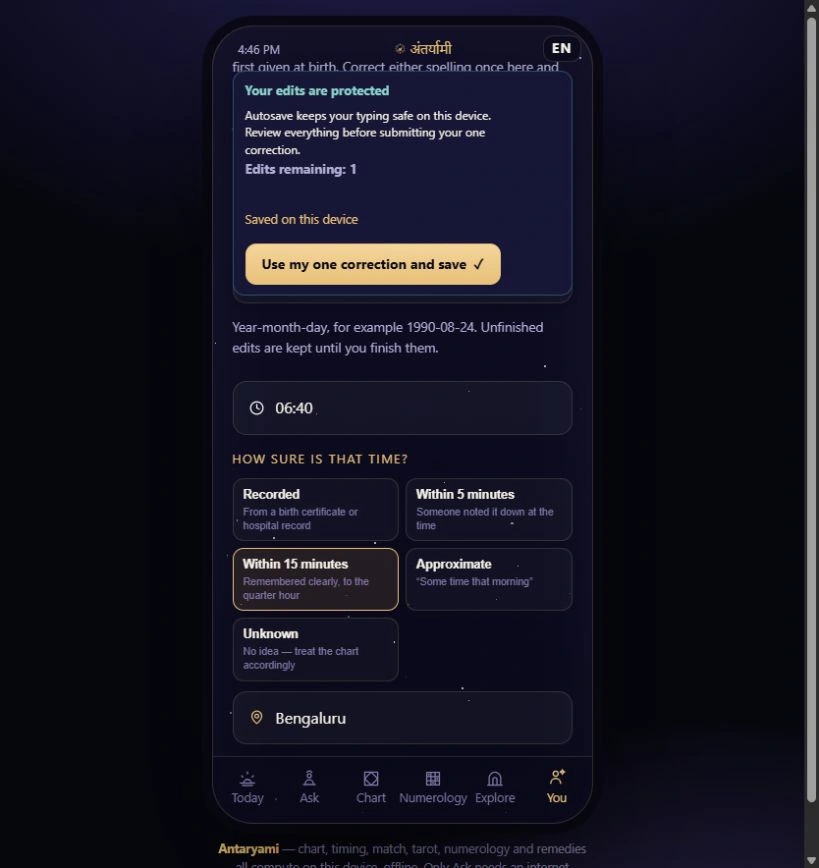
A clock value and confidence in that value are different fields
The profile editor contains a birth-time field and, beneath it, certainty choices. The inspected options include Recorded, Within 5 minutes, Within 15 minutes, Approximate and Unknown, with brief descriptions. Entering a value in the time field does not prove it came from a record. The certainty choice describes what you actually know about that value. Treat the two together. A neat twenty-four-hour time can still be a rough recollection, and a remembered hour should not become documentary evidence because the software accepts its format.
Choose the description that reflects the information available to you rather than the one that promises the most detailed chart. If you have not checked a certificate or hospital record, do not call the time recorded simply because somebody believes it is correct. If relatives disagree, preserve that disagreement while investigating. The interface gives you a vocabulary for uncertainty; it does not settle the reliability of a particular document or witness. That distinction prevents a small data-entry decision from acquiring more authority than its source deserves.
The primary house frame can remain provisional
In the fictional example inspected for this guide, the Chart screen reports a fifteen-minute window and warns that the ascendant crosses between Aquarius and Pisces over that range. That is a result for these specific example inputs, location and calculation convention. It is not a statement that every fifteen-minute uncertainty changes an ascendant sign. The product's useful response is to explain why this particular house frame deserves caution instead of presenting the central clock value as the only possible answer.
Whole-sign house assignments depend on the chosen ascendant sign in this view. When that reference changes, a placement can receive a different house number even if its own planetary sign remains unchanged over the inspected window. Keep those two kinds of stability apart. The example's warning explicitly distinguishes them. A reader who sees a stable planet label beside a provisional house structure has not necessarily found a contradiction. They may be seeing an honest account of which part of the supplied calculation is sensitive to the unresolved input.
Your rising point is not the same label as your Moon birth star
The inspected Chart masthead names the Moon's nakshatra as the birth star, while the ascendant has its own line and may show an unsettled nakshatra across the stated time window. These labels refer to different calculated positions. Do not treat the first unfamiliar Sanskrit term on a screen as automatically belonging to the same reference as every other term. Read whether a label is attached to the Moon or the rising point. That careful distinction can prevent a perfectly visible value from being repeated under the wrong name.
This guide follows the product's displayed references rather than issuing ritual instructions or claiming personal certainty. In the fictional preview, the Moon label and ascendant uncertainty can coexist because they concern different positions. If a chart elsewhere uses a different convention, retain that convention when comparing it. A useful support question identifies the reference and the selected inputs rather than saying only that a star changed. The more precisely you name the discrepancy, the easier it is to investigate the calculation without exposing someone's private birth records.
A familiar description cannot verify an unknown time
You might recognise a passage and feel tempted to adjust the time until more of the chart sounds right. Recognition is not independent birth-time evidence. A description can feel relevant for many reasons, and selecting inputs to fit it creates a circular check. The uncertainty choice should reflect the source of the time, not how much you like the resulting interpretation. Keep real records, family recollections and symbolic readings in separate roles while investigating. The chart cannot certify a clock value because its prose feels unusually accurate.
The app offers a separate birth-time-checking entry point, but this walkthrough has not tested it as a verification service or established that it can recover a missing record. Do not present an algorithmic suggestion as a newly issued birth certificate. If you revisit a value after finding stronger evidence, record why it changed and follow the product's actual correction process. A transparent correction is different from silently trying several values until you obtain the placement or life story you were hoping to see.
Carry the same caution into finer chart layers
- Keep the source of the birth time separate from its typed clock value.
- Read any ascendant-window warning before relying on house assignments.
- Identify whether a nakshatra label belongs to the Moon or the ascendant.
- Do not replace missing evidence with a familiar interpretation or finer grid.
The divisional buttons can create a more intricate view, but additional compartments do not add evidence about the original birth moment. D9 and D10 transform the supplied longitudes under their configured rules; a changed input near a boundary may affect their mapped placements or ascendant. A general note about the Moon's rate of movement is not enough to certify all those quantities as stable. Inspect the relevant reference and retain the profile's uncertainty instead of borrowing confidence from the complexity of the diagram.
Use the profile editor carefully as well. The actual preview describes local autosave and a limited correction workflow. This article did not submit a correction or exercise a live account's saving permissions. Read the current interface before committing a change, and do not save merely to test whether the calculation becomes more flattering. You can inspect the certainty options without altering a person's details. If a question remains unresolved, keeping it visibly unresolved is a legitimate outcome of using a responsible instrument.
Explore what is available without pretending everything is settled
The website's fictional app screenshots are examples of product behaviour, not access to anyone's personal record. This particular guide shows certainty choices and an inspected chart warning; it does not verify the live profile service, a purchased plan or a remote birth-time consultation. Those features and their availability must be checked separately. Keep private birth information in appropriate authenticated workflows rather than including it in a public comment, marketing form or analytics request to obtain an explanation of a screen label.
Antaryami, presented by Temior Technologies Pvt Ltd, can be engaging precisely because it makes room for questions the data cannot yet answer. You do not have to pretend to know your exact minute before learning what a chart instrument does. The helpful first step is to state what you know, label what you do not and see how that affects the selected calculation. That leaves you with a clearer understanding of the product and of your record. A provisional answer, honestly explained, is more respectful than certainty manufactured to complete a beautiful screen.
Choose the certainty you actually have
The time sounds right but I have not checked its record
Use the choice matching your actual evidence. A familiar clock value or convincing paragraph is not a reason to label an unverified recollection as recorded.
The planets look stable, so the houses must be settled too
Planetary sign stability and ascendant stability are separate checks. Read the time-window warning for the house reference instead of inferring it from a planet label.
Astrological interpretations are for reflection, not a diagnosis, a guaranteed prediction or a substitute for professional advice. Journal guides are prepared with AI assistance; they are educational content, not individual consultations.


