 Antaryami
App walkthroughs
The first house in Antaryami: meet a new beginning without accepting a fixed label
Walking into a new workplace can make even a capable person wonder how they will be received. That ordinary moment is a useful introduction to the first house. Antaryami's house language connects it with identity, presentation and confidence, then separates the general theme from information about the selected chart. Nitish Raj Walia explores that distinction here. You do not have to decide whether you are naturally confident before using the instrument. You can learn what its labels mean, notice a question worth considering and prepare for your next beginning without allowing a chart to define the limits of your personality.
The clickable compartment opens an explanation
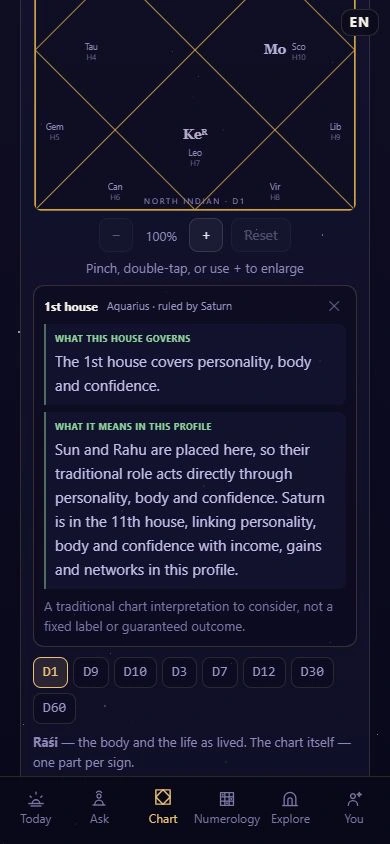
In the inspected divisional panel, selecting house one opens a detail area beneath the chart. It shows the house number, its sign and the sign's ruler, followed by a general theme and an explanation based on the selected placements. This structure matters because it avoids asking a beginner to infer every meaning from a symbol. The house control has a keyboard interaction as well as a click interaction in the source, so its purpose is to be an inspectable part of the instrument, not only a decorative compartment.
Begin in D1 for this walkthrough, and keep the division label visible. A first house in another derived division has a different calculation context. The screenshot uses a fictional adult, so the displayed sign and occupants document an example rather than your own identity. Close the detail when you want to inspect another compartment, and reread its number before carrying over a conclusion. You are following a selected region of a chart, not taking a personality test that has assigned one label to everything you do.
House, sign and planet answer different questions
The house names a life area within the selected chart reference. The sign identifies the sign occupying that house under the view's arrangement. An occupant is a body placed there, while the ruler is the body assigned to that sign by the implementation's traditional rulership table. These labels are related, but they are not interchangeable. A planet can rule the first house while being placed elsewhere. Reading the ruler's house can therefore create a link between two themes without making the two houses identical.
The inspected panel calculates its reference from the ascendant when available and otherwise from the Moon. That distinction should be retained when discussing a house number. If the original time is uncertain, the ascendant-based arrangement may require caution even when some planetary signs appear settled. Do not assume a confident-looking sign label resolves the underlying record. Learning the labels is useful precisely because it helps you ask which quantity you are seeing and what information produced it, instead of treating every number and symbol as a separate personality verdict.
Prepare for the room you are actually entering
Consider an adult beginning a new role. A practical first-house reflection might ask how they want to introduce themselves and what preparation would support that introduction. Learning colleagues' names, clarifying a responsibility and rehearsing a concise description of their work are actions they can take. The chart does not establish how those colleagues will respond. It can provide a traditional vocabulary for presentation while the real preparation remains grounded in the role and the relationships involved. That keeps confidence connected to practice rather than to a supposed permanent gift.
Try writing two sentences: what you can contribute and what you still need to learn. Both belong in a credible introduction. You do not have to perform certainty to appear capable. If the reading mentions leadership, translate that into an appropriate responsibility rather than assuming you should dominate the room. If it mentions sensitivity, do not interpret that as inability to speak. The most constructive reflection gives you a choice about how to act, while leaving room for context, feedback and a personality that is not confined to the chart's wording.
No occupant does not mean there is no identity to discuss
The house-detail code explicitly handles a compartment without a planet. It explains that the house is still read through its ruler. This is a useful correction to a beginner's common assumption that an empty box means the life area is missing or weak. There are twelve houses and not every compartment needs an occupant. In the first-house example, absence of an occupant does not establish lack of confidence, vitality or purpose. The diagram's distribution is a chart property, not a measure of how fully a human being possesses each life area.
When the panel links the ruler to another house, read that as a traditional connection under the selected chart, not as a causal explanation proven about your life. You can follow the mechanics by noting the first house's sign, finding its ruler and locating that ruler in the same division. Do not silently borrow its location from D9 or a transit view. Matching the calculation context keeps the explanation coherent. It also teaches a repeatable way of inspecting an empty compartment without filling it with a frightening assumption.
Keep the body theme within its actual interpretive scope
- Open house one in D1 and identify its sign, ruler and occupants separately.
- Check whether the house reference is the ascendant or the Moon.
- Prepare one introduction and one honest question for your next beginning.
- Avoid turning body or confidence wording into a diagnosis or fixed identity.
The first-house vocabulary includes body and vitality, but this guide does not treat it as a medical assessment. A placement cannot diagnose a condition, certify wellbeing or tell you whether a symptom is safe to ignore. Nor should appearance-related symbolism become a judgement about attractiveness or worth. If those themes appear, read them as traditional associations and keep health questions with qualified care. The instrument's useful role here is educational reflection, not replacing evidence about the body with a flattering or worrying paragraph.
Your presentation can also change across circumstances without contradicting a chart. You may speak easily with friends and feel hesitant in an unfamiliar meeting. That difference invites attention to context, not a search for the one setting that reveals your supposedly true self. Describe the situation before interpreting the theme. A specific question such as how to ask for clarification on the first day is more actionable than whether you are a confident person forever. The chart can remain one reflective lens while lived experience provides a fuller account.
Understanding yourself need not mean defining yourself once
This walkthrough draws its control behaviour and explanatory structure from the inspected app source. It does not verify a live assessment of personality, a consultation or a paid feature being ready today. The individual capture documents the fictional adult preview and should not be shared as evidence of a customer's temperament. Product availability and personal access have their own current checks. Separating those facts makes the website a clearer experience centre: you can inspect the instrument's purpose without being told that an unverified service has already answered your life.
Antaryami is presented by Temior Technologies Pvt Ltd with detailed chart instruments, but a useful visit does not require a grand conclusion. You might leave knowing how the first-house panel distinguishes a general theme from a selected placement and how to introduce yourself more clearly tomorrow. That is a meaningful outcome on its own. Confidence can include curiosity, humility and a willingness to learn. The instrument becomes more helpful when it supports those possibilities instead of asking you to accept a single chart-shaped answer to who you are.
Choose a clear first-house question
There is no planet in my first house. Does that mean low confidence?
An empty compartment does not establish that conclusion. The inspected panel reads the house through its sign ruler as well; confidence in a real situation also depends on preparation and context.
What is a practical way to use this theme before a new job?
Prepare a concise introduction, identify a responsibility you can contribute to and name something you need to learn. Those actions remain useful without requiring a prediction about how others will receive you.
Astrological interpretations are for reflection, not a diagnosis, a guaranteed prediction or a substitute for professional advice. Journal guides are prepared with AI assistance; they are educational content, not individual consultations.


