 Antaryami
App walkthroughs
Learning and what you master: use Antaryami to ask better study questions
An unfinished course can become a story about your identity surprisingly quickly: perhaps you tell yourself you are not disciplined, not academic or simply not suited to the subject. Antaryami's Learning and what you master area offers another vocabulary to inspect, but it should not become another permanent label. In this walkthrough, Nitish Raj Walia uses the real app preview to show how a learning question can remain connected to practice. The screenshot belongs to a fictional adult. Its indicators do not measure your intelligence, diagnose a learning difficulty or predict an examination result. Let the tool open a question, then test that question against the work you actually do.
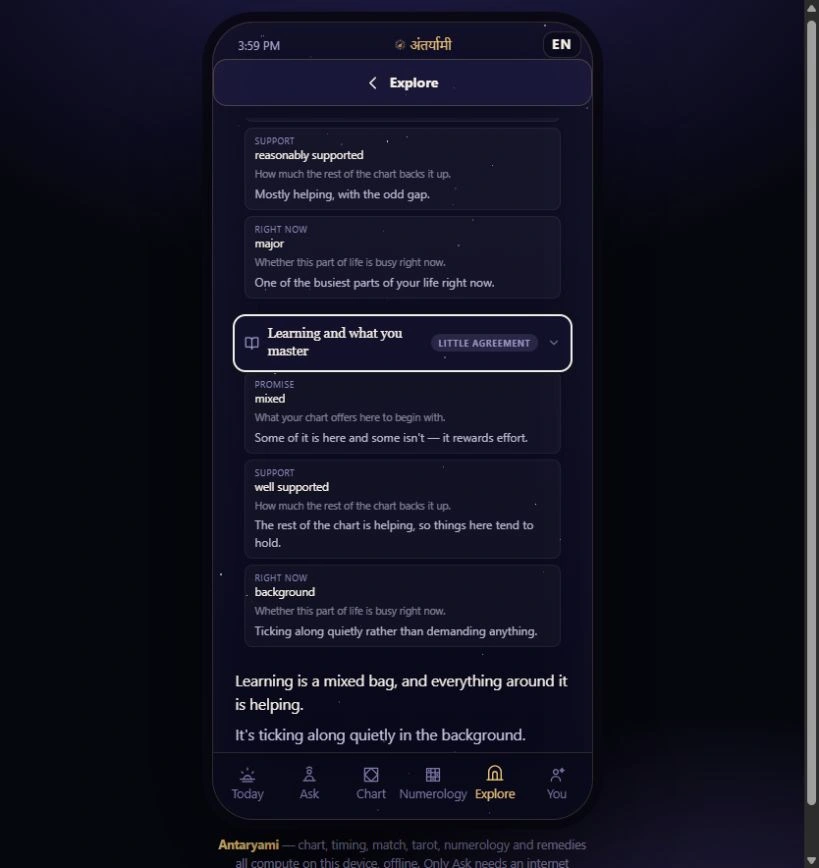
Find the precise point where learning stops
There is a large difference between understanding a lecture, recalling the material later and using it in a new problem. When a course feels difficult, identify which of those situations you can actually observe. Perhaps the explanation makes sense but you have not tried an exercise, or you can repeat a definition without recognising when to apply it. Bring that specific difficulty to the learning category. A broad declaration that you cannot learn is much harder to investigate and much easier for any reading to reinforce.
The source app associates this area with selected chart factors, including its fifth, fourth and ninth house configuration. That is the framework behind the interpretation, not an educational assessment of the reader. The app does not watch you solve a problem or know which resources your course provides. Keep those facts separate from its chart language. A learner's opportunity can also be shaped by time, instruction, money, language and accessibility. None of those practical conditions should disappear because a symbolic description sounds attractively personal.
Do not mistake the badge for a grade
The fictional screenshot shows a confidence label about agreement among model components. It is not a score for the person learning, nor a judgement from a teacher. A little-agreement description can coexist with a supported learning lane because they refer to different things. Read the reason before deciding that the wording is discouraging. The relevant question is how the app's methods relate to one another, not whether you deserve to study the subject or should give up an ambition.
The three displayed lanes also need separate interpretation. A starting-condition label belongs to the natal model; support concerns other contributing factors; current activation is the timing layer. Background activation is not a restriction on attending a class or practising a skill. If an important course has a fixed timetable, its actual schedule remains relevant. Do not postpone preparation while waiting for a screen to describe your learning as more active. The instrument has not measured how much you will understand from an hour spent on the material.
Inspect the explanation without turning it into an IQ claim
An expanded learning area contains prose and a working disclosure. Look for the houses used, their rulers and the measurement labels. The table can help you understand which chart factors the app considered. It cannot establish that those factors measure memory, attention or intellectual capacity in a scientifically tested way. A numerical entry attached to a planet remains that entry's quantity; it should not be converted into an intelligence score because the category discusses learning.
Birth-detail uncertainty remains relevant to the calculation, while uncertainty about how you learn requires a different kind of inquiry. Do not confuse the two. A corrected birth time may change a chart output; it does not by itself identify why a textbook is inaccessible or why a student needs support. If a learning difficulty is persistent or distressing, appropriate educational or professional help has a role beyond this reflective tool. The useful article question is what the interface shows, not whether a chart can replace an assessment that examines your actual needs.
Make the next session something you can evaluate
Choose a small unit from the material you are already using: one worked example, one passage or one skill demonstration. State what you want to be able to do afterwards. Then attempt that task and note where the difficulty appears. The observation might be that a term needs explaining, that a step was skipped or that you have not practised the prerequisite. These details give a tutor or classmate something useful to respond to without asking them to interpret the chart.
After the exercise, return to the learning reading only if you want to compare its themes with your experience. Did its language help you notice a need for structure, confidence or support? Did another part fail to fit? Keep both observations. The goal is not to make the exercise confirm the model but to learn something about the exercise. An astrology-based reflection becomes less intrusive when the evidence of your own practice is allowed to disagree with it, and when one unhelpful paragraph can be left behind without another paid consultation.
Use a reading to improve a request, not to classify a learner
- Identify whether the difficulty is explanation, recall or application.
- Keep the confidence badge separate from any judgement of ability.
- Attempt one task and record the point that needs clarification.
- Ask for support using an example another person can examine.
A parent, partner or friend may be tempted to read a learning category for someone else and draw conclusions about that person's future. Resist that shortcut. A profile is not permission to assign a fixed ability label, especially to a child. This guide uses an adult example and does not recommend behavioural tracking or educational selection from astrology. Listen to what the learner says they need, and respect their authority over the information they choose to share and the interpretations they want to consider.
For your own studies, a constructive request might be for a different example, feedback on an attempt or clarification of one unfamiliar term. These requests are courteous and actionable. They do not require you to announce that a planetary indicator has defined your style. If you discuss the Antaryami screen with someone, present it as a symbolic prompt you found interesting, not as proof they must change their teaching. Shared learning goes better when the other person can understand the practical problem rather than having to agree with your preferred interpretive framework.
Discover the product without surrendering your learning choices
Temior Technologies Pvt Ltd presents Antaryami as a set of instruments you can inspect rather than a demand to explain your whole life astrologically. The learning room is most useful when its vocabulary helps you formulate a question and its working makes the model visible. This preview does not verify a connected Ask answer, an account entitlement or a store download. Those services must be checked through their current official information, separate from the fact that the local reading interface can be demonstrated.
You may enjoy revisiting the category while studying a new subject, or decide that ordinary feedback is more useful for this particular task. Neither response makes you a less serious learner. A well-designed product should leave room for both. Close the article with a question that you could bring to your next session: which step do I understand, which step is missing, and who can help me bridge the gap? That is a learning benefit you can recognise in practice without pretending that a chart has awarded you a qualification.
Choose the next study question
Little agreement means I am bad at learning
The badge concerns agreement inside the app's chosen methods. It is not an ability test, an academic grade or a reason to stop learning.
The material makes sense until I try a problem
Bring one attempted problem and the exact step where you became stuck to someone who can explain it. That evidence is more useful than a global label about your abilities.
Astrological interpretations are for reflection, not a diagnosis, a guaranteed prediction or a substitute for professional advice. Journal guides are prepared with AI assistance; they are educational content, not individual consultations.


