 Antaryami
App walkthroughs
The Moon card in Antaryami: understand a feeling without making it a diagnosis
A day can contain a feeling before it contains a clear explanation for that feeling. You might want familiarity, quiet or a conversation, yet struggle to name the need. Antaryami's selected-Moon card introduces a traditional vocabulary of memory, comfort and emotional response. Nitish Raj Walia explores the inspected card structure here without treating it as a mental-health assessment. The aim is to read the instrument accurately and ask a humane question about your experience. You remain free to disagree with an interpretation, and a difficult day does not have to become evidence that a planet has defined you.
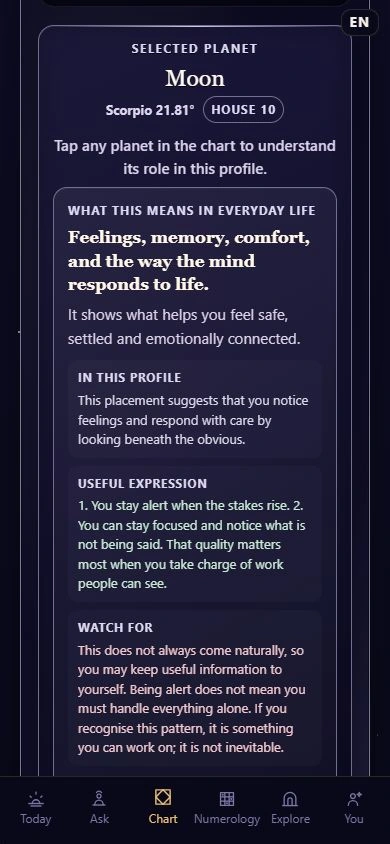
A marker opens a card with several different kinds of information
In the main chart instrument, selecting the Moon brings its explanation beside the diagram. The inspected shared card shows the selected body's name, sign, degree and whole-sign house, then introduces an everyday role and an explanation for the selected profile. Useful expression and watch-for text appear in separate areas. There is also a native disclosure explaining the traditional association. This gives you a route from a compact symbol to more detail without asking you to understand every technical term before you can start.
Begin by confirming which chart and person the card belongs to. The fictional adult example is a product demonstration, not your current mood or birth chart. The default selection can be the Moon, so seeing the card does not always mean a calculation has detected an emotional problem. A selected marker is an interface state. Read the sign and house as placement labels, the role as traditional language and the personal-sounding paragraph as interpretation. Those distinctions make the screen more understandable while limiting how much a convincing sentence can claim.
Read the Moon theme in its traditional frame
The inspected role text associates the Moon with feelings, memory, comfort and the mind's response to life. It also uses traditional ideas of care, home and nourishment. These are the product's astrological associations, not measured psychological variables. The card does not demonstrate that a longitude causes a particular emotion. Keeping the tradition named lets you consider the language without mistaking it for a clinical explanation of what you are experiencing or a rule about what you must need to feel safe.
Ask a smaller question: what has helped you feel settled recently, and did it actually help? A familiar routine may be supportive in one context and restrictive in another. You can notice that difference without deciding the chart has contradicted itself. The point is not to make every preference fit the paragraph. It is to use a theme as a possible prompt while your lived experience remains the evidence for whether the prompt is relevant. That approach makes room for variation instead of requiring a person to behave like a description.
A specific observation is more useful than a sweeping emotional label
Suppose you felt uneasy after receiving an unclear message. Instead of concluding that you are a worried Moon type, describe what happened: the message lacked a deadline, you did not know what was expected and you kept checking for clarification. That account suggests a practical response. You might ask a clear question or agree on when an answer is needed. The chart's language can remind you to notice comfort and response, but it should not replace the situation with a personality explanation that leaves the uncertainty unresolved.
Write one sentence about the event, one about the feeling and one about what you need now. You do not have to share those notes with the app or publish them to use this exercise. If the card's wording does not fit, leave it aside rather than searching your history until it appears convincing. Reflection is allowed to reveal a mismatch. An instrument becomes more trustworthy when it permits that outcome and does not demand that the reader find a personal story to validate every displayed interpretation.
Traditional detail should clarify rather than overwhelm
The card's expandable explanation provides additional context about why the tradition associates the Moon with its listed themes. Open it when you want that background, not because an important answer has been hidden from you. The interaction is useful because it separates a concise explanation from optional depth. You can inspect the placement first, read the broad role and then decide whether more terminology would help. More text does not automatically become more personal evidence, even when the language feels nuanced or unusually familiar.
The selected whole-sign house is calculated relative to the available chart reference. If an ascendant is absent, the implementation can use the Moon reference, which should be understood rather than overlooked. A Moon-based arrangement and an ascendant-based arrangement are not identical contexts. Keep the birth-time certainty visible and avoid borrowing confidence from a clear degree label. The general planet role remains general; the placement layer provides the chosen chart's context. Following those layers is more informative than treating the whole card as one undifferentiated statement about who you are.
Keep wellbeing decisions outside a chart interpretation
- Read the selected marker, placement and traditional role as separate layers.
- Describe one event before giving yourself an emotional label.
- Open the optional tradition explanation only when it adds useful context.
- Seek appropriate support for wellbeing concerns rather than relying on a chart.
This walkthrough does not diagnose anxiety, depression or any other condition from the Moon. A reassuring placement should not discourage care, and a worrying paragraph should not create a diagnosis. If distress is persistent or difficult to manage, qualified support and actual circumstances matter. A symbolic comfort theme can accompany ordinary reflection, but it does not establish what treatment is appropriate or whether symptoms are harmless. Personal notes about feelings also deserve privacy; do not send them to advertising analytics or include them in public questions about a screen label.
For a non-clinical everyday experiment, choose one reasonable way to clarify a need: ask for a deadline, arrange a calm conversation or give yourself time to consider a decision. Evaluate it by whether it helps the real situation. Do not call the result a Moon cure or claim it proves the chart. You can enjoy the language of care while keeping its role proportionate. That distinction protects readers who need more than an app reflection and lets other readers use the instrument without turning ordinary emotions into medical or spiritual problems.
The useful result is a clearer question about what you need
The source review establishes the selected-Moon card and its explanation flow. It does not validate a mood detector or a psychological assessment, and it does not verify live personal access or consultation availability. The individual screenshot uses fictional adult data and must not be described as a customer's emotional record. Current product readiness belongs to its own official checks. These limits keep the guide accurate while still showing how an instrument can be approachable enough for a reader who has never studied a chart before.
Antaryami, presented by Temior Technologies Pvt Ltd, can make traditional language easier to inspect without asking it to explain every private feeling. You might leave the Moon card with a clearer need and a sentence you can use in a real conversation. That is a small but useful outcome. Your experience does not need to become a prediction to matter, and the interpretation does not need to fit perfectly to be considered thoughtfully. The screen offers a lens; you retain the right to decide whether it helps you see this particular moment more clearly.
Read a Moon theme without diagnosing yourself
Does a difficult Moon description mean I have anxiety?
A chart description does not establish a diagnosis. Consider the actual symptoms and circumstances with qualified support when needed; use the Moon theme only as optional reflective language.
What should I write before reading the interpretation?
Describe the event, the feeling and the present need in three short sentences. Keep those observations independent so an appealing paragraph does not rewrite what actually happened.
Astrological interpretations are for reflection, not a diagnosis, a guaranteed prediction or a substitute for professional advice. Journal guides are prepared with AI assistance; they are educational content, not individual consultations.


