 Antaryami
App walkthroughs
From an auspicious shortlist to a workable plan: Antaryami's Beginnings screen
A meaningful beginning usually needs more than a date. People have to be ready, resources have to be available, and the event itself needs a clear purpose. If a traditional time preference matters to you, it belongs within that planning process rather than above it. Antaryami's Muhurta Beginnings screen gives different kinds of beginnings their own categories. In this walkthrough, Nitish Raj Walia uses the real fictional-profile preview to explain how to inspect a shortlist without treating it as a probability of success. The aim is an organised conversation between cultural preference and the practical things an event still requires.
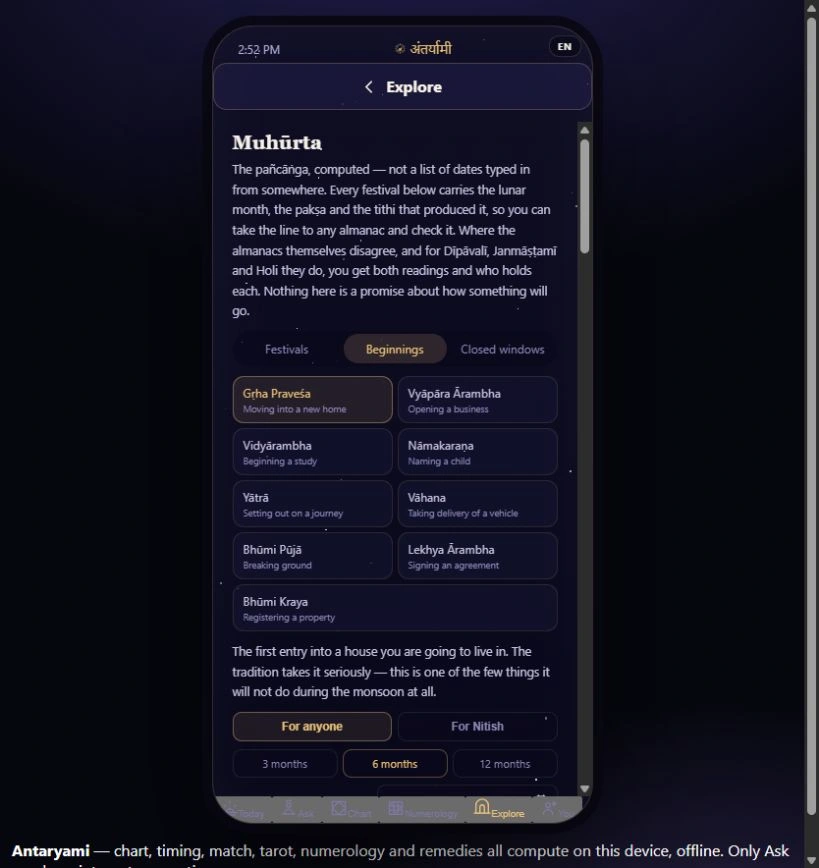
Choose the event you actually intend to begin
The inspected screen separates moving into a home, opening a business, beginning study, naming a child, setting out on a journey, receiving a vehicle, breaking ground, signing an agreement and registering a property. Those categories are not cosmetic synonyms for "good day." They make the intended activity part of the calendar question. Registering a property is not the same action as first entering it to live there. Signing an agreement is not identical to opening the premises for customers. Begin with the most accurate description of the event.
If your plan contains several stages, do not assume one selected category covers them all. Write down the practical sequence and identify the particular moment for which a traditional preference matters. This prevents a broad label from swallowing tasks with different deadlines and requirements. The instrument can help you inspect a rule-based shortlist for a beginning; it cannot decide what your contract requires or make an unfinished site ready to occupy. Keep those responsibilities with the people and professionals who can verify them.
A general calendar and a profile overlay are different modes
The preview offers a general "For anyone" view and a view associated with the selected fictional person. That distinction deserves attention before two results are compared. A general calendar shortlist considers its calendar rules; a profile-specific overlay introduces additional chart context. Do not describe a general list as a unique personal recommendation simply because you opened it while signed in. Conversely, a profile overlay should not be forwarded as though it applies to everyone in the family or to every person attending the event.
The role of a personal chart also depends on the quality of its inputs and the method in use. An approximate time remains approximate even when a list is beautifully arranged. If more than one adult is involved, decide whose profile is relevant to the supported workflow instead of silently switching people until a preferred date appears. A useful comparison holds the intended event and place steady, changes one named mode and reads the accompanying explanation. It does not turn repeated experimentation into evidence that the app has discovered the inevitable best day.
The shortlist needs a horizon and a local clock
The captured screen offers different search horizons. Looking across three months is a different request from looking across a year, because the set of candidate days changes. That can be useful when your event is flexible, but flexibility must come from your real plans. A wider horizon is not inherently more auspicious, and it should not tempt you to ignore a practical deadline. Confirm the period being searched before deciding that the absence of a convenient day means something troubling about the event.
Read each result with its place and local window. A date alone is not enough when the purpose is to choose an hour, and a local interval is not automatically suitable for someone acting in another city. The article's screenshot shows how the interface is organised; it does not supply your current event schedule. Check the current result in the appropriate location context, and verify venue opening hours, travel time and other arrangements separately. These facts can change without any change to the traditional calendar rule.
A rule score is not your chance of success
If a result is graded according to the app's rule set, the grade describes that evaluation. It is not a measured percentage chance that your shop will profit, your move will be happy or your agreement will protect you. That is an important distinction in an interface where numerical comparisons can look authoritative. Read what was checked, which factors were included and any qualifications. A high grade can mean that more of the selected traditional conditions were satisfied, without establishing anything about the outcome of the activity.
This makes the shortlist useful in a limited, understandable way. You can compare candidate windows within a named method and then check which ones remain feasible. If a less highly graded option is the only practical date, it is not evidence that you have condemned the event. Look at the reason and decide how much weight the tradition should have in the decision. Health, safety, affordability, consent and contractual obligations should never become secondary to an opaque score. Cultural meaning is not improved by pretending that numerical presentation removes ordinary responsibility.
Build a readiness list before choosing the hour
- Name the particular beginning and separate it from related preparatory tasks.
- Confirm the general or profile-specific mode and the relevant location.
- Inspect the rule explanation, not just the grade or first date.
- Choose only among windows that remain practical, safe and properly authorised.
For a home move, practical readiness might include access to the property, utilities, safe transport and the availability of the people helping. For a study beginning, it might mean a suitable course, a workable timetable and a place to practise. You can list these requirements without any chart. Once they are visible, the traditional shortlist becomes one preference among known constraints instead of a substitute for preparation. This is a more constructive use of timing than repeatedly checking the calendar while leaving the actual work undefined.
Choose two or three feasible windows, confirm their current details and discuss them with the people affected. An auspicious preference can be a thoughtful part of a shared occasion when it is understood and voluntary. It should not become a way to pressure another person or explain away a lack of readiness. If none of the displayed options works, revisit the supported categories and the practical schedule. The correct next step may be asking a local practitioner about the tradition or a qualified professional about the event, rather than buying another interpretation.
The product benefit is a more deliberate choice
Antaryami can make a traditional timing discussion less vague by organising the event, horizon, mode and working on one surface. It cannot promise that doing the right thing at the selected hour will remove setbacks. A strong beginning is supported by what you do before and after it as well as by the meaning you give its date. The screen is most helpful when it contributes a clear question to that wider process: why this candidate window, under which rules, for which activity?
This real-screen article by Nitish Raj Walia for Temior Technologies Pvt Ltd is an introduction to the Antaryami experience, not a live personal muhurta service embedded in a blog. Current access, release availability and the selected calculation label belong in the actual product workflow. Explore the method here, return to the appropriate feature when available, and keep your practical checklist close by. A calendar preference can make a beginning feel considered. Preparation is what gives the people involved something concrete to begin with.
What belongs in your planning decision?
The candidate receives a high rule grade.
Read that as a grade within the named traditional method, not a probability that the event will succeed. Check readiness and actual constraints separately.
I am buying a home and moving later.
Treat registration, signing and moving-in as distinct actions. Select the appropriate event category rather than assuming one window describes all stages.
Astrological interpretations are for reflection, not a diagnosis, a guaranteed prediction or a substitute for professional advice. Journal guides are prepared with AI assistance; they are educational content, not individual consultations.


