 Antaryami
App walkthroughs
When a calendar says wait: understanding Antaryami's closed windows without fear
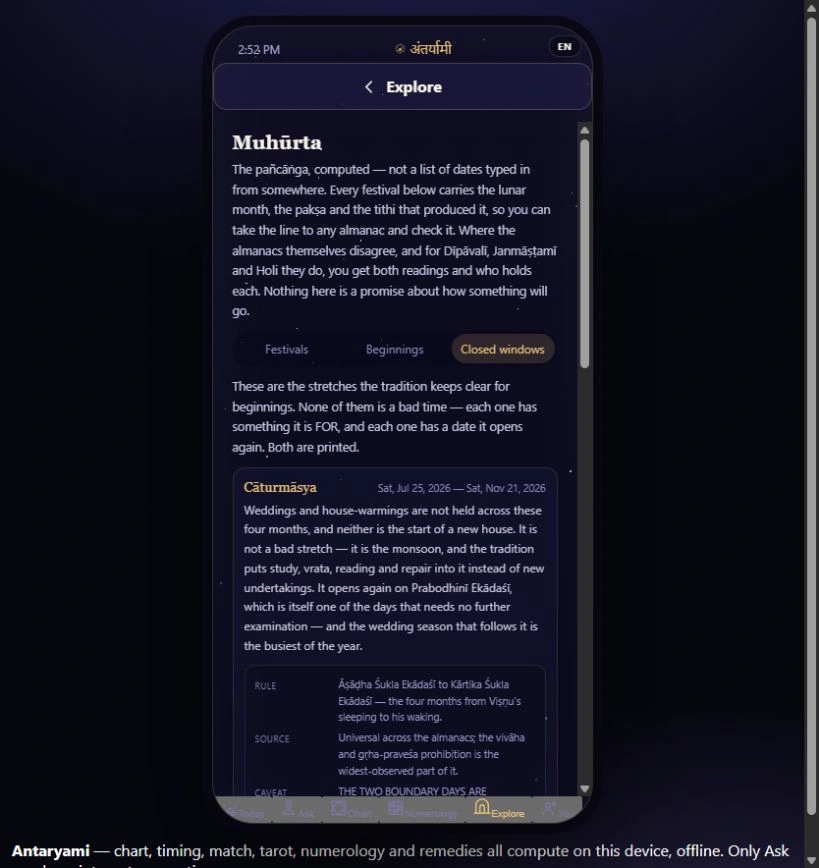
The words "closed window" can feel more severe than the underlying question deserves. A traditional calendar may set aside a period for particular beginnings, but that is not the same as saying life must stop or that the people born during it are unlucky. Antaryami puts closed-window explanations alongside festival and beginning information. This guide by Nitish Raj Walia follows that real preview screen and asks a practical question: what exactly is being set aside, under which convention, and until when? Reading those details can replace a vague fear with a much narrower, more useful understanding.
Closed for a purpose is not closed for life
Start with the activity covered by the entry. A traditional restriction may concern a particular ceremony or kind of beginning; it should not be expanded without explanation into a judgement about every action on the date. The inspected screen includes wording about the period and what the tradition places within it. Read that scope before making a plan. A season can have different cultural purposes without becoming a danger label attached to every ordinary task a person needs to complete.
This is especially important when you encounter the term out of context in a social post. A cropped headline can remove the difference between starting a ceremony and continuing an existing responsibility. You may still have work, care duties or necessary travel. Nothing in an educational calendar walkthrough authorises ignoring those obligations. If a tradition matters to your household, discuss its actual scope with an appropriate local source. Do not turn an unfamiliar phrase into a new rule that governs unrelated parts of everyone's life.
A named period needs its start and return point
The closed-window view is useful because it makes periods visible as calendar spans rather than leaving them as ominous names. Inspect the dates, year and explanation of when the window changes. A captured screenshot cannot tell you whether the same period is currently running in the place where you intend to act. Return to the feature's current context and compare like with like. The existence of a period name is not a reason to assume it applies today, or to every year in the same civil-date form.
A bounded calendar entry also gives you a constructive scheduling question. If a discretionary beginning can reasonably wait, what other preparations can be completed in the meantime? If it cannot wait, what does the relevant tradition say about the actual category of activity? Asking that question is better than staring at a red or gold label until it feels like an instruction. An explanation should make the timing discussion specific enough to act on thoughtfully, not suspend your plans in an undefined atmosphere of concern.
The tradition behind the entry matters
A calendar screen cannot stand in for every region, family and religious institution. Read the source or convention named in an entry, and retain any qualification when you discuss it. Where customs differ, a digital product should help you notice the difference rather than secretly merge practices into an invented universal rule. You can respect the calendar your family follows while acknowledging that another household may make a different, equally deliberate observance choice. The interface is a way to examine the explanation, not a device for ranking people's devotion.
You may also find that the screen's language is broader than the question you came with. Narrow it down before accepting a conclusion. Is the entry discussing weddings, house entry, a festival season or a specific astronomical condition used within the tradition? Does it name an exception or a different activity associated with the period? These distinctions matter. A blanket statement such as "nothing should happen now" is rarely a useful summary of a carefully scoped rule and should not be added merely to make a blog sound dramatic.
A calendar interval cannot define a person's worth
Do not transfer an event-timing restriction onto a child, a partner or someone whose birthday falls within the span. A person is not a closed window. Nor does a past event become invalid because you discover a calendar label afterwards. Those moves confuse a traditional scheduling preference with an assessment of human value or a causal explanation for everything that followed. A product explanation should interrupt that confusion, especially when someone is already anxious about a family occasion or an important memory.
If an event was difficult, examine the real circumstances with care. A timetable problem, a disagreement or an unexpected expense needs its own explanation and response. Assigning the difficulty to an ominous date can distract from what can actually be improved. The calendar may still be meaningful as part of your cultural practice. Meaning does not require blaming a period, blaming yourself for not knowing a rule, or treating another person's life as evidence of a supposed defect in the day they arrived.
A waiting period can be used for preparation
- Identify the kind of beginning the restriction concerns.
- Read the span, convention and any exceptions in their current context.
- Keep the label away from judgements about people or past events.
- Use an optional pause for preparation; never delay urgent or mandatory action.
For a non-urgent beginning that you freely choose to postpone, make the pause concrete. Organise the documents, finish the work, discuss responsibilities or confirm the next feasible window. A useful pause has a purpose and a return point. It does not require repeated paid consultations until you feel completely certain. If you notice that calendar checking is increasing distress rather than supporting a manageable plan, step back from the instrument and talk with someone you trust about the practical concern underneath it.
Do not postpone urgent care, safety action or an official deadline on the basis of a traditional window. Those situations have requirements the calendar does not measure. For an ordinary optional occasion, you can combine cultural preference with everyone's availability and informed consent. The product's contribution is to display the rule and its bounds. Your contribution is deciding how it belongs in the actual situation. Neither a coloured interval nor a reassuring phrase can take over that responsibility, and a good educational article should not pretend otherwise.
Seeing the limits makes the calendar more useful
A calendar that shows only appealing windows can encourage you to mistake selection for a complete view of the method. Showing closed periods as well makes room to explain what the rules include and exclude. That is valuable when the explanation remains calm, bounded and open to inspection. The feature should help you understand a tradition, not create a new reason to feel unsafe about an ordinary day. The useful outcome is a more precise question and a plan that remains connected to reality.
Antaryami's experience centre introduces this screen as one part of a wider collection from Temior Technologies Pvt Ltd. Nitish Raj Walia's walkthrough uses a fictional app preview and does not independently validate every displayed period or turn a screenshot into current calendar advice. Check the live feature's supported location, year and method when it is available, and consult appropriate local guidance for the observance itself. A closed window can be understood without closing down curiosity, kindness or the practical choices that remain yours.
What should you check before deciding to wait?
Does the label concern every activity?
Read its stated scope. A traditional restriction on a particular beginning must not be silently expanded to urgent care, routine obligations or a person's worth.
Can an old screenshot tell me the current span?
No. Confirm the year, place and present calculation context, then read the period's actual boundaries and explanation.
Astrological interpretations are for reflection, not a diagnosis, a guaranteed prediction or a substitute for professional advice. Journal guides are prepared with AI assistance; they are educational content, not individual consultations.


