 Antaryami
App walkthroughs
Antaryami's Both view: compare numerology methods without mixing the answers
Two columns can make a confusing subject much clearer, provided the columns do not pretend to answer exactly the same question. Antaryami's Both view puts Western and Vedic/Traditional numerology alongside each other while keeping their roles and methods distinct. The fictional profile in this real screenshot makes a useful example: one track can preserve a master-number result while another reduces its date total differently. This article by Nitish Raj Walia shows how to inspect that difference rather than call it a contradiction or turn a matching value into proof. You will learn what to compare, what to leave separate and how to use the product as a learning experience without asking a symbolic table to decide your life.
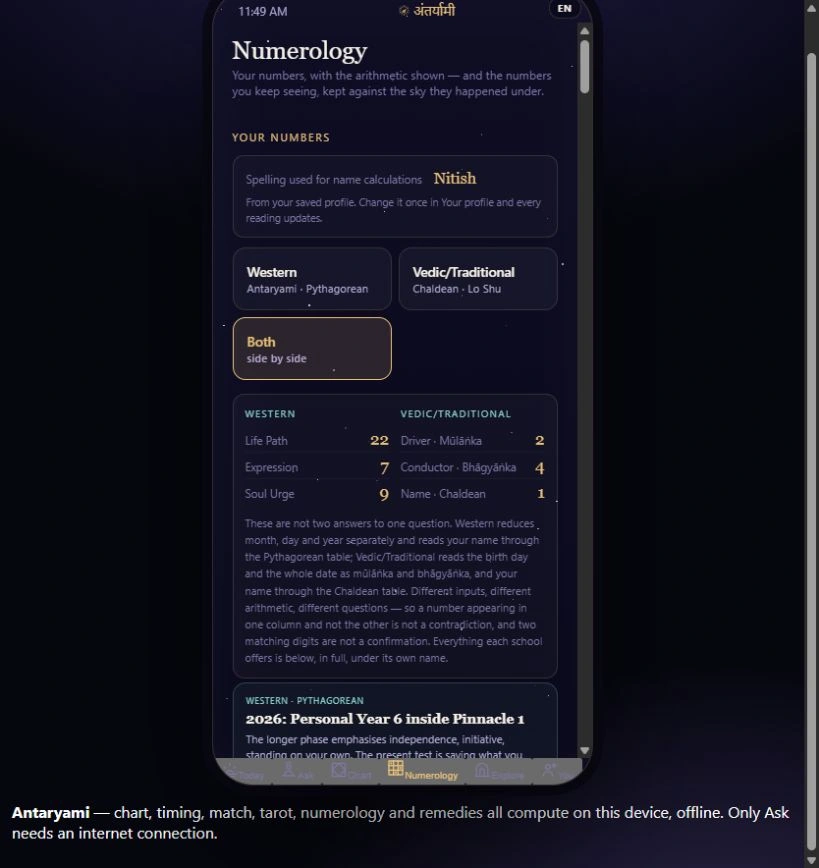
The selected person stays the same while the rules stay different
A fair side-by-side view starts with one selected profile. The date and supplied name do not secretly change when the method tab changes. What changes is the operation and the interpretive track. Antaryami's presentation model gives the Western, Chaldean, Lo Shu and other supported tracks distinct identities. That protects the results from being silently relabelled. A number should not become Pythagorean because it is placed in a Western-looking card, or become a Chaldean result merely because a planetary association sounds appealing.
The screenshot's Nitish is a fictional adult used for this preview. It is not founder Nitish Raj Walia's personal numerology. Keep that distinction when discussing the visible values. The picture is evidence of how the interface organises an example, not a claim about the founder's character. You can learn a great deal from the comparison without using anyone's private record. That is one reason a fictional product exhibit can be useful: it lets you examine the methods before deciding whether to prepare your own information.
Life Path and Conductor need their conventions beside them
The implemented Western Life Path reduces month, day and year separately before combining them, with applicable master-number preservation. The traditional Conductor reduces the digits of the complete date to its traditional result. These procedures often share a single-digit relationship but do not always preserve the same displayed form. In the fictional comparison screenshot, the Western Life Path is shown as 22 while the traditional Conductor is 4. That difference is not automatically an error; it reflects how the named methods treat the date.
Do not flatten the Western 22 simply to make the columns look consistent, and do not promote the traditional 4 to a master-number label it did not calculate. The product's job is to explain why the values differ. The reader's job is not to force them into agreement. Inspect the working in each track and compare the operations. The arithmetic can be checked. Whether a symbolic interpretation feels useful is another question, which should be considered against experience rather than decided by the visual symmetry of the columns.
Expression and a Chaldean name total use different letter assignments
The Western Expression role and the traditional Chaldean name result both involve the supplied name, but they do not use the same letter table or necessarily the same treatment of name parts. Equal input text does not require equal output. Antaryami keeps the original spelling visible so that the comparison can begin with the actual material used. If the spelling changes, the comparison needs to acknowledge that first. Otherwise you may blame a method for a difference created by a nickname, transliteration or missing name part.
The difference in labels matters as much as the difference in values. Expression is a named Western role. A traditional birth-name total belongs to the Chaldean track. Neither should be presented as the universal name number that replaces every other system. Ask how the letters were assigned and reduced in each method. This is an interesting learning exercise because it exposes the choices behind the interface. It is not a reason to change a person's name until the screen displays a value you think will guarantee success or affection.
Agreement is not independent proof, and disagreement is not a verdict
If two tracks display the same digit, that can be mathematically interesting without validating their traditional meanings. The operations may share features, and the symbolic descriptions can be broad enough to overlap. Do not count agreement as a scientific confirmation that an interpretation must be true. Nor should different digits be treated as evidence that the person is internally divided or somehow inconsistent. The columns belong to different frameworks. Your life is not obliged to resolve their differences into one tidy number.
This is especially important when comparing people. A pair of matching values does not establish consent, trust, compatibility or shared goals. A pair of different values does not prove that a friendship or partnership is doomed. The screen can teach the method distinction and support reflective questions, but the actual relationship has its own evidence. If a symbolic theme helps you start a respectful conversation, that may be useful. The other person is still free to reject the interpretation, decline a chart discussion or explain their experience in different terms.
Use the comparison to answer one method question at a time
- Hold the selected profile and its input spelling steady while changing tracks.
- Compare a named role pair and read both operations before evaluating the final values.
- Keep each interpretation with the method that produced it.
- Record what the comparison explains and what it cannot establish about a person or decision.
Choose one pair of roles to investigate and write the question before reading the interpretations. You might ask why Life Path and Conductor differ, or how the same name is processed by two letter tables. Follow the working for that pair. Once you can explain the difference in ordinary language, read each role's symbolic meaning separately. Keep a note of what each method actually claims to describe. This is more productive than scanning every panel until one feels flattering enough to become your preferred result.
Then choose whether you want a reflective exercise at all. You could compare a theme with a real situation and notice an exception, or simply finish with a clearer understanding of the arithmetic. Both are legitimate outcomes. The product should not demand personal belief as the price of learning its interface. A method comparison is successful when it makes the separate rules understandable, not when it manufactures a final authoritative biography out of several symbolic systems that were never designed to be blended that way.
Let the comparison help you choose an experience, not surrender judgement
The website can introduce this distinction before you use personal app access. Its public content and fictional exhibits are an experience centre, while verified purchases, entitlements and official download availability belong to separate operational flows. A screenshot of Both does not prove that a paid account is active. Check the current app page and plan terms before making assumptions about a store link or purchase. An honest product gallery can make the interface appealing while remaining clear about what is demonstrated and what is available.
This AI-assisted guide by Nitish Raj Walia is part of the Antaryami Journal from Temior Technologies Pvt Ltd. The comparison view shows a useful product principle: several traditions can be displayed without erasing their differences. You are invited to inspect that work and understand what each track does. Keep the method labels, keep the arithmetic visible and keep your lived experience outside any demand for perfect agreement. A good comparison gives you more clarity and more room to question, rather than another reason to believe that the app has reduced a whole human being to a pair of columns.
Choose a comparison question
Why can 22 and 4 both appear?
In this example, the Western method preserves an applicable master number while the traditional date reduction produces 4. Inspect the separate operations; do not relabel either track to force agreement.
Do matching values prove the reading?
No. Agreement between symbolic arithmetic systems does not establish that their interpretations predict behaviour or events. Keep real-world evidence and the role labels visible.
Astrological interpretations are for reflection, not a diagnosis, a guaranteed prediction or a substitute for professional advice. Journal guides are prepared with AI assistance; they are educational content, not individual consultations.


