 Antaryami
App walkthroughs
The Vedic/Traditional numerology screen: Driver, Conductor and the name are different tools
A traditional numerology screen can contain more than one tradition. That is not a problem if the labels explain what each part is doing. Antaryami's Vedic/Traditional presentation separates Driver, Conductor and the birth-name result, and its wider numerology model keeps Lo Shu and directional guidance under their own method identities. This real-screen walkthrough by Nitish Raj Walia explains how to read those distinctions before interpreting the values. Our screenshot is a fictional example from the app preview. It is an invitation to understand the product, not a certificate of anyone's nature, a religious requirement or a guarantee that a chosen number will bring a particular outcome. The first useful question is where each result came from.
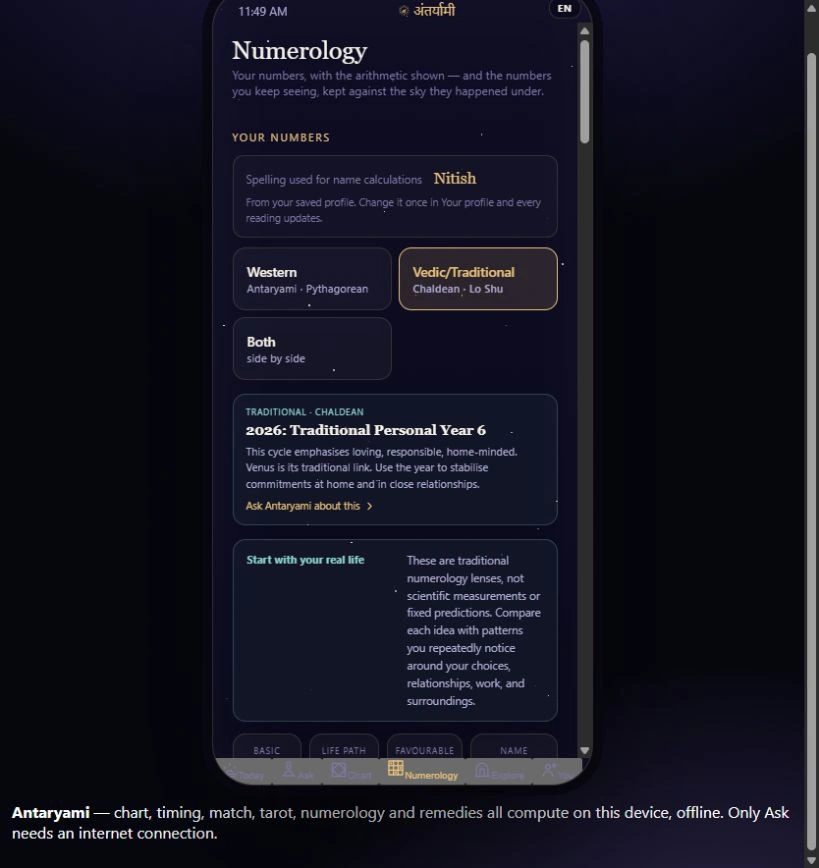
Two date questions begin with different parts of the record
Driver, also described as Mulanka in this traditional presentation, reduces the calendar day of birth. Conductor, or Bhagyanka, reduces digits from the complete birth date. Those operations begin with different information. Someone born on the fourteenth can understand the Driver reduction as one plus four, producing five. That simple example explains the operation; it does not establish a personality from the day alone. Read the Conductor's full-date working separately rather than assuming that it repeats the Driver calculation with a more elaborate name.
The difference helps explain why two people born on the same day of the month can have a shared Driver while their Conductor values differ. It also prevents you from treating the two numbers as independent scientific tests of character. They are related symbolic constructions from the birth record. The app's separate labels make those constructions easier to inspect. Begin with the input and arithmetic, then learn the traditional interpretation attached to the role. A clear sequence is more useful than trying to choose whichever of the two descriptions sounds more attractive.
The birth-name card uses its own letter table
The Chaldean name result comes from letters rather than the day or complete date. Its table assigns values differently from the Pythagorean table used in the Western view. The implemented Chaldean table does not assign the value nine to a letter. That does not mean nine can never occur as a reduced total, and it does not make a person with a nine result an error. Distinguish the values assigned to individual letters from the result produced by adding and reducing the supplied name.
The displayed spelling deserves the same attention as the date. If your full birth name has several parts, do not compare it with an abbreviated input and call the changed total a contradiction. For names written in another script, a chosen transliteration is still an input choice that should remain visible. The screenshot uses a fictional demonstration name, not Nitish Raj Walia's private name calculation. A product can show how a name table works without turning the founder or the reader into an uninvited public example.
Traditional planet links are interpretive associations
Some traditional number interpretations include a planetary association. In the app's numerology presentation, those links belong to the named traditional method. They do not mean that a date reduction has measured a planet's force in a person's body or established a medical condition. Nor should that association be copied onto the Western card, whose method notes identify that it has no planetary ruler. Keeping the link in its own track makes the comparison more informative and avoids manufacturing a hybrid system that neither calculation actually implements.
If a number description mentions patience, expression or responsibility, turn the theme into a question you can discuss. Where would patience be helpful, and where would delay be costly? What needs a clearer explanation? Which responsibility can you reasonably carry? Those questions do not require a gemstone purchase or a promise of cosmic correction. Do not treat a traditional association as a prescription for health, money or relationships. Its place in the product is educational symbolism, and any practical action still needs to make sense in the actual situation.
Lo Shu is a grid method, not another name total
Lo Shu arranges relevant date digits in a three-by-three pattern under its own rules. It is not a visual form of the Chaldean birth-name sum. Antaryami's model keeps it under a separate identity so that a grid cell, a Driver value and a name number do not become three unnamed versions of one answer. When a grid is shown, read the stated inputs and additions. A method that includes eligible calculated additions is not directly comparable with a grid that uses only the original date digits.
The words missing and repeated also need careful handling. A digit absent from a symbolic grid is not proof that a person lacks a human ability or is defective. A repeated digit is not a certificate of mastery. The pattern can be part of learning the tradition, but your experience, training and relationships exist outside its cells. Ask what a claimed pattern is intended to suggest and what could challenge that interpretation. A careful app explanation should leave those questions open instead of making a small diagram the judge of a whole life.
Use the visible working to make a narrow, useful comparison
- Decide whether you are inspecting a day reduction, a complete-date reduction or a name-table calculation.
- Confirm the exact date or spelling and the selected person.
- Read the working and keep any comparison within that same role and method.
- Treat the interpretation as a symbolic prompt, not permission to judge another person.
Choose Driver, Conductor or Name and inspect only that card first. Confirm the selected profile, the birth date or spelling used, and the appropriate method. Follow the working far enough to explain the result in your own words. Then compare another calculator only if it is answering that same role under the same rules. A disagreement between a traditional Conductor and a master-preserving Western Life Path may be expected. A disagreement between identical inputs under an identical convention is a different question worth investigating.
Keep the comparison factual. Save the role label, the input choice and the operation, not just a dramatic screenshot of the final value. If private details are necessary for support, use the appropriate private route rather than a public social comment. You can understand a calculation without publishing somebody else's record. After the audit, read the interpretation with a balanced example from everyday life. Notice both what helps and what does not. This makes the screen a place to learn instead of a search for a number that removes uncertainty.
Understanding the distinctions is part of the product benefit
The useful edge of this presentation is not that it places more mystical labels on the screen. It is that a reader can tell which input and tradition are responsible for each result. Driver, Conductor, Chaldean Name and Lo Shu can remain interesting without being merged. That clarity lets you enjoy a familiar tradition while asking specific questions about it. It also gives a beginner permission to stop after one card rather than feel responsible for understanding every panel in a single session.
Nitish Raj Walia's AI-assisted Antaryami Journal guide comes from Temior Technologies Pvt Ltd. The pictured screen belongs to an offline source preview with fictional details; connected access and official downloads must be checked separately on the current website. Explore the comparison view if you want to see the different tracks together. You do not have to choose one number as your entire identity. A considerate product should help you understand the role of each instrument and still leave you free to take what is useful, question what is unclear and leave what does not fit.
Which traditional result are you reading?
Driver or Conductor
Driver begins with the birth day; Conductor uses the full birth-date digits. Inspect the role-specific working rather than treating the two cards as synonyms.
Name or Lo Shu
A Chaldean name result uses a letter table. Lo Shu uses a grid rule and its labelled eligible inputs. They describe different operations, not competing totals of the same material.
Astrological interpretations are for reflection, not a diagnosis, a guaranteed prediction or a substitute for professional advice. Journal guides are prepared with AI assistance; they are educational content, not individual consultations.


