 Antaryami
App walkthroughs
The small method note that makes Antaryami's timing screen much easier to trust
The most useful part of a polished timing screen may be the small explanation you were about to skip. Antaryami includes a control asking what is measured and what is not. Opening it changes the way the surrounding dates should be read. This guide by Nitish Raj Walia looks at that real preview interaction, not at a claim that a good-looking interface proves accuracy. The question is practical: before you use a displayed time, can you identify its city, date, reference and method? Those details matter more than how confidently a coloured window catches your eye.
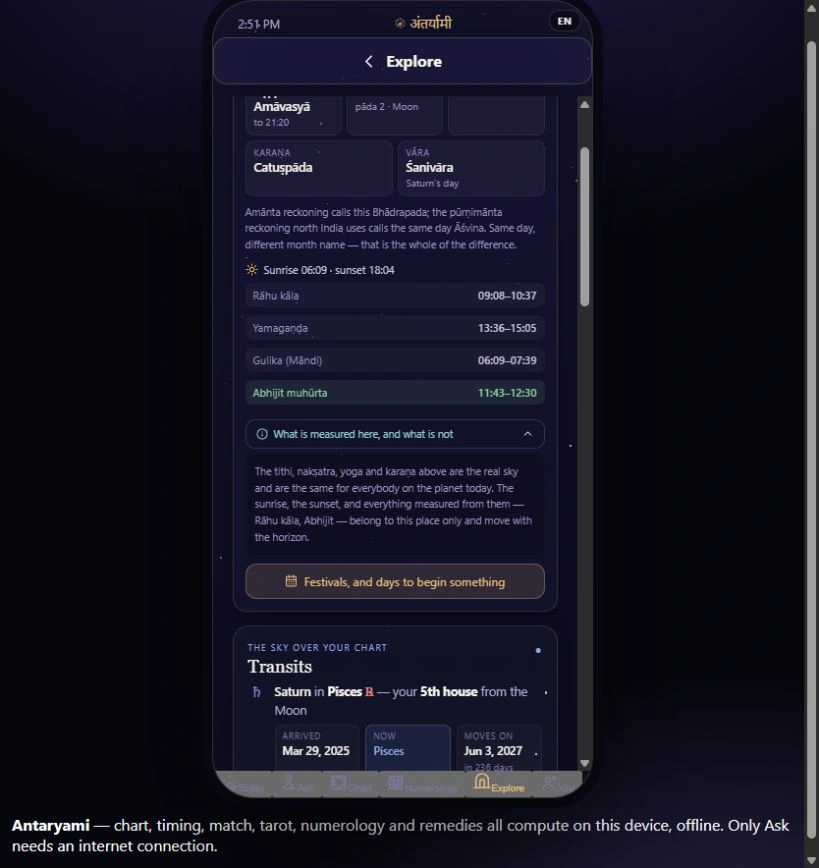
A method note gives the numbers a context
A number without its basis can look more certain than it is. A time on a panchanga card might be a local boundary, a sunrise-derived interval or the result of a selected observance rule. The method explanation helps distinguish those possibilities. In the inspected app, it is part of the same Timing surface rather than a separate advertisement about accuracy. That placement is useful: the explanation belongs close to the result that needs it, while still allowing a first glance at the day's main fields.
Read the note as information about the instrument, not as a guarantee about your future. Even a well-defined numerical calculation does not establish that beginning an activity at the displayed hour will produce the outcome you want. There are different questions here: whether a method was implemented correctly, whether its inputs were suitable, whether another convention would differ, and what a traditional interpretation means. A single accuracy slogan cannot answer all four. Naming the method is the beginning of a check, not the end of one.
A shared instant and a local day are not the same reference
The celestial geometry used for a lunar field is associated with an instant. A human calendar labels a day in a place. Sunrise-based observances add another location-specific reference. When those layers are combined in a panchanga, it is easy to say that everything is either completely universal or completely personalised. Neither shortcut is helpful. Establish which part of the result is being compared before explaining a difference between two screens. A change in the local clock is not automatically a change in the underlying angular state.
This distinction is useful when relatives live in different countries. Two people can discuss the same celebration while reading different local schedules. Before declaring an app or an almanac wrong, compare their date reference, location and observance rule. Ask whether one result is using sunrise, another a particular period of the day, or simply a different civil-date presentation. This article does not resolve every regional festival question. It provides the reading habit that makes such a question specific enough to investigate instead of turning a difference into a contest of confidence.
Know which place is actually selected
The captured card displays Bengaluru. That is the place used in this fictional preview, not a claim that Bengaluru hours suit every reader. In the inspected Timing component, the city is supplied from the selected profile context. If your intended activity is happening elsewhere, check the product's current place-selection behaviour before relying on the local windows. Birthplace identifies the location used for a natal calculation; the place of an upcoming event answers a different practical calendar question. One should not silently stand in for the other.
Avoid fixing a location mismatch by editing reliable birth details. Changing a birthplace just to make a calendar appear local would contaminate the profile's natal inputs. If the required event city is not available on a particular surface, use the appropriate location-aware screen or ask support to clarify the supported workflow. A missing control is a product limitation worth acknowledging. Inventing a new personal history to work around it would make the next chart look internally consistent while answering the wrong question.
An engine name needs a stated calculation scope
Swiss Ephemeris is an astronomical calculation library with a documented technical interface. Antaryami's founder has confirmed licensing, but a licence alone does not prove that every visible screen is using the same runtime calculation path. The app-source preview contains separate engine and method states, and a traditional fallback must remain labelled as such. This matters when an educational page mentions Swiss Ephemeris: the supplier name should describe an evidenced position-calculation role, not act as a blanket certificate for dates, interpretations, arithmetic or personal predictions.
For a meaningful comparison, retain the inputs and settings alongside the result. Ayanamsa, the selected chart reference and available birth-time information can matter to what you see. A technical source can explain what a library calculates; it cannot certify your saved input or the symbolic conclusion someone attaches to the longitude. If a surface's label and its actual runtime disagree, that deserves a reproducible product review. The responsible response is to document the mismatch and clarify the screen, not to cover uncertainty with a more impressive badge.
Make a disagreement small enough to examine
- Record one disputed field with its date, city and method.
- Check that both results refer to the same kind of boundary or window.
- Separate the numerical comparison from any prediction attached to it.
- Use fictional examples for public questions whenever possible.
Suppose two calendars appear to disagree about a boundary. Begin with one field, not the entire day's reputation. Note the date, place, displayed zone or local clock, method and exact value. Then check whether the same type of boundary is being compared. One entry could be a tithi end while another indicates an observance window. Those are not competing answers to one question. Reducing the comparison to a named field makes a support request far more useful than saying that one website feels more accurate.
You can follow the same approach without collecting personal data. A fictional public example is enough to report where a label appears or whether an explanation is accessible. If a personal calculation is necessary, share only the minimum information through an appropriate support channel, not in a public comment beneath a blog. Screenshots can reveal names and birth details. A careful comparison should improve the calculation question while preserving the person's control over the record being discussed. Technical curiosity does not remove the need for discretion.
Trust grows through inspectable limits
An explanation that admits its limits is not less professional than a page that promises certainty. It gives you the information needed to judge the result's appropriate use. That is especially valuable in a product combining astronomical positions with traditional interpretation. You should be able to enjoy the instrument while understanding which parts are calculations, which are conventions and which are reflective language. The small note gives a patient reader somewhere to begin that distinction.
Temior Technologies Pvt Ltd's Antaryami experience centre can introduce those habits before you choose personal access. This guide by Nitish Raj Walia is based on the inspected app source and fictional preview; it is not an independent certification of every calendar date. Open the method explanation, check what you can verify and leave remaining questions visible. A useful timing tool does not need to eliminate uncertainty from life. It needs to tell you honestly what the displayed information is, where it came from and what decisions still belong to you.
Which uncertainty are you investigating?
Two screens show different local times.
Check the city, date, time presentation and exact boundary being compared. Different event rules can also produce different displayed windows.
The screen mentions a famous calculation engine.
Read its exact scope and runtime label. Licensing or a supplier name does not independently validate an input, a traditional interpretation or a future outcome.
Astrological interpretations are for reflection, not a diagnosis, a guaranteed prediction or a substitute for professional advice. Journal guides are prepared with AI assistance; they are educational content, not individual consultations.


