 Antaryami
App walkthroughs
Five parts, one day: reading Antaryami's panchanga without turning it into a personal forecast
A calendar usually gives you one large date. A panchanga gives the day several names, and the unfamiliar words can make it feel as though you are supposed to understand an entire tradition before breakfast. You are not. Start by noticing that the five fields have different jobs. This Antaryami walkthrough by Nitish Raj Walia follows the real Timing preview, which displays a city-level day card beside profile-related information. The fictional example is useful precisely because it lets us learn the distinction: information about a day is not automatically a personal forecast for every reader who opens the screen.
The five fields are categories, not five separate fortunes
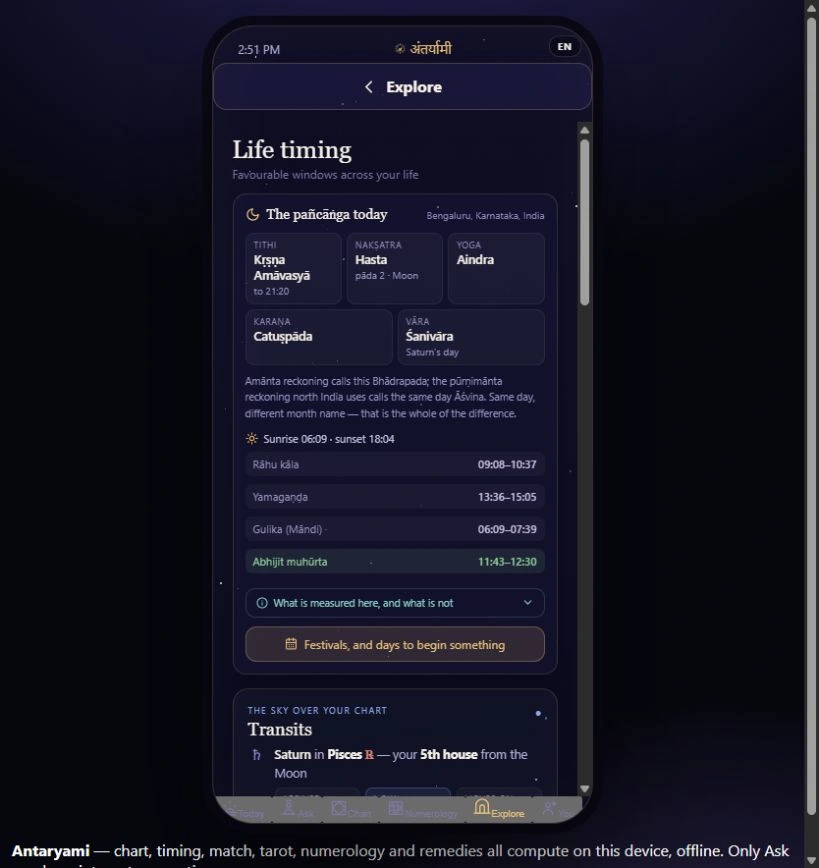
The inspected card labels tithi, nakshatra, yoga, karana and vara separately. In panchanga usage, these describe a lunar-day division, a lunar mansion, a Sun-Moon angular combination, a half-tithi subdivision and the weekday. You do not have to memorise every name within those categories to begin reading the screen. First recognise that each field is answering a different calendar question. Combining their names into one dramatic sentence about luck would erase the structure that makes the instrument educational.
The word yoga here needs particular care. It is a panchanga category, not a recommendation for a physical exercise session and not interchangeable with every natal-chart combination also called a yoga. Likewise, a current nakshatra on the day card is not necessarily your birth nakshatra. The same vocabulary can appear in different contexts. Look at the title and the time reference around the word. This is one reason Antaryami places the day's fields together instead of asking you to infer their meaning from scattered symbols.
A calendar field can change during the civil date
A displayed tithi may include an end time. That is a useful reminder that the traditional division and the midnight-to-midnight civil date are not identical units. A phone can continue to show the same calendar date while a lunar field crosses its boundary. Read the accompanying clock information rather than assuming that the first name you see applies unchanged until bedtime. The picture in this article is a captured preview, so its boundary time belongs to that example, not to whichever day you are reading the article.
This also explains why copying a screenshot into tomorrow's message can be misleading. A person receiving it might mistake a historical example for a current recommendation. If you are discussing a day card, include the relevant date, city and calculation context. Do not announce a universal end time without those details. An educational screenshot can show where a field appears and how to read it; it cannot keep its old numerical values current. Treat the article as a guide to the instrument, not as a live almanac embedded in a photograph.
The place label is part of the information
The real preview shows Bengaluru beside the panchanga title, with sunrise, sunset and local windows below. That place label is not there to decorate the card. Sunrise-based divisions and the displayed local clock require a location context. A visitor living elsewhere should not copy the Bengaluru hours and assume they are the correct hours for their own day. Check which city the app is using, especially when a saved birthplace and a current residence are not the same location.
A location-aware calendar does not mean that every astronomical field is independently different for every person. At a given instant, the relevant celestial geometry is shared; local dates, observance rules and sunrise-based calculations determine how it is used on a day card. The careful reading question is therefore, "What is this field tied to?" Sometimes the answer is an angular state, sometimes the local day or sunrise, and sometimes a traditional rule. The selected person's identity should not be used to explain every difference between two city calendars.
A traditional window is not a safety instruction
Below the five fields, the card presents named windows such as Rahu kala and Abhijit muhurta. Their presence introduces another layer: a traditional way of favouring or setting aside parts of the day for particular beginnings. Those labels do not measure road safety, financial risk or medical urgency. You can respect a household's calendar preference without claiming that a named interval controls what happens to everyone who acts within it. The distinction is especially important when a practical obligation cannot be moved.
Imagine an appointment booked around several people's work schedules. If the chosen hour overlaps a traditional window, consider the purpose and the actual flexibility before becoming alarmed. A routine task, an emergency and a deliberately timed ceremony are not the same kind of event. Do not postpone necessary care or disregard an official deadline to satisfy a calendar label. The productive conversation is about how to include a preference within real constraints, not about blaming a time interval for circumstances that need ordinary attention and professional judgement.
A first reading can be an exercise in identification
- Confirm the day and location rather than copying the screenshot's hours.
- Identify tithi, nakshatra, yoga, karana and vara as distinct categories.
- Read boundary times and local windows with their method note.
- Keep the calendar state separate from the selected profile's interpretation.
Read the card from the heading downward and identify the source of each piece of information. Which fields name the current traditional calendar state? Which line supplies the place? Which numbers show the day's local windows? Then locate the adjoining profile-specific transit information and notice that its title changes the question. This exercise requires no personal prediction. It teaches you to read a dense screen with enough care that familiar words do not trick you into treating different kinds of information as one result.
If a field remains unclear, use the method note before hunting for a confident explanation elsewhere. It is reasonable to understand only tithi and vara on a first visit, then return to yoga or karana later. Your progress is not measured by how many auspicious labels you can repeat. It is measured by whether you can explain what a field describes, which time it belongs to and what it does not establish. That is a durable skill even when the next day's names change completely.
The benefit is calendar literacy you can share
A thoughtful panchanga screen can make a conversation about a family observance more concrete. Instead of saying that an app called the day good or bad, you can explain which field or rule your family is considering. That opens room for regional practice, different almanacs and practical scheduling. It also lets you share a useful explanation without publishing anyone's private chart. A city-level educational example is often enough to understand the form of the question.
Antaryami, from Temior Technologies Pvt Ltd, places these details alongside other instruments so that a reader can see their different purposes. Nitish Raj Walia's guide does not certify the captured hours against every almanac or promise an outcome from following them. Use the real app's current result and method label when the feature is available, then bring your own circumstances to the decision. Five fields become less intimidating when they are understood as five kinds of calendar information, rather than five authorities competing to control your day.
What does the day card actually tell you?
Does today's nakshatra replace my birth star?
No. The day card and your natal chart have different time references. Read the screen title before treating a lunar mansion as your birth placement.
Can I reuse the Bengaluru window in another city?
Do not assume that the local clock and sunrise-based intervals transfer unchanged. Check the selected date, city and calculation context.
Astrological interpretations are for reflection, not a diagnosis, a guaranteed prediction or a substitute for professional advice. Journal guides are prepared with AI assistance; they are educational content, not individual consultations.


