 Antaryami
App walkthroughs
Marriage and the person beside you: Antaryami reflection without a relationship verdict
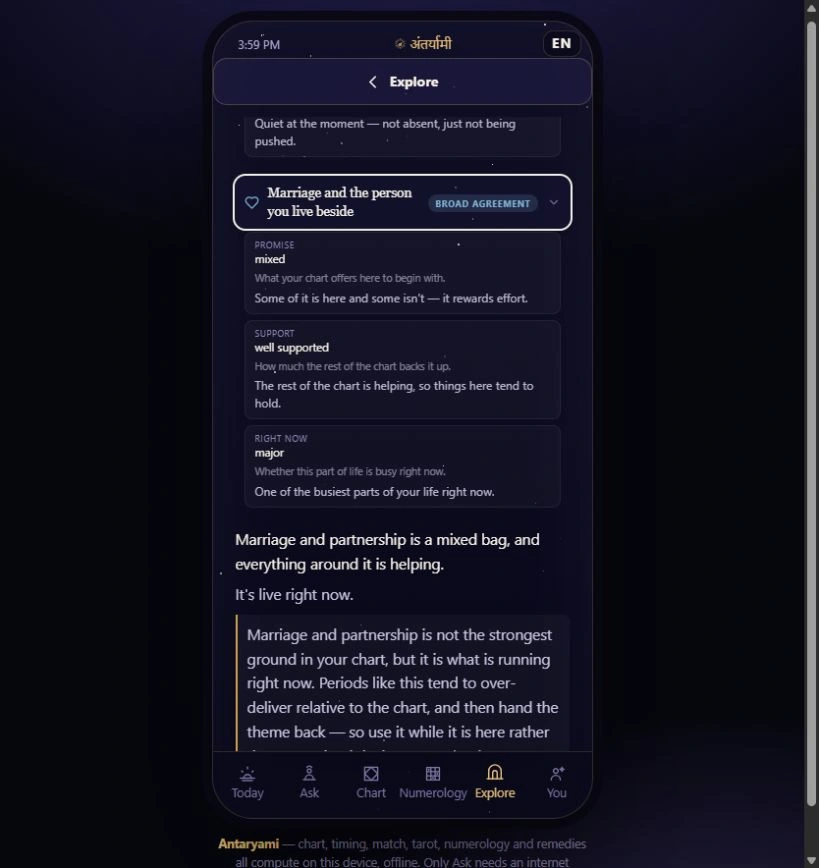
When a relationship question matters, a decisive sentence can feel like relief. You may want to know whether the other person understands you, whether a difficult conversation will improve or whether the uncertainty can finally end. Antaryami's Life room contains a partnership-themed area, but a reading for one profile is not private knowledge of the person beside them. Nitish Raj Walia uses the real preview here to explain that difference and make the interface easier to read. The fictional example is not a compatibility verdict. Its value is a way to organise your own reflection while leaving the other person's voice and choices intact.
First identify whose chart is being interpreted
Life uses the currently selected profile to generate this area. Opening a heading about marriage does not silently introduce a partner's chart or verify that a partnership exists. Check the profile before interpreting the language. The source configuration for the inspected category includes the seventh and second houses with selected significators. Those are components of the app's traditional assessment for one person. They are not a record of what another adult thinks, what they have agreed to or how they behave in private.
This distinction matters for somebody who is single, dating, married, separated or living in a household that does not fit the heading neatly. You do not need to invent a future spouse to make a paragraph relevant. Consider only the questions that genuinely concern you, and leave the rest as part of the model's vocabulary. A reflective instrument should not prescribe a household arrangement or make people feel that their lives are incomplete because an interface has chosen a familiar traditional category name.
Do not confuse this area with two-chart matching
Antaryami's Explore menu provides separate Match and Compare instruments. Their inputs and presentation are different from a single-profile Life reading. This article does not calculate a Guna Milan score or test those other workflows. If you move between them, identify which instrument you are using and which profiles it actually includes. The same subject word can appear in several rooms without meaning that each room answers the same question or uses the same arithmetic.
A score in another instrument would still not decide whether two people should marry, just as this panel cannot settle the future of a relationship on its own. Consent, safety, trust and practical compatibility require the people involved and their real circumstances. Do not stack several symbolic outputs together until they seem to authorise a decision you wanted to make anyway. Comparing methods can be interesting, but agreement among interfaces is not permission to disregard another person's stated wishes or a fact you would rather not confront.
Read the lane labels without turning them into a sentence
The fictional partnership screenshot combines a mixed natal interpretation with supporting factors and current activation. Read each lane's explanation before deciding what the combination means inside the app. Mixed is not a diagnosis of a partner, and active is not a promise of an event. These are distinct model descriptions. A panel that preserves them separately gives you more context than a single alarming grade, but the extra context still does not become a guaranteed forecast of how two people will behave.
You can use the difference to ask a more careful question. Perhaps the relationship is attracting much of your attention even though several aspects remain uncertain. That observation can be made from your life without a chart. Compare it with the reading and note where the language helps, where it does not and where another person's account is missing. Avoid presenting the most dramatic line as an explanation they must accept. They are entitled to describe their experience without being interpreted through a profile they did not choose to discuss.
Ask for an answer the other person can actually give
Suppose a message has felt distant and you have started constructing an explanation around it. Before assigning a chart-related cause, ask what you know: the words sent, the situation you were discussing and whether the other person has had a chance to explain. A straightforward question about what they meant leaves space for an answer. Announcing that a reading has revealed their fear, intention or future behaviour removes that space and can turn curiosity into an accusation.
A useful phrasing acknowledges your part in the uncertainty. You might explain that you read the message one way and want to check rather than assume. Let the reply change your understanding. The purpose is not to obtain reassurance that fits the chart but to understand the conversation. If the reading helped you notice that you were guessing, keep that benefit. It has not proved the guess correct. An interactive product becomes more humane when its user carries this distinction into real exchanges rather than using the interface as an authority over somebody else.
Do not make private conflict into public proof
- Confirm that this Life area reads one selected profile.
- Keep it distinct from separate Match or Compare workflows.
- Ask about the actual words or expectation instead of guessing motives.
- Share a public explanation rather than another person's private record.
The expandable working can help you inspect the app's chosen chart factors, and a connected Ask action may offer another route for explanation where available. Neither action requires you to publish a partner's messages or expose someone else's birth record. This preview has not exercised the remote answer service. Read its current privacy and access information before using it, and share only information you have authority to disclose. An intimate story deserves more care than a general product demonstration.
If you share this Journal guide, the public article explains the instrument without making a personal report public. That is often the better choice when you want a friend to understand what you are exploring. Keep actual boundaries separate from symbolism: nobody owes access to their profile, a reconciliation or agreement with an interpretation because you have paid for a reading. The app should help you reflect on your own choices, not furnish a justification for controlling someone else's choices.
Explore the product without asking it to make the relationship decision
The Antaryami experience centre lets you inspect this approach before considering personal app access. Look for clear method boundaries, inspectable working and room to disagree with an interpretation. The screenshot demonstrates one actual-source preview state; it does not confirm a live store download, purchased entitlement or remote consultation. Those availability facts belong on the current official pages. A polished product visit should explain what the instrument offers and what it has not established, especially when the subject feels personally important.
For Temior Technologies Pvt Ltd, a useful Antaryami Journal article should leave the reader with more agency, not less. The partnership area can provide language to consider and a route into the app's reasoning. The people in a relationship still supply its lived evidence and make its choices. You may leave with a question worth asking, a misunderstanding worth checking or the conclusion that the reading did not help today. All three are legitimate outcomes of an exploratory visit; none needs to be converted into a verdict about whether love will last.
Make space for another person's answer
Does this panel include my partner's chart?
No. The inspected Life area interprets the selected profile. Match and Compare are separate instruments with their own inputs and explanations.
A message feels distant and I am guessing why
Check the actual meaning with the person who sent it. A reading cannot verify their intention, and their explanation is allowed to differ from the story you imagined.
Astrological interpretations are for reflection, not a diagnosis, a guaranteed prediction or a substitute for professional advice. Journal guides are prepared with AI assistance; they are educational content, not individual consultations.


