 Antaryami
App walkthroughs
Pinnacles and challenges in Antaryami: read the age range before the life story
Life rarely changes in tidy chapters, yet a chapter framework can help you organise a question. Antaryami's Western numerology screen includes four pinnacles paired with challenges and labelled age ranges. Nitish Raj Walia explores their inspected arithmetic and controls here, including why a challenge value of zero is not an error. The aim is to understand the model without treating it as a timetable for promotion, marriage or personal maturity. An age range belongs to a convention; it should not become a deadline by which a reader must prove they have fulfilled the story printed beside it.
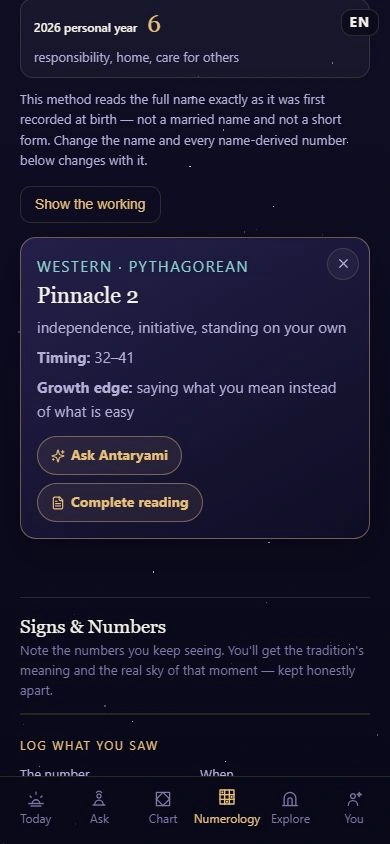
A cycle card contains more than one number
The inspected Western section groups pinnacle and challenge values within each age-range card. It marks the current pinnacle based on the profile's age and allows a card to open a detail region. Read the labels before the values, because the two numbers have different procedures and interpretive roles. The fictional adult screenshot shows a cycle selection; it does not announce that the reader is entering the same stage. A current marker is a model state, not detection of a life event or proof that circumstances match the interpretation.
The detail can show a timing label, a growth-edge theme and working where supplied. This structure gives you a route to inspect a single chapter rather than accepting four compressed life stories at once. Keep the profile and method context in view. Switching systems or people resets the detail in the source. That helps prevent an explanation from being carried into an unrelated chart, but it does not establish forecasting accuracy. The clarity benefit is that you can identify what the model is saying and where its age convention begins and ends.
Pinnacles add while challenges use differences
The inspected implementation constructs the first two pinnacles from month-plus-day and day-plus-year components, the third from the first two pinnacle results and the fourth from month-plus-year. It applies its Western reduction rule, which can retain master numbers. Challenges instead use absolute differences between selected components, with the third based on the first two challenges. They reduce fully to a single digit. These are procedural distinctions. A challenge is not a more negative version of the same number, and its label does not establish that hardship must occur.
Zero is a valid challenge result when the relevant reduced values match. The interface explicitly treats it as a result rather than missing data. That is useful to know before interpreting a blank-looking or unfamiliar value. Similarly, the presence of a two-digit pinnacle does not rank someone above another reader. The arithmetic determines a model output; the tradition attaches a theme. Keeping those layers separate helps you inspect a paired card without turning one value into a promise and the other into a punishment.
Do not mistake a calculated chapter for a universal developmental stage
The source sets the first pinnacle's end at thirty-six minus the fully reduced Life Path value. The next two ranges each last nine years, and the fourth is open-ended. When a Life Path is a retained master number, the range calculation uses its single-digit reduction. Those details document this model's convention. They are not a clinical account of development, a universal history of adulthood or a guarantee that everyone reaches the same kind of turning point at the assigned age.
A practical comparison should therefore ask which boundary rule another source uses rather than assuming an age difference proves one system knows your future better. The app can label a period consistently while your actual responsibilities change at different times. Parenting, study, work and caregiving do not need to wait for a cycle boundary to matter. You can learn the chapter structure without reorganising your biography to fit it. A useful model makes its rules available for inspection and leaves lived timing free to remain more complicated than its categories.
Translate a growth theme into something specific
Suppose a challenge description prompts you to think about communication. Instead of deciding the entire age range will be defined by difficulty, choose one conversation you can improve now. You might clarify an expectation or ask for feedback on a repeated misunderstanding. That task can be evaluated through the actual interaction. The theme offers an entry point, but the evidence of progress comes from what you do and how people respond. A broad chapter should not replace the details that make a practical response possible.
You can use the pinnacle theme in the same way. If it mentions building or learning, identify a manageable project rather than expecting a major opportunity to arrive automatically. Make room for the possibility that the description does not fit. The model is not entitled to your agreement. A reflection can end with an irrelevant theme and still teach you something about the interface's arithmetic. The person reading it remains larger than the chapter, and the next action should serve their circumstances rather than demonstrate loyalty to a number.
An age label should not become a score for your life
- Identify which value is the pinnacle and which is the challenge.
- Inspect the age rule and the different reduction conventions.
- Treat a zero challenge as a calculated result, not missing information.
- Choose a current task without turning a chapter boundary into a life deadline.
People can feel behind when a framework seems to announce the age at which success should happen. This guide makes no such claim. A pinnacle range does not certify when someone must marry, lead a company, become financially secure or discover a calling. Opportunities and constraints vary, and a chart-derived chapter does not measure them. Do not use the model to judge a relative's progress or deny someone's potential because their current circumstances look unlike the printed theme. A symbolic stage is not an eligibility decision about a human life.
For your own use, distinguish a deadline that is real from one supplied by interpretation. An application closing date requires attention; an expectation that you should have achieved something by a numerological boundary is a different kind of statement. Keep important health, legal and financial decisions with appropriate evidence and advice. The paired cards can organise optional reflection, but they cannot establish that waiting is safe or that action is overdue. Their value grows when the reader can understand the range without feeling trapped by it.
Learn a framework while keeping your own pace
The app-source review confirms the paired cycle cards, range calculation and selectable detail. It does not validate predictions about major milestones or verify a live cycle consultation. The screenshot documents fictional adult input and is not a customer's timetable. Current product access needs separate official confirmation. This scope lets the website present a detailed model honestly: the rules and labels are inspectable, while the meanings remain traditional interpretations that should be considered rather than presented as established outcomes for every reader.
Antaryami is presented by Temior Technologies Pvt Ltd with room to explore both concise explanations and their working. Here you can leave knowing why a challenge differs from a pinnacle and why the age labels depend on a defined rule. That is useful knowledge without a dramatic verdict. You may keep a reflective question from the current card and ignore an interpretation that does not help. Your pace remains yours, and the framework should make a conversation more organised rather than make your life feel late for an appointment it never agreed to.
Read a stage without judging your pace
Does a challenge value of zero mean the screen failed?
Not necessarily. In the inspected rule, equal component values can produce an absolute difference of zero, and zero is a valid challenge result rather than a missing value.
Am I behind if my life does not match the current pinnacle theme?
The age range is a numerological convention, not a deadline for achievement. Assess your goals and circumstances directly instead of using a symbolic chapter to grade your progress.
Astrological interpretations are for reflection, not a diagnosis, a guaranteed prediction or a substitute for professional advice. Journal guides are prepared with AI assistance; they are educational content, not individual consultations.


