 Antaryami
App walkthroughs
Shuffle, cut, reveal: follow Antaryami's tarot interaction without giving the cards control
A digital tarot room can feel like a paragraph generator if everything appears at once. Antaryami's inspected feature instead has a sequence: choose a spread, enter the shuffle stage, choose a cut and reveal the dealt cards. This guide by Nitish Raj Walia follows that interaction using a fictional adult preview, without entering a private question or sending anything to the online Ask service. The aim is to understand what the controls actually do. An engaging sequence can make reflection more deliberate; it does not turn a random selection into verified knowledge of what will happen to you.
Choose the arrangement before you begin
The spread and option controls are part of the reading context. A one-card draw has one position to inspect; a larger arrangement has several named positions and a different layout. Reversal settings determine whether reversed interpretations are included, and a held-out significator changes the eligible deck. Decide those choices before drawing so that you can later explain what was selected. Changing the setup resets the feature's current spread state rather than allowing an old reading to masquerade as a result from the new arrangement.
Use a small spread for the first demonstration. It is easier to see the relationship between a dealt card, its position and its explanation when you are not trying to interpret a large group of images. An optional question may help you remember your intention, but it is not needed to inspect the interface. Keep sensitive details out of the field. You can learn the workflow with a neutral question in your own mind and no recorded personal story, just as the fictional demonstration does here.
The visual shuffle and the draw mechanism have different roles
The app presents a shuffle animation before the cut stage. The inspected engine constructs its random draw using the platform's cryptographic random source and a Fisher-Yates shuffle, with rejection sampling for integer selection. The animation is the visible introduction to that process, not independent evidence about the future. The actual source code matters more to a technical explanation than how vigorously the card backs move. This guide describes the implementation that was inspected; it does not claim an independent certification of the whole product.
A random source has a narrow job: contribute randomness to selection within the eligible deck. It does not make the symbolic meaning medically, psychologically or predictively reliable. Likewise, a beautifully animated deck is not proof that a result was random unless its underlying mechanism is known. Keeping these claims separate lets you enjoy the interaction without overselling the mathematics. The question text is retained as context by the feature but is not used to favour particular cards in the draw.
The cut changes the order of the stack
At the cut stage, the source engine interprets the selected fraction as a position in the eligible deck and rotates the stack at that point. That is different from shuffling the whole deck again. The control therefore participates in the order from which cards are dealt, rather than existing only as a decorative flourish. When explaining the feature, use that precise statement instead of claiming that the cut reveals intuition or changes how accurately the cards can foresee an event.
The inspected interface's cut display needs a wording review: its percentage-like slider is labelled as a number of cards, even though the engine derives the cut from a fraction of the eligible deck. This article does not repeat that label as an exact card count. The screenshot shows the subsequent face-down deal, and the source explanation here keeps the mechanism clear. An honest walkthrough can acknowledge a display issue without fabricating a nicer result or claiming that a cosmetic label has altered the verified mathematical operation.
A face-down deal creates a useful pause
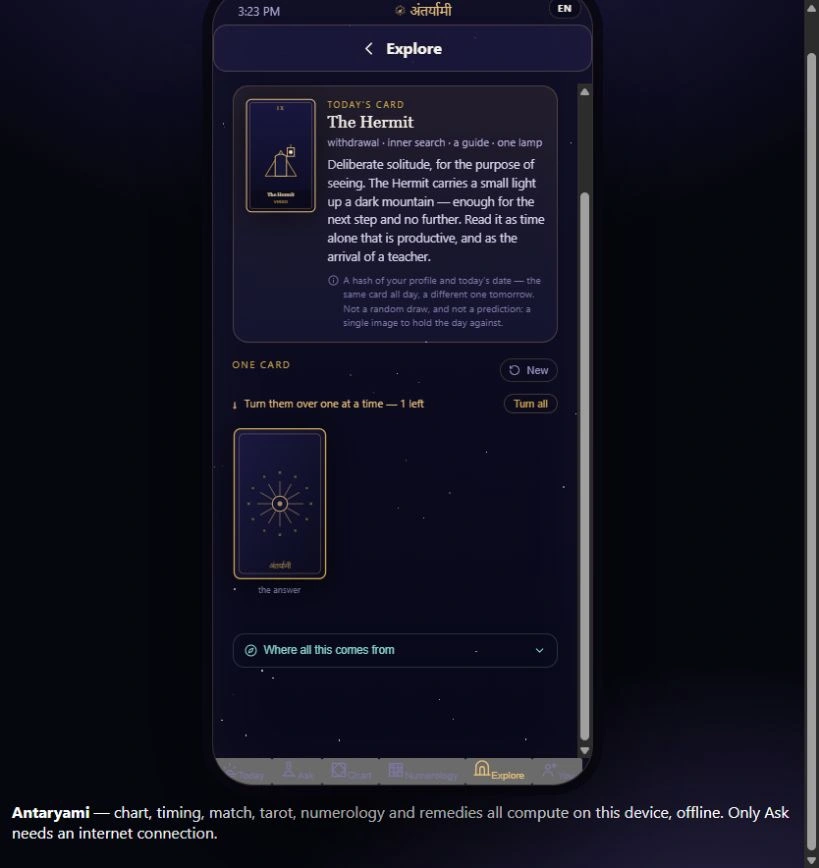
After the cut and deal, the preview shows a face-down card and a control to turn it over. The inspected one-card flow was exercised through that reveal. A larger spread can reveal individual cards or turn them all. This pause lets you separate the choice of arrangement from the moment you begin interpreting its images. It is an interaction design benefit, not a test of courage and not evidence that the hidden image already knows the outcome of a situation.
Once a card is visible, read its position and the relevant interpretation together. Do not take a severe-looking title as a literal description of what will happen. A card name belongs to a symbolic vocabulary; the actual image and contextual explanation may invite a less dramatic question. You can also find that the meaning is not useful for your situation. The reveal does not create an obligation to agree with it or a requirement to ask for another paid reading until the uncertainty has disappeared.
The draw details identify the process, not a certified truth
- Choose a spread and read the reversal and significator options.
- Understand the cut as a fraction-based stack rotation, not a prediction.
- Reveal the dealt card and read its position with its symbolic explanation.
- Treat saving and online Ask as separate actions with their own conditions.
The completed feature shows information about the generator, shuffle, options and a seed fingerprint. Those details make the process more inspectable. A short fingerprint can identify a reading within the product context; it should not be described as a legal signature, a security guarantee or proof that an interpretation is correct. Retaining the chosen spread and options is often more helpful for an ordinary comparison than repeating a technical label that the other person does not understand.
The interface also offers keeping the reading and asking about it. Those are separate actions from revealing the card. In this demonstration, neither saving a personal journal entry nor sending a question to the online service was performed. Before using those actions yourself, understand the applicable account, privacy and service conditions. A source screenshot of a button does not establish that a website account has received the record, that a cross-device library is available or that every action is included in your current access.
The benefit is participation you can understand
The sequence can make a reflective activity feel more considered than receiving an instant verdict. You choose an arrangement, pause before revealing and inspect how the draw was produced. Those are concrete interactions a product can demonstrate. What it cannot demonstrate through the same sequence is that the selected image proves another person's intentions or the outcome of a future decision. The meaningful distinction is between participating in a symbolic exercise and surrendering judgement to it.
Nitish Raj Walia's Antaryami guide is prepared for Temior Technologies Pvt Ltd with real app-source screens and fictional details. Current release availability and access belong on the app and plan pages, not in an invented download badge beneath a demonstration. Explore the interaction if it interests you, take one question that helps and return to the evidence of your own life. A card can be turned over without turning your next choice into something the card is allowed to decide.
What does this control change?
Does the cut create a new full shuffle?
No. In the inspected engine it rotates the already shuffled eligible stack at a fraction-derived position. The slider's card-count wording is flagged for app review.
Does the fingerprint validate the interpretation?
It identifies process information for the reading; it is not proof that a symbolic meaning or a future prediction is true.
Astrological interpretations are for reflection, not a diagnosis, a guaranteed prediction or a substitute for professional advice. Journal guides are prepared with AI assistance; they are educational content, not individual consultations.


