 Antaryami
Birth-record workshop
East or west? What a reversed longitude sign changes
The coordinate pairs 30° north, 76° east and 30° north, 76° west share most of their digits. They do not identify the same place. A missing minus sign or an omitted hemisphere can therefore matter far more than a final decimal. This workshop follows one simple correction from a written location through a comparison note, without using anybody's private birth record.
Translate the convention before copying
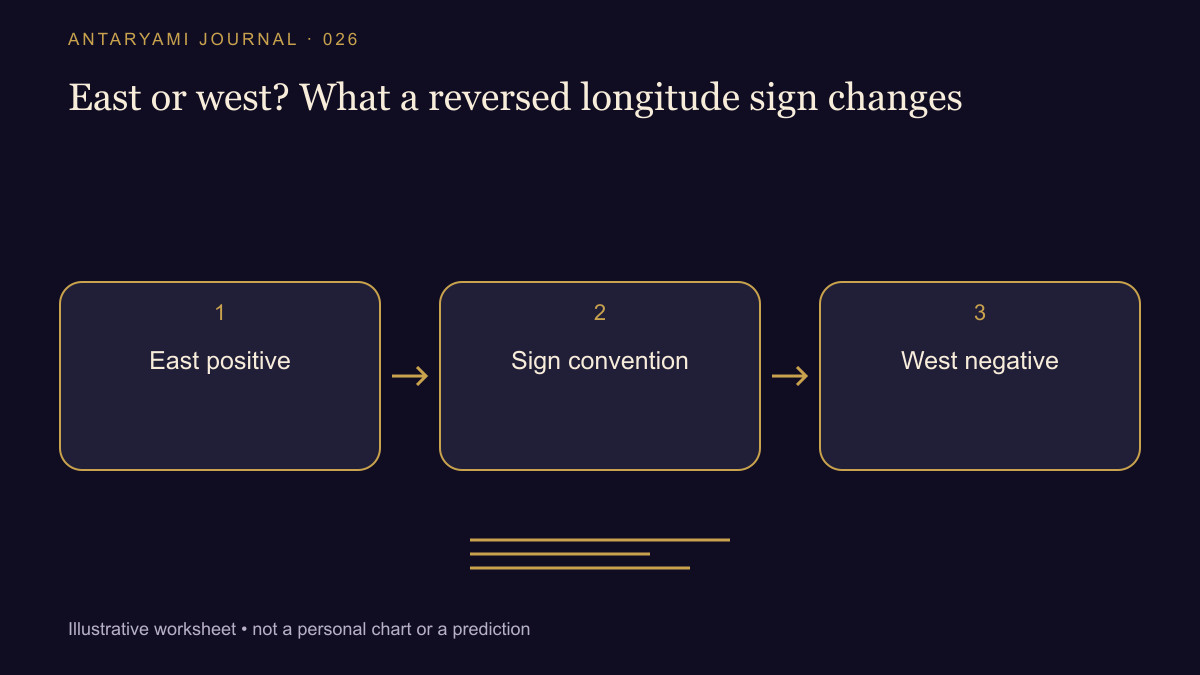
Many numeric formats use positive longitude for east and negative longitude for west, but the receiving system's documented convention must be checked. Swiss Ephemeris includes explicit guidance on longitude signs. A reader should not assume that every old document, map or data interface uses the same notation just because the field is named longitude.
Under an east-positive convention, the teaching pair 76° east and 76° west becomes +76 and -76. The two longitudes differ by 152 degrees along that coordinate scale. This arithmetic is not a surface-distance calculation: the places' latitudes and an appropriate geographic method would be needed for that different question.
Find the point in a labelled context
After copying the coordinate, check whether the resulting country or region is plausible for the stated place. A visual map can expose a sign mistake quickly, but a familiar-looking shape is not a complete verification. Read the coordinate and its hemisphere again rather than simply dragging a marker toward the expected continent.
Keep latitude and longitude in separate labelled fields. Reversing their order can produce another class of mistake, and some exchanged formats specify an order that differs from everyday spoken usage. A coordinate pair should travel with its format definition when shared between tools.
Correct the record once, with a reason
If the original entry lost its west sign during transcription, preserve the original and the corrected value in your review note. Write the evidence for the correction, such as the source's explicit W label. Do not describe the adjustment as birth-time rectification; you have corrected a coordinate transcription, not established an unknown event time.
Then rerun the relevant calculation using the corrected location and otherwise unchanged inputs. Comparing two versions while also changing the birth time or method would make the effect harder to isolate. Keep the before-and-after record sufficiently clear for another reviewer to repeat.
Do not infer a civil clock from longitude alone
Longitude has a geometric relationship to local solar time, but a modern civil time zone follows regional rules. Reversing a longitude sign should not trigger a homemade clock correction based only on degrees. Check the actual place and applicable time interpretation separately. A reliable fix restores the intended location, documents the correction and then lets the declared calculation method use the appropriate inputs.
Astrological interpretations are for reflection, not a diagnosis, a guaranteed prediction or a substitute for professional advice. Journal guides are prepared with AI assistance; they are educational content, not individual consultations.