 Antaryami
Birth-record workshop
A chart screenshot with no settings: what can you compare?
A chart arrives as a cropped screenshot: a wheel, several glyphs and a few degrees, with no settings panel. It can still be interesting to discuss, but there are limits to what it establishes. The sensible response is to identify what is visible, name the missing context and avoid turning an incomplete picture into a precise comparison of calculation methods.
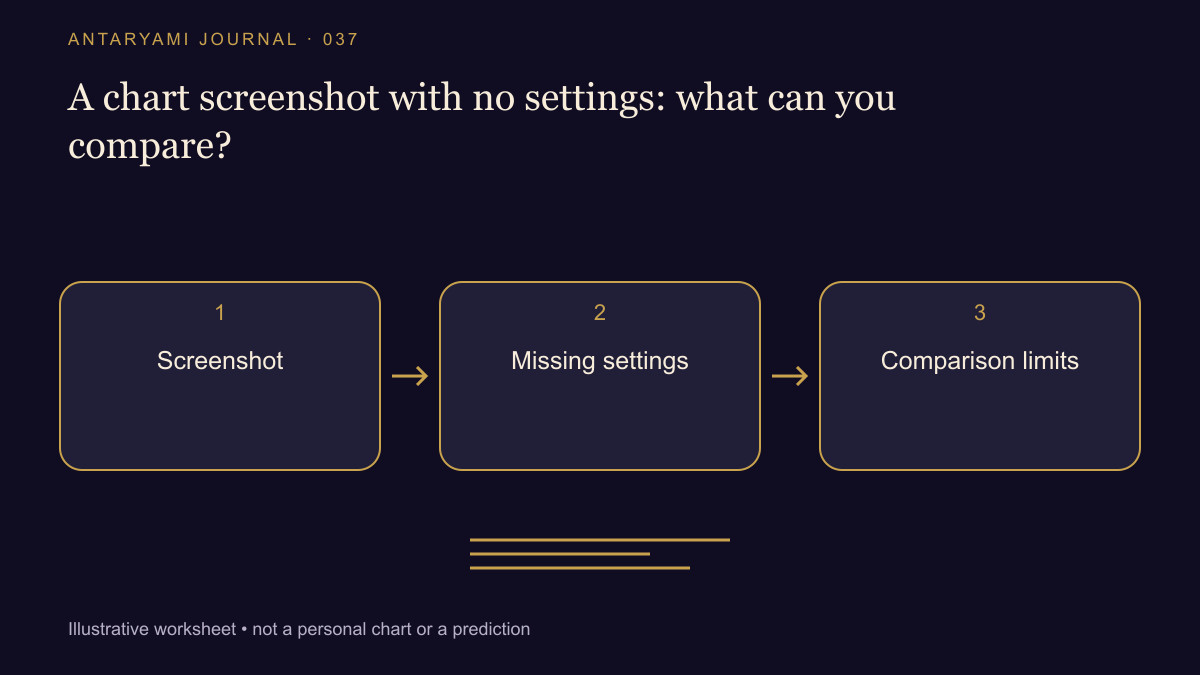
Inventory what the image actually shows
List the visible sign labels, numeric positions, house numbers, time labels and any method names. Keep uncertain readings marked as uncertain. A small glyph or a truncated degree should not become a confidently transcribed fact merely because it resembles something familiar.
Then list what is absent: perhaps the zodiac reference, ayanamsa, house method, observing convention, event time or software version. Not every missing field matters to every question, but a reviewer needs the ones that affect the chosen result. A screenshot cannot supply metadata that was never included in it.
Choose a question the evidence can answer
You may be able to discuss the drawing's layout or explain a visible label. You may not be able to reproduce its planetary positions or decide why another calculator differs. Keep the task proportional to the available information. An incomplete comparison should remain incomplete rather than be rescued with guessed settings.
For example, two clearly printed positions might support a demonstration of circular separation if they use an established common reference. Without that common reference, even a tidy subtraction can answer the wrong question. State the condition under which your explanation applies.
Ask for a minimal addition
Request the specific missing setting or a clean export of the relevant numeric table. Do not demand an entire private profile when a method label would resolve the issue. If the source is another person's chart, obtain permission before asking them to disclose birth details or account information.
Keep the unedited screenshot available privately if a crop was made for a public question. Cropping may protect personal information, but it can also remove a legend that changes the meaning. A careful redaction preserves technical labels while concealing unnecessary identifiers.
Distinguish illustration from calculation
Some images are fictional demonstrations or editorial diagrams rather than personal chart outputs. Read captions and surrounding text before treating them as a result for the viewer. An attractive instrument can explain a concept without being a live reading. A useful conversation starts by naming what the image is, then asks only the questions its actual contents can support.
Astrological interpretations are for reflection, not a diagnosis, a guaranteed prediction or a substitute for professional advice. Journal guides are prepared with AI assistance; they are educational content, not individual consultations.