 Antaryami
Calculation workshop
J2000 and of-date coordinates: check the reference frame first
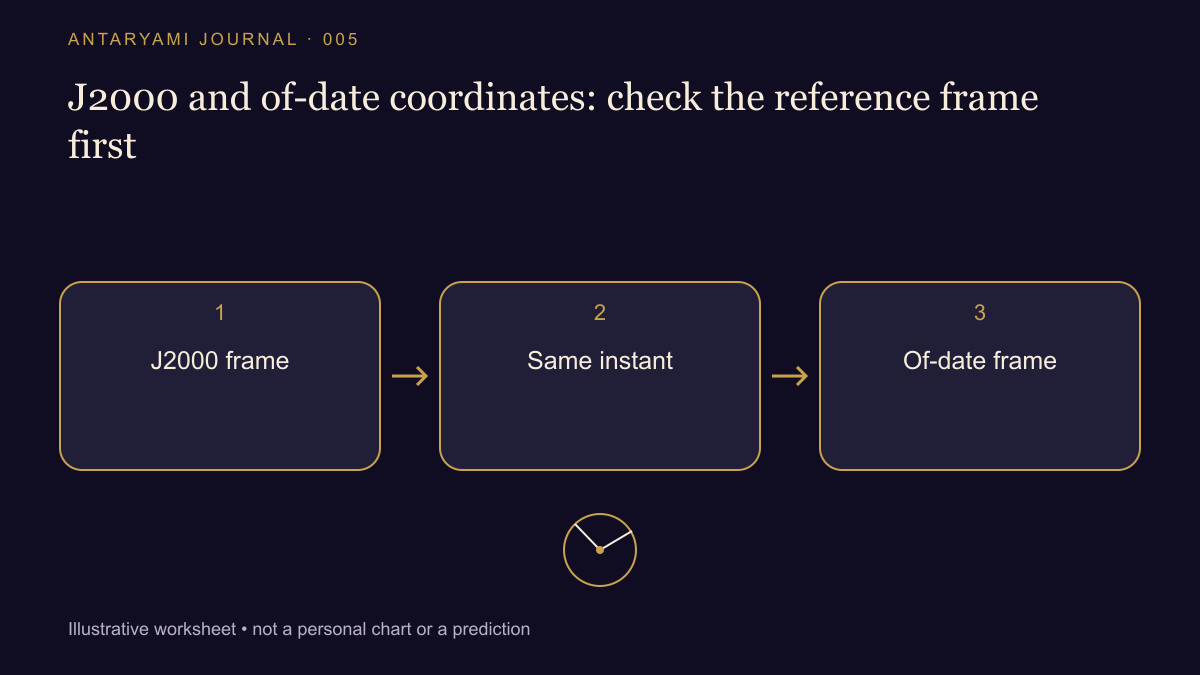
A coordinate table marked J2000 is compared with another marked of date. The date of the event appears identical, yet the numbers differ. The event time and the reference used to describe a direction are separate pieces of information. This guide explains why a careful comparison needs both. It does not ask you to memorise a coordinate transformation before you can read a chart responsibly.
Separate the event from the reference
JPL's Horizons manual documents fixed standard-epoch ecliptic frames and ecliptic frames of date. A fixed frame and a changing frame need not express the same direction with identical coordinates. “Calculated for today” does not necessarily mean “expressed in today's frame.” The request can describe a present event using a fixed reference.
Think of two maps that describe the same meeting place from different grid origins. The meeting has not moved merely because the coordinate labels differ. The analogy is limited, but it helps prevent a common mistake: treating a reference-frame label as decorative metadata instead of part of the definition of the numbers.
Compare the complete field labels
Before subtracting values, record the coordinate system, frame, epoch convention and units from each table. Keep the observing centre and time scale as well. A single label such as J2000 can be used in context that requires a more precise explanation; do not invent that explanation when a provider has not supplied it.
A fictional audit might begin with “ecliptic longitude in a fixed standard-epoch frame” on one side and “ecliptic longitude of date” on the other. At that stage the correct conclusion is that the fields are not directly matched. Request equivalent outputs or a documented transformation before declaring the size of an implementation error.
Do not apply a convenient offset
It may be tempting to subtract a familiar ayanamsa value or another remembered angle until the tables look similar. That is not a general reference-frame transformation. A zodiac-origin choice, a coordinate-plane choice and other corrections must not be collapsed into whichever single number seems to improve agreement.
If a service supports a documented frame selection, use it and preserve the full request. If it does not, state that the comparison remains incomplete. A narrow limitation is more useful than a confident homemade correction that nobody else can reproduce. Avoid changing personal profile data to compensate for a difference in output conventions.
Keep the conclusion technical
Matching reference frames helps establish whether two calculations agree under the same assumptions. It does not validate a claim about a person's future. A useful support note names the mismatch, links the relevant documentation and provides fictional inputs where possible. That gives a reviewer a concrete question to answer, while keeping reference-frame precision separate from interpretive certainty.
Astrological interpretations are for reflection, not a diagnosis, a guaranteed prediction or a substitute for professional advice. Journal guides are prepared with AI assistance; they are educational content, not individual consultations.