Antaryami
Birth-record workshop
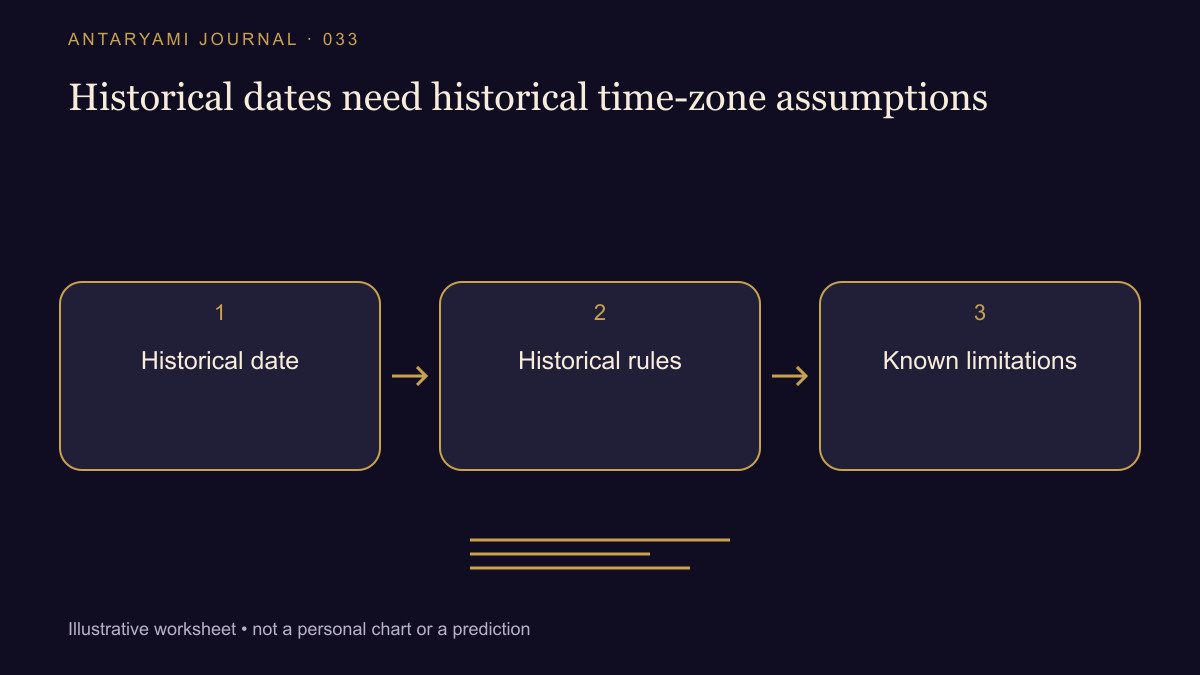
Historical dates need historical time-zone assumptions
A birth record from decades ago is entered using the offset displayed on a phone today. The result looks plausible, but today's civil-time rule may not describe that earlier event. A historical conversion needs the event place and date, the original clock statement and a suitable interpretation of the rules that applied then. Modern familiarity is not sufficient evidence.
Treat a region's clock history as history
IANA's time-zone material describes a database of regional civil-time information, with explicit limitations in historical coverage. It is not a guarantee that every old local practice is known perfectly. Use it as a documented source of rules while retaining uncertainty where the record or historical evidence is incomplete.
Do not assume that a current country boundary or present-day abbreviation settles an older event. A place may have used different administrative rules, and a source may use a label differently from a modern interface. Identify the event's historical context instead of simply copying a nearby city's current offset.
Keep four facts in the worksheet
Record the original local date and time, the event location as stated, the source's clock convention if known, and the rule set used for conversion. Add the resulting offset and instant as outputs of that interpretation. This separation makes it possible to review a later correction without losing the source statement.
For a fictional example, a record might explicitly say local mean time while a modern form assumes standard civil time. The right response is to investigate that difference, not silently rename the source's convention. A conversion can be numerically consistent with an assumption that remains historically unsupported.
Avoid a homemade universal correction
There is no single number of minutes that repairs every old birth record. Longitude-based mean time, daylight-saving rules and calendar interpretation are different issues. Adding a convenient correction until a chart resembles another screenshot can conceal rather than resolve the actual question.
If a provider documents a supported historical range, read what that range means. A calendar converter's ability to accept an old year does not necessarily certify every regional civil-time detail for that year. Where a limitation matters, state it plainly and seek the appropriate evidence rather than advertising exact historical reconstruction.
Preserve the unresolved part
A useful conclusion can distinguish a verified transcription from a provisional zone interpretation. That does not make the whole record worthless. It tells a reader which part is established and which part needs further work. Use fictional examples in public support discussions and protect original documents. Historical care begins by retaining the uncertainty that a neat modern timestamp can otherwise hide.
Astrological interpretations are for reflection, not a diagnosis, a guaranteed prediction or a substitute for professional advice. Journal guides are prepared with AI assistance; they are educational content, not individual consultations.