 Antaryami
Birth-record workshop
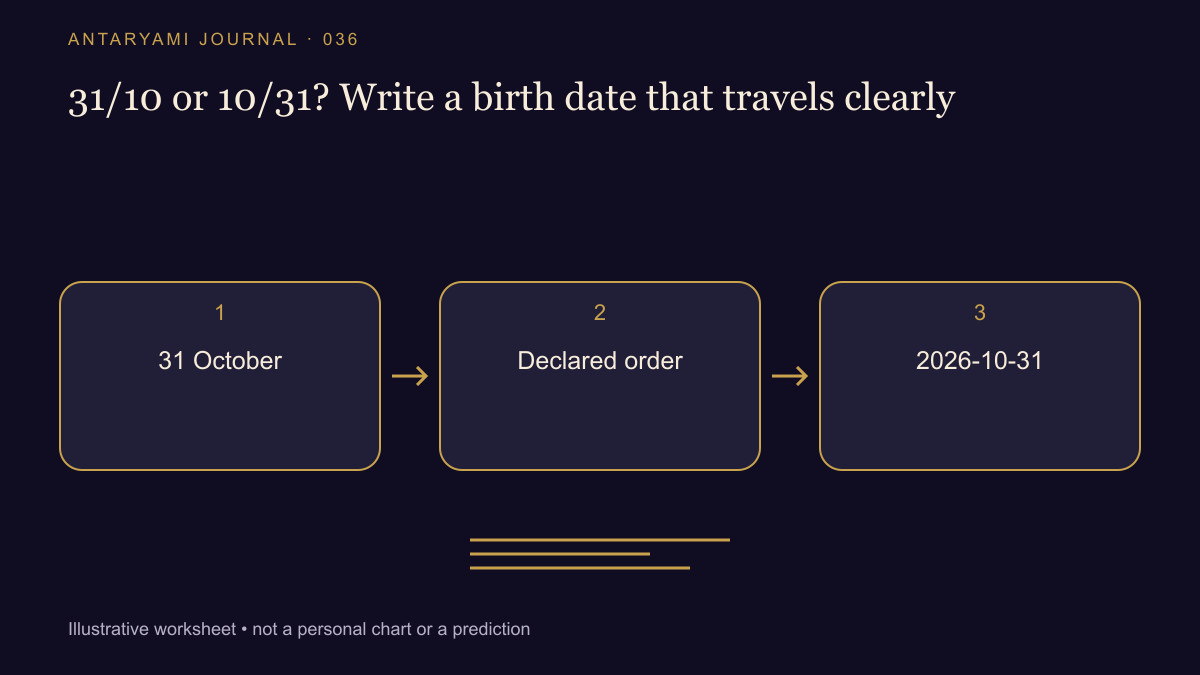
31/10 or 10/31? Write a birth date that travels clearly
A shared note contains 03/04/2001. One reader sees 3 April; another sees March 4. Both are using familiar date-order conventions, and the slash-separated text does not tell them which one the writer intended. A birth record should not depend on the reader guessing correctly. This workshop turns that ambiguity into a small, practical communication check.
Give the month a name when writing for people
For a human-readable note, “3 April 2001” makes the intended month explicit. A consistent year-month-day format can also help, especially when its convention is labelled. RFC 3339 uses a defined date-time structure for technical exchange; it should not be confused with a promise that every informal date string follows that standard.
Do not silently select an interpretation just because both alternatives are valid dates. The absence of a validation error is not confirmation of the writer's intent. If the original text remains ambiguous, ask its owner which month was intended and preserve the clarification with the record.
Keep locale from changing the event
A device's language or region setting can affect how a date is displayed. Changing that display preference should not change the underlying event date. When comparing screens, identify whether the difference is merely the order of fields or an actual change in the represented day and month.
If you export a record, include an explicit date convention and keep the original source wording where useful. A column labelled date without a format note can become ambiguous when opened in a spreadsheet configured for another region. Check a known example rather than assume the receiving program will infer the same convention.
Test an ambiguous and an unambiguous example
Use two fictional dates in a review: 03/04/2001, which permits two common readings, and 23/04/2001, which exposes some month-first assumptions. A system that handles the second sensibly may still silently choose a convention for the first. Test the intended meaning, not only whether a value is accepted.
Avoid relying on automatic reformatting to resolve documentary uncertainty. A program may have selected a valid interpretation without knowing which event the original writer meant. That decision should be visible and correctable rather than passed off as recovered historical evidence.
Confirm the complete saved date
Before using a record for a chart, read the date back with the month written out. Confirm the year as well; a two-digit year can introduce another ambiguity. This modest review is often more useful than studying a detailed interpretation generated from the wrong month. A clear record helps the calculation do its job, while leaving the interpretation separate from the accuracy of the original input.
Astrological interpretations are for reflection, not a diagnosis, a guaranteed prediction or a substitute for professional advice. Journal guides are prepared with AI assistance; they are educational content, not individual consultations.