Antaryami
Calculation workshop
A Julian day number is not a Julian-calendar date
The phrase Julian date can refer to an astronomical day count, while a Julian-calendar date belongs to a calendar system. Confusing the two can turn a valid conversion into a completely different question. This article explains the reading distinction and a documented example. It does not ask you to convert a historic family record without first identifying the calendar and time convention.
Recognise the day count
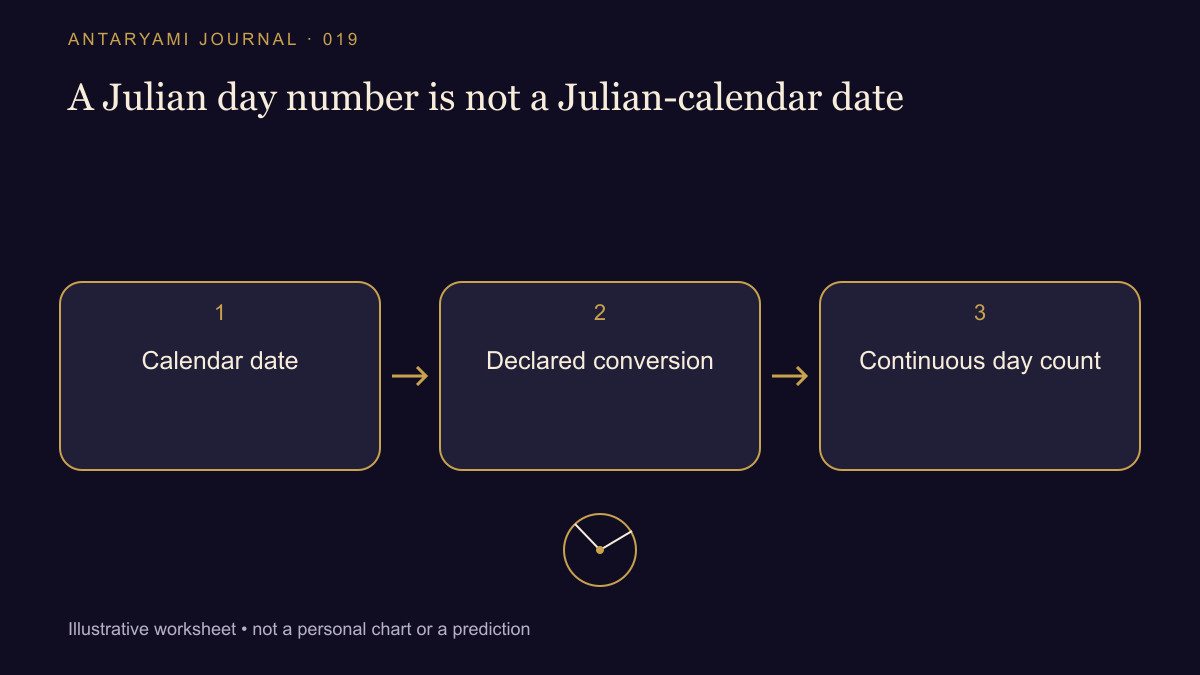
An astronomical Julian date is a continuous count with a fractional part, rather than a year-month-day label. USNO's conversion explanation gives the example of 1978 January 1 at 00:00 UT1 as JD 2443509.5. The decimal fraction belongs to that counting convention; it is not a month number or an instruction to divide a date in half.
The conventional day count begins its integer boundaries at noon in the relevant reference convention. That is why a midnight example can end in .5. Do not assume that every decimal .0 means the start of a local civil day. A calculation's stated time scale remains important to interpreting the value correctly.
Keep the calendar name separate
A Julian-calendar label and a Gregorian-calendar label can describe the same day using different calendar rules. Converting between them is not the same task as formatting an astronomical day number. A screen should identify which task it performs rather than use Julian as a loose synonym for old or historical.
For a record review, write the original date exactly as supplied and add the claimed calendar in a separate field. If the calendar is uncertain, do not silently choose whichever option gives a more familiar result. The correct historical interpretation can depend on the place, period and context of the record.
Avoid an unlabeled numeric export
A value such as 2443509.5 loses essential meaning if its heading is removed. Keep the quantity name, time scale, conversion convention and source alongside it. If two services provide different day counts, check those labels and their treatment of date and time before concluding that the same instant has been calculated differently.
Likewise, a date-only input should not acquire a guessed noon or midnight merely to satisfy a converter. Those choices describe different instants. If the source record supplies no time, preserve that limitation. A convenient software default should not be rewritten as documentary evidence.
Use a round trip carefully
Converting a documented example into a day count and back can check your handling of a specified convention. It cannot prove that an unknown historical input used that convention. Keep the successful arithmetic check and the unresolved historical question as separate conclusions. That distinction lets a technical worksheet remain useful without claiming more certainty than the original record provides.
Astrological interpretations are for reflection, not a diagnosis, a guaranteed prediction or a substitute for professional advice. Journal guides are prepared with AI assistance; they are educational content, not individual consultations.