 Antaryami
Birth-record workshop
When OCR reads 1 as 7: check an imported birth record
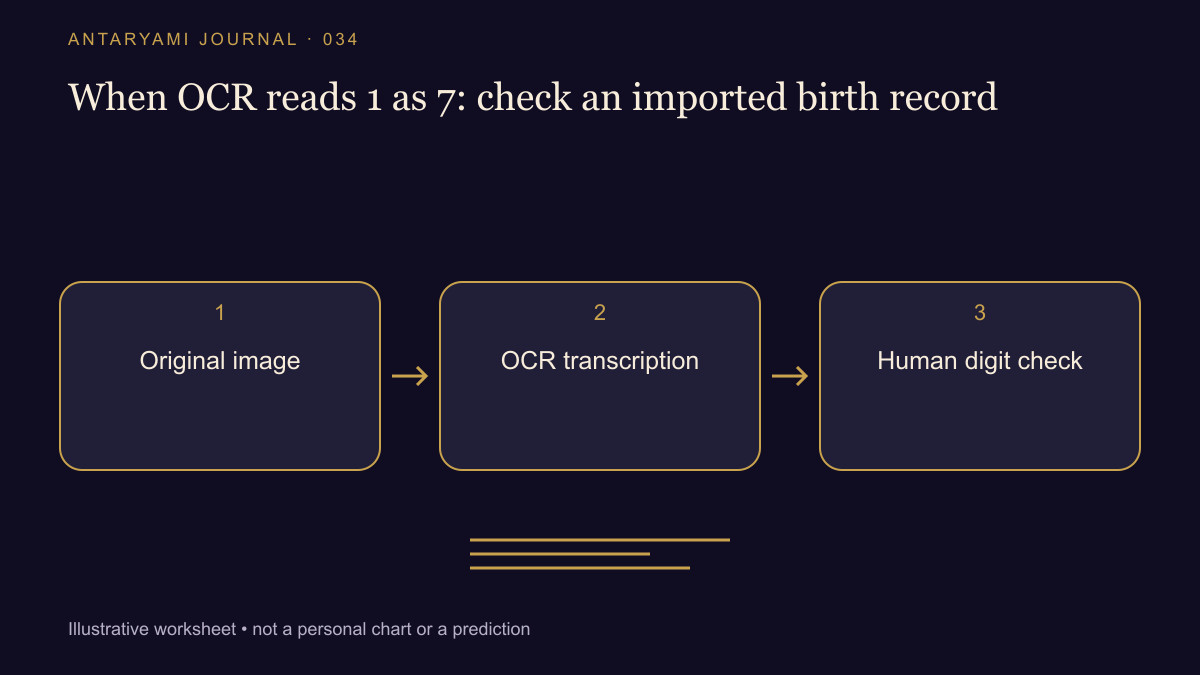
A scanned note contains a narrow handwritten 1. An automatic transcription reads it as 7, changing a time from 01:20 to 07:20. The extracted text looks tidy and can be copied into a form without a warning. This fictional example shows why optical character recognition is a transcription aid, not proof that every extracted birth detail matches the original.
Compare one field at a time
Put the source image and extracted field beside each other. Check the event date, time, AM/PM label, place and any calendar or zone notation separately. Looking only for an overall resemblance can miss a single digit that materially changes the interpreted event.
Do not assume the handwritten character is definitely a 1 because the first chart seemed more convincing. The image itself may be unclear. If the character cannot be resolved from suitable evidence, label the transcription uncertain and ask the record owner for clarification through a private process.
Keep the original wording
A transcription should preserve labels such as approximate, after sunrise or registered on rather than reduce everything to a bare number. Removing those words can change the meaning even when the digits are recognised correctly. Keep a source note identifying where the transcription came from and what interpretation was applied.
Avoid posting a full identity or medical document publicly to ask about one character. A carefully redacted excerpt may be sufficient for an appropriate reviewer, but only share what is genuinely necessary and with permission. A convenient troubleshooting route should not expose the rest of a person's private record.
Validate format after checking the image
Format validation can reject impossible values such as 32 November, but it cannot detect every plausible transcription mistake. Both 01:20 and 07:20 are valid clock readings. A successful form submission therefore does not certify that the source image was read correctly.
Once a correction is supported, record the old value, the corrected value and the reason. Then repeat the relevant calculation without changing other settings. This makes the effect of the transcription correction understandable rather than mixing it with a new method, location or interpretation.
Give the review a clear outcome
Mark a field as verified against the source, corrected with stated evidence or unresolved. Those categories are more useful than a vague note that the whole scan was checked. The final aim is not to distrust every imported record. It is to make the small human review that protects an attractive automated result from resting on a misread digit.
Astrological interpretations are for reflection, not a diagnosis, a guaranteed prediction or a substitute for professional advice. Journal guides are prepared with AI assistance; they are educational content, not individual consultations.