 Antaryami
App walkthroughs
Ashtakavarga in Antaryami: read the support map without turning points into predictions
Twelve bars, several colours and a word such as strongest can make a chart feel immediately legible. But strongest in which calculation, and compared with what? Antaryami's Ashtakavarga panel offers a support map with a checkable counting structure. Nitish Raj Walia follows the actual interface here using a fictional adult chart, explaining the combined bars and the separate planet grids without treating either as a forecast. You can appreciate the visual pattern and still ask what a bindu counts. The most interesting fact may be that the combined raw total stays fixed while its distribution across signs changes.
Find the support map beneath the primary chart
Open the Chart section's technical working disclosure and find Ashtakavarga below the Shadbala table. This is a different technique with a different unit. The panel contains twelve bars arranged by house from the selected chart reference, followed by planet-specific rows. Do not read its point count as rupas merely because another strength system sits nearby. An interface can put related instruments together for navigation while keeping their arithmetic separate. The title and unit are your first clues to which question a particular panel answers.
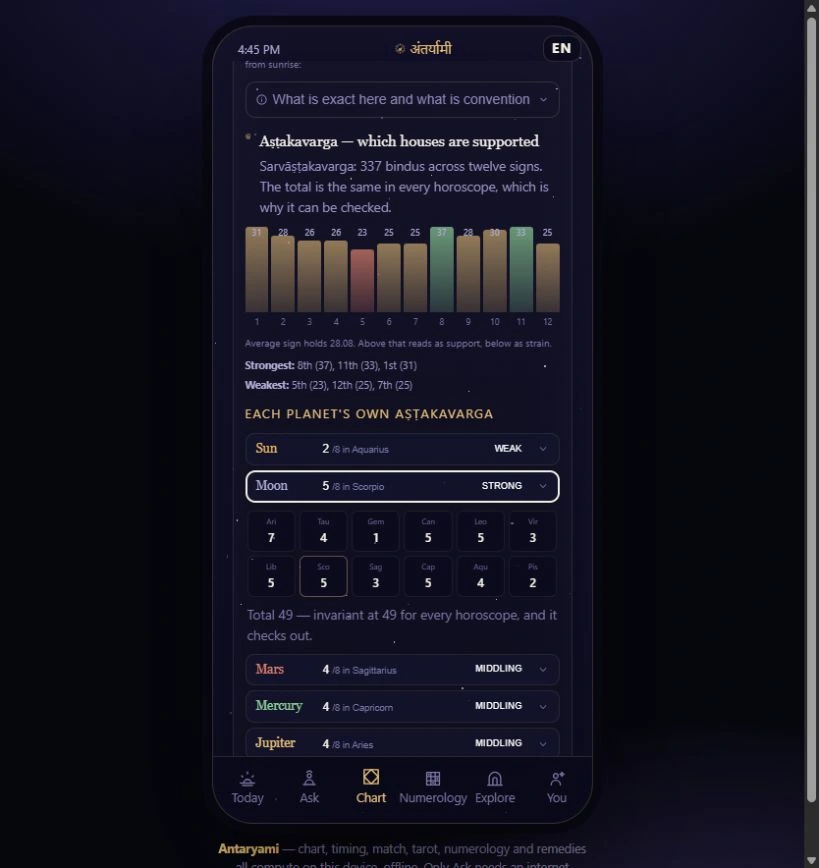
The fictional screenshot keeps the house bars and an expanded Moon row in view. Its colours help you compare positions within this displayed map, not rank the person's value or announce which part of life will succeed. Before discussing a high or low bar, name the house, the point count and the chart setting. That small amount of context makes the observation reproducible. A dramatic caption about an unusually strong chart can obscure all three, leaving a reader with an impression instead of an explanation they can investigate.
A constant total makes a useful consistency check
The inspected raw implementation combines seven planet tables with a total of 337 bindus across twelve signs. Their contributions are allocated from eight reference points under configured counting rules. A different arrangement of chart inputs redistributes the points; it does not give the app permission to invent a larger raw total for a supposedly more fortunate person. This is the counting convention described by the source and this screen. Reduced or otherwise transformed tables need their own labels and should not be silently substituted for this raw presentation.
The reference average displayed by the panel is 28.08, from 337 divided by twelve and rounded. That explains where the comparison line comes from. It does not mean that having an above-average count establishes an above-average chance of a life event. The calculation is internally constrained, and checking that constraint is valuable engineering evidence. It is not independent validation of the traditional meaning attached to the distribution. A correct total answers whether these counts follow the configured structure, not whether a prediction about your circumstances will come true.
A house bar and a sign cell need their own context
The upper chart places combined counts into house order using its chart reference. In the fictional preview, the eighth house carries 37 while the fifth carries 23. Those values are observations of this example's raw map, not public recommendations or personal scores for the reader. The words strongest and weakest describe a comparison within this table. They do not establish that an eighth-house topic will dominate the person's future or that a fifth-house concern must be feared. Keep the comparison confined to the displayed quantity.
The selected ascendant matters when a sign-based distribution is arranged by house. If the birth-time window leaves the ascendant uncertain, the association with house numbers deserves that qualification too. A stable combined total cannot resolve a disputed reference. Similarly, if a product uses a substitute reference because required place information is missing, the resulting display must be read under that stated limitation. It is possible for a counting invariant to hold while the intended personal house frame remains unavailable or provisional. Both facts belong in the explanation.
Five out of eight is a contribution count, not an eighty-point scale
Below the combined bars, selecting a planet reveals a twelve-sign grid for its own table. The inspected Moon row reports five out of eight in Scorpio, and the expanded grid sums to 49 under this configured method. The denominator of eight comes from the reference-point structure; it is not eight possible life outcomes or eight people sampled in a study. Calling the result a sixty-two-and-a-half-percent success chance would import a meaning that this counting operation has not supplied.
The grid also makes a useful distinction visible: the planet's count in its current sign and the planet's total across every sign are different quantities. The example's row highlights one cell, while the note checks the full table. Do not compare a selected cell directly with the combined house bar as though both numbers had the same denominator. Read what each view counts, then ask how they are related. The interface rewards this slower approach because you can return from the summary to an actual distribution instead of trusting a single favourable or unfavourable word.
Inspect an interesting bar without inventing an event
- Name the displayed unit as bindus and identify the selected reference.
- Check the combined raw total separately from its distribution.
- Open one planet row and distinguish its highlighted cell from its full total.
- Keep interpretations labelled instead of converting point ratios into event odds.
Choose one bar that stands out and describe it literally. You can say that this example has a particular raw count in a particular house under the selected reference. Then open a planet row and compare its sign cells. That gives you a practical tour of the support map without requiring an event prediction. If you want to explore traditional interpretation, keep that next step explicitly labelled as interpretation. Do not turn a low count into a diagnosis, a fertility assessment or a warning that someone is unsafe to marry.
Neither a high point total in one location nor a changing transit context is a substitute for financial, medical or legal advice. The actual resources, relationships and obligations in a person's life remain outside this counting grid. A thoughtful use of the panel is to understand its method and examine a symbolic question without assigning it decision-making authority. You can stop when you have learned how a bar relates to its underlying table. There is no need to keep searching until the app appears to approve a choice you already wanted to make.
Use the map to understand the product, not to grade yourself
This actual-source preview introduces one part of Antaryami's calculation working with fictional adult inputs. It does not verify live paid access, a store download or an online engine's delivery. Those questions need the current official product and account information. What the screenshot does show is the instrument's visible organisation: combined bars, individual grids and explicit counting notes. You can inspect a mathematically structured feature while remaining honest about what the mathematics establishes and what it does not establish about a human life.
Through the Antaryami Journal, Temior Technologies Pvt Ltd wants an interested reader to see the working behind an attractive exhibit. Ashtakavarga becomes approachable when a point has a named origin and a table has a stated reference. The discovery is not that your life can be reduced to twelve bars; it is that a traditional technique can be presented in a form you can question. Leave with that distinction intact. Consistent counting is worth checking, and a symbolic interpretation is worth considering only within its disclosed limits.
Check what the points actually count
Does five out of eight mean my chance is 62.5 percent?
No. Eight is the number of reference points in this contribution structure, not the denominator of a measured event probability.
The total is correct, so the interpretation is proven
The invariant checks consistency of the configured raw table. It does not independently verify a claim about a relationship, health issue or future event.
Astrological interpretations are for reflection, not a diagnosis, a guaranteed prediction or a substitute for professional advice. Journal guides are prepared with AI assistance; they are educational content, not individual consultations.


