 Antaryami
App walkthroughs
Shadbala in Antaryami: understand six strengths instead of chasing one impressive number
You read that a planet is strong, then another part of a chart sounds less encouraging. Has something gone wrong? Often the two passages are answering different questions. Antaryami's Shadbala panel makes one specific strength calculation inspectable through units, requirements and expandable components. Nitish Raj Walia opens its actual preview here with fictional adult details, showing how to read the quantity before adopting an interpretation. The benefit is not a grander score for your personality. It is being able to ask what this particular number measures, where it came from and why it should not replace every other part of a reading.
Open the technical layer only when your question needs it
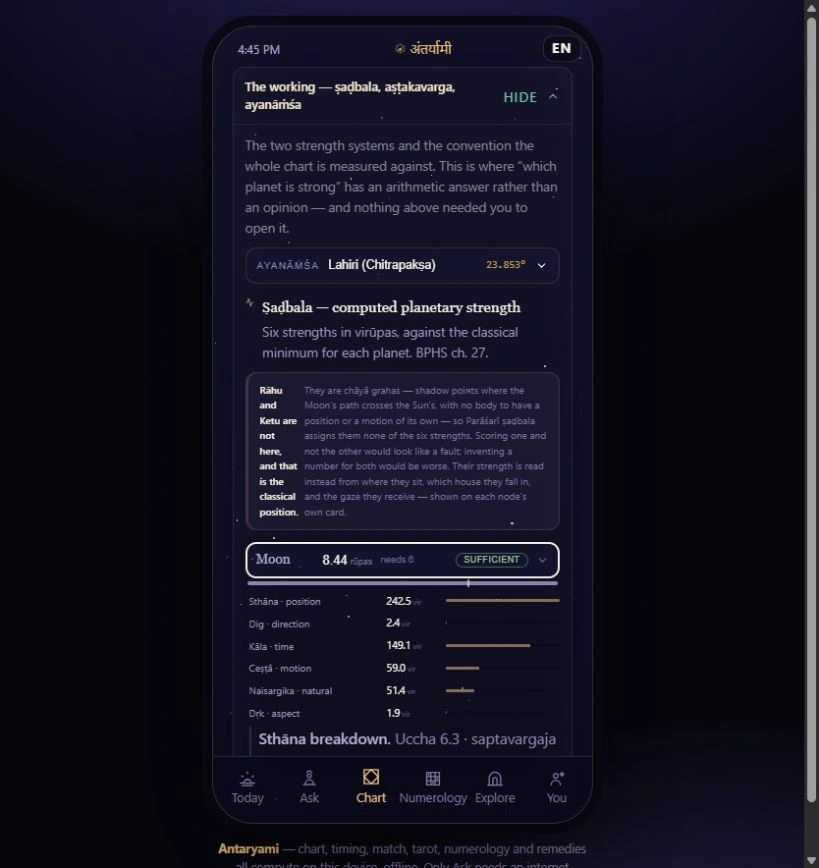
The inspected Chart section keeps its main placement reading separate from a disclosure labelled with Shadbala, Ashtakavarga and ayanamsa. Opening that disclosure reveals the technical panels. You do not need to memorise them before using the primary chart. This arrangement lets a beginner start with a selected planet and later investigate a measurement that interests them. A detailed interface becomes more approachable when the first task is to locate one relevant quantity rather than understand every row in the same sitting.
The Shadbala table shows seven planet rows, each with a computed value, a stated requirement and a sufficient-or-below label. The panel does not score Rahu or Ketu in this system; their absence is explained rather than concealed behind invented values. That is a product convention worth noticing without turning the omission into a judgement about the importance of those points elsewhere. Different techniques can include different participants. Read the title of the table before assuming it is intended to supply a universal nine-body ranking.
Rupas and virupas name quantities, not chances of success
In the inspected implementation, the six component quantities are combined in virupas and divided by sixty to express the total in rupas. The expanded row uses the smaller unit for its components, while the main row shows the total in rupas. Keeping those labels attached explains why the component numerals can look much larger than the total. A component reporting a few hundred virupas is not mysteriously more powerful than a total near eight rupas; you are looking at different units in a connected calculation.
The fictional Moon row displays 8.44 rupas against a requirement of six. That comparison means the calculated quantity exceeds the selected threshold in this example. It does not mean that the person has an 8.44 personality rating, a guaranteed favourable Moon experience or a particular probability of success. If a related screen expresses the value as a percentage of its requirement, identify that denominator explicitly. A ratio to a reference quantity can exceed one hundred percent without becoming an outcome probability.
Read the requirement beside each row, not the longest bar
The requirement is not identical for every planet in the app's configured table. For example, the inspected source assigns five rupas to the Sun, six to the Moon and seven to Mercury, with separate values for the other scored planets. This means a raw-value ordering and a comparison against requirements are different operations. A planet can have a longer bar than another and still need a different quantity under the convention. Look at the row's unit and requirement before deciding what its visual prominence means.
The bars are also scaled for the panel's presentation. Their lengths are not a universal probability scale carried into every other instrument. A useful reading habit is to say what you actually see: this row reports a quantity above its listed requirement, or this component contributes a stated amount. Do not expand that into a claim that every subject associated with the planet must work out well. A calculated strength figure does not independently evaluate relationships, finances, health or the opportunities a person has in real life.
Follow one component before trying to interpret the total
Selecting a planet opens six labelled rows: position, direction, time, motion, natural strength and aspect. The inspected Moon example makes those components visible together with further breakdowns. Pick one and ask which inputs it uses. Position includes several configured subcalculations; time includes context tied to the birth setting; aspect uses its own contribution arithmetic. These are distinguishable parts of the implementation. Their presence allows you to examine the calculation rather than treating the total as an unexplained instruction from the app.
You may notice that the component values are not all similar in size. That is not automatically a bug, because their configured ranges and contributions differ. Nor should you rename a larger value as the person's dominant trait. The panel is about a planet within this chart system, not an inventory of observed behaviour. If you want to investigate a surprising result, keep the component label and units in your question. Specific wording makes a source check possible; a vague request to explain why someone is weak often confuses the quantity with a judgement about the person.
Inspect the caveats before calling the calculation exact
- Read the total unit and the requirement on one selected row.
- Open a component and follow its stated inputs or breakdown.
- Compare quantities only after checking their units and denominators.
- Read the convention disclosure before discussing precision or reliability.
Below the rows, a control explains what is exact here and what is convention. The inspected source explicitly labels its motion-strength treatment as an eight-state convention rather than the classical chesta-kendra arithmetic requiring a mean-motion model the offline engine does not carry. Other notes identify assumptions and dependencies. Opening this disclosure is part of evaluating the instrument. Showing six rows does not establish that every historical formulation or every other astrology program would calculate them through an identical process.
The app preview also identifies an offline position source elsewhere on the Chart screen. A Swiss Ephemeris licence should not be used to claim that this particular preview has silently replaced that source or independently validated every downstream interpretation. Keep the runtime label, the calculation convention and the human meaning separate. If a required input is absent, read the reported limitation rather than filling it with a reassuring guess. Transparent omissions and qualifications are useful information, even when a complete-looking table would be easier to advertise.
A better explanation leaves room for several kinds of strength
Shadbala, sign placement, a house-model assessment and current period activation are not interchangeable grades. The same planet can be described differently across those techniques because they inspect different relationships within the chosen framework. That does not make every disagreement a defect, and it does not remove the need to examine genuine inconsistencies. Start by checking that two passages actually describe the same quantity. Only then ask whether their arithmetic or wording disagrees. This keeps a technical discussion from becoming a contest between impressive-looking numbers.
Antaryami from Temior Technologies Pvt Ltd can introduce that distinction through an inspectable table rather than demanding trust in a single adjective. This guide shows the real preview, not proof that your account has an active plan or that a connected service is available. Use the official app pages to verify those details separately. The useful next step is modest and clear: find one strength quantity, understand its requirement and read its limits. You can leave with better understanding without adopting the table as a scoreboard for your life.
Keep the strength statement specific
The component numbers look bigger than the total
Check the units: components use virupas, and sixty virupas make one rupa in the inspected calculation. Compare like units before interpreting their size.
Sufficient must mean every outcome will be good
Sufficient compares this calculated quantity with its listed reference requirement. It does not certify a life outcome or override other calculation layers.
Astrological interpretations are for reflection, not a diagnosis, a guaranteed prediction or a substitute for professional advice. Journal guides are prepared with AI assistance; they are educational content, not individual consultations.


