 Antaryami
App walkthroughs
Ask in Antaryami: carry the right context into a better question
What does this mean? is a natural question, but this can refer to a planet, a transit, a tarot card or a numerology result. An answer that loses that context can sound helpful while explaining the wrong thing. Antaryami's inspected source includes contextual Ask routes that carry a named source from the feature into the conversation. Nitish Raj Walia explores that design here and offers examples of clearer questions. This walkthrough does not claim the offline preview has delivered a live AI answer. It explains the interaction while keeping server availability, privacy and interpretation separate from the appeal of a conversational screen.
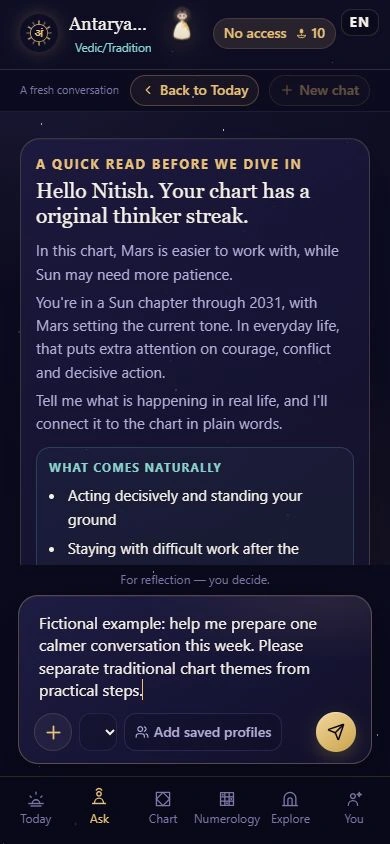
A contextual button has a more specific job than opening an empty chat
Several inspected features offer an Ask Antaryami action near the result being viewed. The source includes context categories for chart planets, current transits, numerology detail, life areas, tarot and timing material. The purpose is to identify what the person asked to have explained. A normal typed question does not automatically receive every contextual allowance. This is a useful distinction because a current transit, a second chart and a natal placement should not all be treated as facts from the same birth chart simply because they appeared somewhere in the app.
The individual screenshot documents a fictional adult composer or context state, not a customer's question or a live answer. Read the visible source label when present. If you opened the conversation from a selected Mercury card, your question can ask about that card without pretending you meant today's Mercury transit. The source is a guide to interpretation, not a guarantee that an answer is correct. It helps establish what should be discussed, while the quality and availability of the response still need their own verification.
A focused question is easier to evaluate
Instead of asking whether your chart is good, ask what the selected house means, how its ruler differs from an occupant or which part of a paragraph is interpretation. Those questions have a clear focus. A useful explanation should identify the relevant method and remain within the supplied context. You can then compare it with the visible instrument. A broad request for a verdict on your life is harder to evaluate and invites a sweeping answer that may feel personal without showing what information supports it.
For a timing question, distinguish the calculated window from a promised event. For numerology, name the system and number role. For tarot, identify whether you mean one revealed card or the whole spread. These small details help preserve the feature's own boundaries instead of blending several symbolic systems into one confident story. You do not need a complicated prompt; one question with the right context is enough to begin. If the response introduces facts that were never supplied, treat that as something to check rather than as proof of extraordinary insight.
Conversation should not make the instrument disappear
The inspected Ask interface can show a Back to source control when the conversation was launched contextually. That gives you a way to revisit the feature and check the labels while reading an explanation. It is useful because a paragraph can become persuasive when separated from the small detail it began with. Returning to the instrument helps you ask whether the answer referred to the correct profile, division, method or date. The navigation is part of an inspectable workflow, not merely a way to spend longer in chat.
The interface also includes previous-conversation and new-chat controls. Their presence does not mean every historical result is part of the current question. Read the current context before relying on a previous answer, especially after changing a profile. A family member's selected chart does not establish the signed-in user's identity or age. The guide has not exercised live history storage or deletion. It explains the source's separation of context and conversation so readers can understand what they are opening rather than assume every visible message belongs to the same person and moment.
An offline feature tour is not a successful server response
The source explicitly distinguishes local calculations from Ask routes that need a server. An offline preview may let you inspect a chart or prepare a question while being unable to reach the answer service. This walkthrough does not send a request to a live provider or verify its model, cost, latency or answer accuracy. A disabled action or unavailable message should remain visible rather than being replaced with a demonstration answer presented as live. A polished composer is not evidence that the complete conversation workflow is operational.
Before using a real service, check the current access requirements, displayed charges where applicable and relevant privacy choices. Do not infer that a website registration or a preview screenshot grants a working app entitlement. The founder's website and app plans have their own release checks. A useful experience centre can show how the intended interaction is organised while being candid about what is verified. This is more informative than letting a visitor assume that every button in a source-guided tour has already completed its backend task successfully.
A good question should leave you able to inspect the answer
The source review confirms contextual categories, feature-specific prompts and return navigation. It does not certify live AI availability or the accuracy of a response that has not been received and evaluated. The screenshot uses fictional adult data and contains no customer's conversation. Official access and service readiness must be confirmed separately. This scope keeps the article honest while still showing an important product idea: an explanation should know which instrument the reader is asking about, and the reader should be able to return to that instrument.
Antaryami, presented by Temior Technologies Pvt Ltd, can make detailed traditions more approachable through conversation when the underlying context remains clear. You may leave this guide with a better question rather than a dramatic answer. That is useful progress. A question about a method, placement or limit gives you something to verify, while a general promise about life gives you little to inspect. Keep the source visible, the disclosure proportionate and your judgement active. The conversation should help you understand the tool, not ask you to stop asking how its answer was reached.
Choose a question with a checkable focus
What is better than asking whether my chart is good?
Ask what a selected label means, which rule produced a value or how interpretation differs from calculation. A specific question lets you compare the answer with the visible source rather than accept a broad life verdict.
Does seeing the Ask composer prove the live service works?
No. The inspected source separates local calculations from a server-dependent answer route. This guide verifies interface structure, not a successful live provider request or its response quality.
Astrological interpretations are for reflection, not a diagnosis, a guaranteed prediction or a substitute for professional advice. Journal guides are prepared with AI assistance; they are educational content, not individual consultations.


