 Antaryami
App walkthroughs
D12 in Antaryami: explore family inheritance without treating it as a genetic record
Some things arrive from family as objects. Others arrive as habits: how disagreement is handled, what counts as success, whether rest needs to be earned. Antaryami includes Dvadasamsa, labelled D12, with a traditional theme of parents and inheritance. Nitish Raj Walia examines the inspected calculation here without turning that theme into a genetic test, an estate document or a judgement of your parents. The interesting opportunity is to understand the instrument and ask which inherited practices you want to keep. A family story can influence you without becoming a script you are obliged to perform.
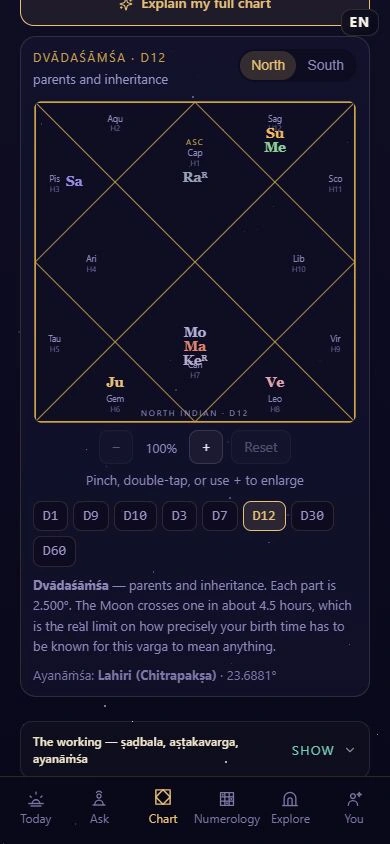
D12 is a particular division, not the whole family story
Open the divisional panel within Chart and select D12. Its name and theme should be read before its planet labels, especially if the page contains another chart higher up. A choice in this panel changes this panel's mapped data. It does not establish that the whole app is now interpreting parents, and it does not change the factual record used as the starting point. Select a house only after confirming the current division so that the detail you read belongs to the intended view.
The layout switch is separate from the division switch. North and South provide ways to inspect the same mapped placements; neither arrangement adds family evidence. An enlarged diagram may help you identify a symbol, but its visual size is not a measure of interpretive certainty. When you save notes about the view, record D12 and the uncertainty of the original inputs. That gives a later conversation a useful reference instead of leaving somebody to guess which beautiful chart an earlier comment was describing.
Follow the two-and-a-half-degree rule
The D12 implementation divides a thirty-degree sign into twelve portions of two and a half degrees. It starts counting mapped signs from the supplied sign itself, advancing by the portion index. That is a deterministic transformation of sidereal longitude. A supplied position six degrees into a sign sits in the third portion, because the portions begin at zero, two and a half, and five degrees. The result explains a compartment in the divisional diagram; it does not explain a biological mechanism transmitting a family trait.
This distinction prevents two kinds of confidence from being blended. You can check whether the rule was applied consistently without claiming the resulting symbolism has been validated as a description of your relatives. The positions can also depend on birth-time and calculation choices near a boundary. A finer partition does not repair an approximate source record. Treat this article as an explanation of Antaryami's selected implementation, rather than as an assertion that a single mapping settles every historical or interpretive question surrounding family astrology.
Notice a pattern before deciding what it means
Imagine that money conversations in your family usually end in silence. You may recognise that habit without knowing why it began. A family-themed chart can prompt a question, but your observations are what establish the pattern: who speaks, when the silence appears and what happens afterwards. Write down a specific interaction rather than announcing that your lineage carries a fixed block. Specificity leaves room for context and change; a sweeping explanation can make everyone feel trapped in a story that was never properly examined.
You could then try a different approach, such as agreeing on a calm time to discuss one shared expense. That action has a purpose independent of a placement. If it helps, the practical improvement is worth keeping without claiming the chart caused it. If it does not, reconsider the communication and circumstances rather than assuming the family theme has become stronger. The instrument is most constructive when it encourages attention to real patterns while leaving the explanation open to what people actually tell you about their experiences.
Understand influence without creating a family ranking
The product's traditional association with parents does not make D12 a tool for awarding a good-parent or bad-parent grade. People can carry affection, disappointment and gratitude at the same time. A diagram cannot settle those feelings or verify another person's motives. If you use this lens for reflection, keep the question close to your own experience: which expectations shaped my decisions, which support mattered and which boundaries do I need now? That is different from claiming a planet proves what a parent intended.
There may also be family experiences that are painful to revisit. You are not required to turn them into a spiritual lesson to use an astrology product respectfully. Pause if an interpretation becomes distressing, and seek appropriate support when needed. Do not let symbolic language excuse harmful conduct or discourage protective decisions. The family theme can provide a starting vocabulary, but it cannot replace listening, accountability or professional help. A thoughtful guide should give readers permission to set the instrument down as readily as it invites them to explore it.
Keep legal and biological questions with the right evidence
- Name a family pattern through a concrete interaction, not a sweeping label.
- Distinguish symbolic inheritance from genetic evidence and legal rights.
- Choose one inherited habit to retain, revise or release thoughtfully.
- Keep the original input certainty and D12 label alongside any chart note.
Inheritance in an astrological theme can be broad and symbolic. Legal inheritance concerns actual rights, documents and applicable law; genetics concerns biological evidence. Neither is established by this D12 panel. Do not make an estate decision, accuse a relative about parentage or claim a hereditary condition from a mapped sign. A precise-looking degree is still a chart input, not a substitute for the records or qualified advice required by those questions. The same word appearing in two fields does not make their evidence interchangeable.
For an everyday exercise, separate three lists: what you were given materially, what you learned through repeated behaviour and what you choose to practise now. You may discover that the third list is where your agency becomes most visible. D12 can accompany that reflection without certifying the first two lists. Keep private family documents in suitable authenticated or professional channels, not public article comments. This walkthrough does not require anyone else's details to teach the mapping or to encourage a more deliberate relationship with the habits you have inherited.
Your next action need not repeat the previous generation
The verified source shows the D12 rule and its place in the divisional controls. It does not demonstrate a service that authenticates ancestry or verifies family history. The individual preview screenshot uses fictional adult information and should be read as product documentation. Store availability, personal access and any consultation are separate matters requiring current confirmation. These limits are not reasons to make the interface less interesting; they are reasons to tell the reader clearly what kind of interest the instrument can support.
Antaryami, by Temior Technologies Pvt Ltd, can offer a place to examine an old vocabulary with a clearer view of its calculation. The valuable question here is not whether your family has assigned you a destiny. It is which influences you recognise and how you want to respond to them. You can honour a useful tradition, change an unhelpful habit and leave an uncertain interpretation unresolved. A good encounter with D12 ends with greater room for choice, not a longer list of family labels everyone is expected to obey.
Separate a family theme from a factual claim
Does an inheritance label tell me who owns a family asset?
No. Ownership and inheritance rights need the relevant documents and qualified legal advice. The D12 panel displays a traditional chart theme, not an estate determination.
How can I use this reflection without judging my parents?
Describe a habit you experienced and the response you choose now. Keep motives and family facts open to real conversations rather than treating a placement as evidence about another person.
Astrological interpretations are for reflection, not a diagnosis, a guaranteed prediction or a substitute for professional advice. Journal guides are prepared with AI assistance; they are educational content, not individual consultations.


