 Antaryami
App walkthroughs
The fifth house in Antaryami: make room for learning, creativity and play
Not everything worth doing needs to become a business, a competition or a public achievement. Writing a song, teaching a skill and enjoying a game can matter because of the experience itself. Antaryami's fifth-house language brings creativity, learning, affection and play into a traditional theme. Nitish Raj Walia explores the inspected control as an invitation to understand those labels and choose a small project. The chart is not a ranking of intelligence, a promise of romantic success or a prediction about children. Its most useful contribution may be giving you a question you had forgotten to ask.
Find house five before borrowing meaning from a planet
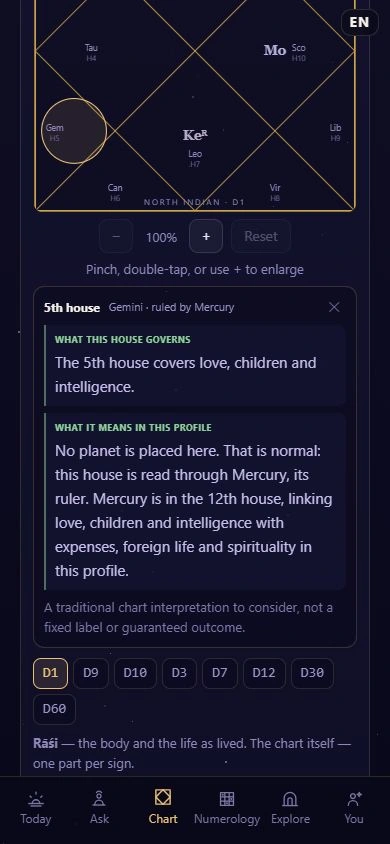
In the D1 divisional panel, choose the fifth house and read the detail beneath the diagram. It identifies the sign and ruler, states what the house covers and then describes the occupants or ruler connection in the selected example. This order gives the life theme a visible source. A beginner can see why an interpretation mentions creativity rather than assuming a planet abbreviation explains itself. Keep the selected division in view because the same numeral in another mapping belongs to a different chart context.
The image uses fictional adult information, and its arrangement should not be treated as a reader's personal creative profile. You can learn the controls without entering a private project, a child's details or a romantic history into a public channel. The North and South options rearrange the same mapped data rather than deciding which artistic path is correct. If you need a closer view, enlargement serves readability. It does not supply more evidence for an interpretation simply because the diagram now occupies more of the screen.
Read the theme as a vocabulary, not a list of promised events
The inspected fifth-house guide groups romance, children, education, intelligence, creativity and play. These are traditional associations used by the product, not measured outcomes for the person opening it. A title mentioning intelligence is not an IQ result. A romance theme does not establish that someone will return your feelings. A children theme does not predict pregnancy or any characteristic of an unborn child. Keeping these boundaries clear lets the vocabulary remain interesting without turning broad human activities into conclusions the instrument never verified.
The common reflective question can be what you enjoy creating or sharing. One adult may feel alive while explaining a difficult idea; another may prefer gardening or making music. Their experiences are specific and need not compete for a better placement. If the theme prompts curiosity, begin with an activity you already care about. The chart can accompany that curiosity while your interest, circumstances and practice provide the relevant evidence. This keeps an expansive traditional category from becoming an instruction that every reader must pursue the same kind of life.
A project can be small enough to start today
Suppose you want to draw but keep waiting to know whether you are naturally gifted. A useful experiment is one page, one subject and a short amount of time you can realistically give it. The result tells you what you enjoyed and what you might practise next. A fifth-house interpretation cannot establish your artistic ceiling, and an empty compartment is not a reason to refuse the experiment. The feature is more helpful when it starts a conversation about attention than when it becomes a gatekeeper deciding whether you are allowed to try.
Choose a purpose that does not depend on applause. You might want to understand colour, finish a family story or make something a friend would enjoy. Define what completion looks like for this first attempt. That makes the activity manageable without reducing enjoyment to a score. If the project changes direction, let the change reflect what you learn rather than assuming you violated a chart. Creative work can contain uncertainty, revision and play; none of those is evidence that a traditional theme was wrong about your worth.
Do not let a symbolic intelligence theme become an educational verdict
People learn under different conditions, with different interests and opportunities. The fifth-house panel cannot diagnose learning needs, assess a child's abilities or determine who deserves an educational opportunity. If you use the theme while planning your own study, ask what would help you engage: clearer explanation, repetition, feedback or a realistic schedule. Those questions can be answered through experience and suitable teaching. A chart-based claim about intelligence would add a label while leaving the actual learning conditions unexamined.
Teaching also involves listening rather than only delivering information. If you are helping another person, check what they understand and what they want to learn instead of announcing that their chart makes them a certain kind of student. You do not need their birth record to explain a skill. The product's theme can remind you of the pleasure of sharing knowledge, but the learner's responses should guide the interaction. Respecting that distinction makes the instrument relevant to human learning without giving it authority over someone else's educational future.
Keep relationships and family questions outside a guaranteed forecast
- Choose one creative task small enough to complete without outside approval.
- Treat intelligence wording as a traditional theme, not a measured ability.
- Let actual learners and partners speak for themselves.
- Keep pregnancy and future-child predictions out of a symbolic house reading.
Romantic or family language can sound especially persuasive when tied to a personal chart. This guide does not use the fifth house to predict a partner, guarantee conception or assign a future child's traits. Affection involves real people whose choices and consent cannot be read from a selected profile's compartment. If the theme helps you reflect, ask how you express care, enjoy shared time or make room for another person's interests. Those questions preserve agency instead of turning someone else's response into an event the chart owes you.
The ruler and occupants contribute traditional placement text, but they do not create verified evidence about another person. Follow the ruler in the same division and retain the input's certainty label. The panel can explain an empty house through its ruler, so absence of a planet is not absence of love or creativity. Read the mechanics before forming a large conclusion. A useful fifth-house visit should widen the kinds of enjoyment and learning you consider, not make the diagram responsible for supplying a particular romantic or family outcome.
The instrument can open a door without deciding what is behind it
The app-source review establishes the fifth-house vocabulary and its selectable explanation. It does not establish a validated intelligence test, relationship forecast or reproductive service. The individual screenshot is a fictional adult example, not a report about a customer's abilities. Access and feature readiness must be checked through the current official product. By keeping the educational purpose clear, this guide can introduce an appealing instrument without implying that every traditional topic has become a verified capability for personal prediction.
Antaryami, from Temior Technologies Pvt Ltd, can be a place to explore traditional ideas with enough explanation to make the controls understandable. For this theme, the practical result might be permission you give yourself to enjoy a modest project. You can write, play, teach or practise without proving that you possess a favourable chart. The instrument contributes a language for curiosity; you contribute the activity and its meaning. That leaves creativity where it belongs: open to participation, revision and pleasure rather than reserved for people whose diagrams appear to promise it.
Keep creativity open to participation
Can a fifth-house placement decide whether I am intelligent?
This panel is not an intelligence assessment. Learning and educational needs require direct evidence and appropriate support; a traditional theme should not become a ranking of ability.
What can I do if I feel creatively stuck?
Choose a small activity with a clear finish, such as one sketch or one paragraph. Notice what you enjoy and what needs practice, without waiting for a chart to certify talent.
Astrological interpretations are for reflection, not a diagnosis, a guaranteed prediction or a substitute for professional advice. Journal guides are prepared with AI assistance; they are educational content, not individual consultations.


