 Antaryami
App walkthroughs
Show me the working: understand Antaryami Life without mistaking numbers for probabilities
A number can look reassuring before you know what it measures. Put it beside an elegant chart and it can become even harder to question. Antaryami's Life feature has a useful counterweight: the working can be opened. This article by Nitish Raj Walia follows that disclosure in a fictional adult preview, looking at units, inputs and model choices rather than treating every visible figure as a prediction. You do not need to become an astrologer to ask whether two quantities are comparable. Begin with the label, then the arithmetic, and only then the interpretation the app places around it.
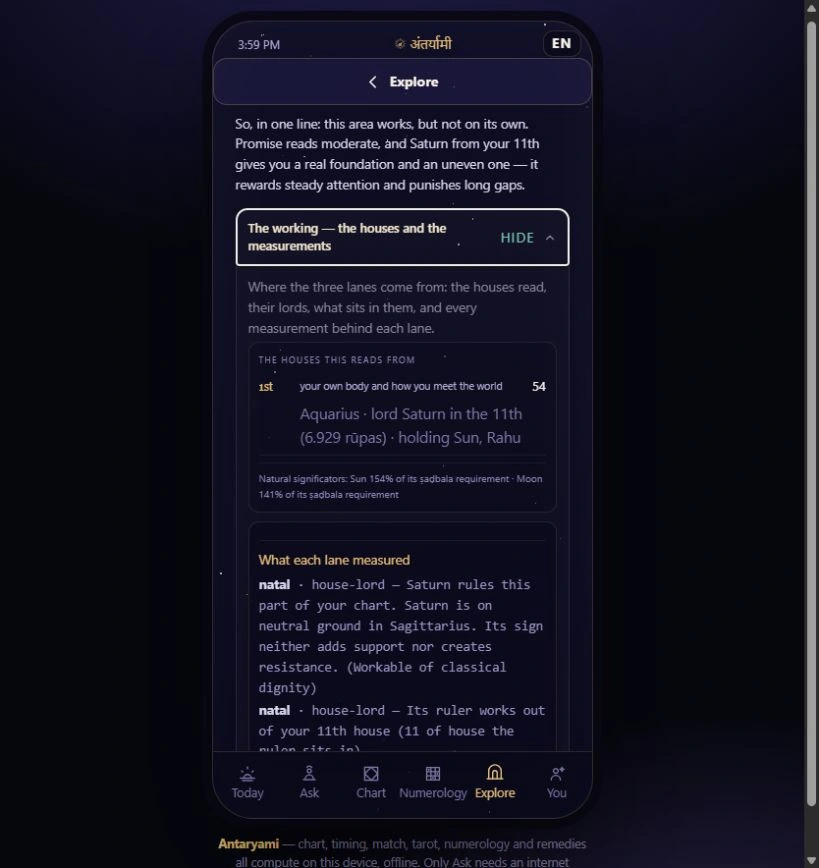
Ask what the quantity is before asking whether it is good
The expanded working includes several kinds of information: house identifiers, a ruler's location, a strength quantity, support points and adjustments selected by the app. Those entries are not all on the same scale. A house number tells you which compartment of the model is being considered; it is not a ranking. A strength value expressed in rupas is not a percentage of career success. A point total from a different technique needs its own explanation rather than borrowing the meaning of a nearby number.
Read one row aloud with its noun attached. Instead of saying a planet has seven, say that the table reports a particular strength quantity in the stated unit. Instead of saying the house has fifty-four percent, describe fifty-four as the displayed house-model score if that is what the row actually labels. This habit may feel unusually careful at first, but it prevents a very common mistake: converting a mathematical-looking result into a likelihood that the interface has never calculated or independently validated.
Follow the fictional arithmetic without adopting its result
In the inspected basic-make-up example, the house working starts with 76, applies occupant adjustments of minus 12.5 and aspect adjustments of minus 9.2, then displays a rounded result of 54. The unrounded subtraction is 54.3. The important lesson is not that fifty-four means something about you; these values belong to the demonstration profile. It is that a visible result can be traced to earlier components and rounding rather than being accepted as an unexplained score from nowhere.
Checking that subtraction does not validate the weights or prove the interpretation. The app itself identifies the occupant and aspect adjustments as model choices. You can therefore separate three checks: whether the arithmetic follows the shown inputs, whether the convention is clearly labelled, and whether its interpretation deserves confidence for the purpose you have in mind. Passing the first check cannot silently settle the other two. This is especially important when a reader is tempted to make a consequential choice because a score appears exact.
A requirement comparison is not an outcome percentage
The disclosure also compares a planet's strength quantity with that planet's stated requirement under the selected tradition. The fictional example shows a Sun value expressed as 154 percent of its requirement. That is a ratio between a computed quantity and a reference threshold. It does not mean a person has a 154 percent chance of succeeding, nor does it give the planet unlimited authority over every topic. The denominator matters: a share of a requirement and a probability of an event are entirely different statements.
This helps explain why apparently strong arithmetic can coexist with a qualified interpretation. A strength measure, sign condition, house location and current period describe different parts of the app's assessment. You should not erase one because another has a larger-looking numeral. Follow the stated technique and its role in the relevant lane. If the app cannot produce a component, absence of that component is not permission to insert a favourable default. A clear account of missing information is more useful than a complete-looking table assembled from guesses.
Understand the confidence label within its actual scope
Life uses confidence words to describe agreement among its available lines of astrological evidence. The expanded explanation tells you why a label was assigned. That is a model-internal relationship, not a published clinical study, a measured forecast-accuracy rate or proof that the techniques are statistically independent. Read the reasons rather than assuming that a phrase such as broad agreement certifies the outcome. Several components can converge within a chosen framework while the framework itself remains an interpretive tradition.
A quieter confidence label should not be read as an insult or an alarming diagnosis. It can indicate disagreement or limited contributing evidence. Likewise, a stronger label does not remove uncertainty in the supplied birth details. The profile's input quality and the model's internal agreement are separate questions. When you compare two screenshots, compare their conventions and inputs as well as the badge. Two labels from different calculation settings may not be evaluating exactly the same evidence, even if the colour and typography look familiar.
Trace one claim all the way back to its context
- Identify the unit or reference threshold attached to a number.
- Trace one row through its inputs and rounding.
- Distinguish internal method agreement from externally tested reliability.
- Bring unresolved conventions back as precise questions, not invented conclusions.
Choose a sentence that interests you and locate the relevant lane beneath its heading. Open the working and find the contributing house information. Identify the sign, its ruler, any occupants and the displayed measurements without trying to infer hidden causes. Then return to the sentence. Does its wording make clear that it is a traditional interpretation? Is the subject actually the one you came to explore? This round trip is more informative than scanning the page for the highest figure and treating it as the final answer.
You can disagree with a weighting, find a phrase unhelpful or need a term explained. Keep those responses specific enough to be investigated. Record the label and the calculation setting, not somebody else's private birth details or a dramatic fragment divorced from its qualifications. A useful support question might concern how the app arrived at an aspect adjustment. That is different from asking for certainty about an event. The first question has an inspectable implementation; the second exceeds what showing this arithmetic can establish.
Keep calculation precision separate from life certainty
Astronomical coordinates can be supplied by a named calculation engine, while the subsequent assessment still contains interpretive choices. An engine name does not certify every sentence produced downstream. Check the actual method label in the product state you are using; this fictional preview is not evidence that every Life component is executing a licensed astronomical engine online. The useful promise of a working disclosure is transparency about the inspected process, not an automatic promotion of traditional interpretation into a scientifically established forecast.
Through Antaryami, Temior Technologies Pvt Ltd is building an experience where detail can be inspected without overwhelming the first screen. That only works when the detail remains honestly labelled. The website can introduce the working, and the app can organise it for the selected profile, but your own judgement still has a role. Close this guide with one habit: whenever a figure sounds impressive, ask what exactly it counts or measures. That question protects both an interested beginner and an experienced reader from reading more into the number than it actually says.
Read the quantity, not the impression
A value exceeds one hundred percent
Inspect its denominator. A quantity expressed as a share of a traditional requirement can exceed one hundred; that is not a probability of an outcome.
The calculation adds up, so the prediction must be true
Correct arithmetic establishes consistency with the shown inputs. It does not independently validate the chosen weights, interpretive convention or forecast.
Astrological interpretations are for reflection, not a diagnosis, a guaranteed prediction or a substitute for professional advice. Journal guides are prepared with AI assistance; they are educational content, not individual consultations.


