 Antaryami
App walkthroughs
Lo Shu in Antaryami: a missing digit is not a missing human quality
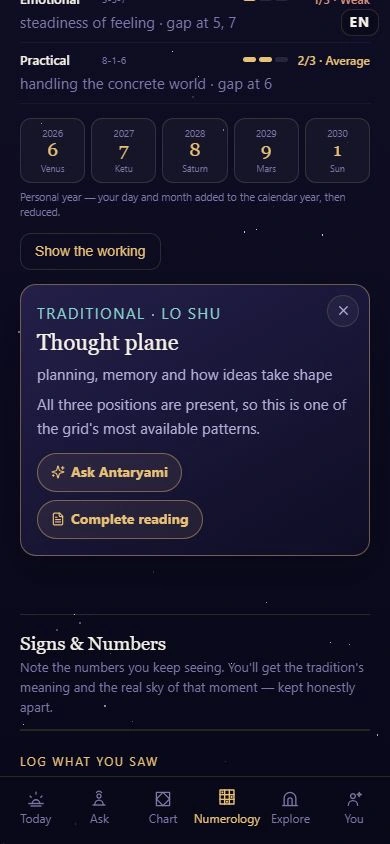
An unfilled square can look more worrying than it deserves. In a numerology grid, missing usually describes the presence of a digit under a rule; it does not demonstrate that a person lacks kindness, intelligence or willpower. Antaryami's Vedic/Traditional screen includes a Lo Shu grid and selectable plane explanations. Nitish Raj Walia follows the inspected implementation to show what goes into the grid and how its counts are displayed. The practical purpose is to understand the model without letting a few empty cells become a list of personal defects you must spend your life correcting.
Lo Shu is one component, not the whole Traditional method
Choose Vedic/Traditional within Numerology and locate the Lo Shu grid. The screen also contains Chaldean-related number roles and an Eight Mansions Kua role, so the umbrella tab name should not make those systems identical. The grid has its own arrangement and rules. Beneath it, plane rows can open method-labelled details. The fictional adult capture documents this component and its selected explanation, rather than assessing the reader's personality or claiming that every Traditional quantity is a classical Vedic calculation.
Read the note about inputs beside the grid before interpreting its pattern. The displayed Missing list refers to cells unfilled under that input convention. Repeated characters in a filled cell represent repeated occurrences of that digit, not a larger compartment or a guaranteed stronger human quality. The interface makes a compact pattern easy to inspect, but the meaning remains symbolic. Naming the component helps a beginner avoid treating the whole page as one blended calculation whose separate quantities supposedly confirm the same personal story.
This implementation adds more than the raw date digits
The inspected screen states that its grid uses date digits plus Driver and Conductor, with Kua added when it is available. That is a declared product convention and should remain attached to the result. A different grid using only raw date digits may therefore look different even for the same date. Compare the input rule before assuming a mistake. The Kua role is labelled Eight Mansions rather than Chaldean or Lo Shu, and the screen explains when that value is unavailable instead of inventing one to fill the pattern.
This walkthrough does not advise supplying private demographic information merely to make a square appear complete. Missing inputs should stay missing when the user has not appropriately provided them. The arithmetic can be explained through fictional data without requiring a real profile change. If you want to compare results, note which additions are included and which are absent. An explicit convention is easier to question than a pattern that hides how it was assembled. It also prevents an empty cell from being treated as evidence before you even know what the model counts.
Three dots do not measure three units of a human trait
The inspected interface lists planes with three cell positions and reports how many are filled. Its working explains that the scoring uses the count of filled cells: three, two or one receive the corresponding displayed grade. Repeated occurrences within one cell do not become three separate filled positions in a plane. Two planes with the same count receive the same grade under the rule. This describes a structural property of the grid, not a validated scale measuring a reader's emotional, mental or practical ability.
The selected-plane detail can explain the associated traditional theme and working. Keep those layers distinct. A count is checkable from the pattern; an interpretation about what the pattern means for a person is another claim. The latter has not been validated here as a psychological assessment. A person can perform well at a task even when a themed plane has gaps, and a complete plane does not demonstrate that the task will be easy. Your practice and actual circumstances contribute evidence the digit arrangement never collected.
Avoid making a grid into a character inventory
A reader may see a missing digit and search for a corresponding weakness. That search can find a story in almost anyone's life, especially when the theme is broad. This guide does not treat an empty cell as proof of a defect or a reason to label a child, employee or partner. The grid is formed from written inputs and additions under a convention. It cannot establish someone's worth or determine whether they possess a quality required for an opportunity. Those are serious conclusions with no support in a cell count.
If a theme interests you, ask a specific question about an activity. Perhaps you want to plan more clearly or communicate with greater patience. Choose an observable practice and evaluate it directly. You do not need to believe a quality is missing before practising it. This keeps improvement open to everyone, including readers whose grids happen to look complete. A filled cell should not become a reason to ignore feedback, just as an empty one should not become a reason to expect failure. The model can prompt curiosity without owning the explanation of your capabilities.
A visible gap should not create a manufactured emergency
- Identify Lo Shu separately from Chaldean and Eight Mansions components.
- Check which date and added-number inputs the displayed grid includes.
- Read a plane grade as a filled-cell count, not a measured personal ability.
- Choose an observable practice without assuming a human quality is missing.
Nothing in this walkthrough establishes that a purchased remedy, changed spelling or ritual can supply a missing psychological quality. An altered input could change a displayed pattern, but that would be a new calculation, not proof that the person changed in the promised way. Do not sell urgency around an empty square. If a voluntary cultural practice matters to a reader, its meaning should remain separate from a guaranteed effect on wellbeing or success. The grid's appearance is not a diagnosis requiring immediate correction.
For a practical exercise, select one plane and describe its count without using a personality adjective. Then read the theme and decide whether it raises a question relevant to your current life. You may answer no. That outcome is allowed. If you keep a question, identify an action and the evidence you would use to assess it. Keep personal notes private rather than turning them into marketing data. A useful symbolic tool should make it easier to understand the rule and its limits, not make a reader more dependent on explanations for every empty cell.
The grid is most useful when its assumptions stay visible
The source review confirms the grid arrangement, declared additions and selectable plane details. It does not validate the pattern as a personality test or establish a live remedy service. The individual screenshot uses fictional adult information and documents the product preview. Official availability and access should be checked independently. This distinction makes the experience more transparent: readers can see what the model counts while being told clearly that a count does not settle what a person can feel, learn or achieve.
Antaryami, from Temior Technologies Pvt Ltd, can help introduce several symbolic systems without disguising their differences. Here the useful result is understanding why two grids can differ and why an empty cell is not an empty part of a human being. You can explore the plane's theme, keep a practical question or leave the interpretation aside. The instrument contributes an inspectable pattern, not a verdict. That gives the reader space to remain curious while protecting the much richer account of their abilities and relationships found in real life.
Keep a grid count separate from a human quality
Does a missing digit prove I lack the associated ability?
No deficiency is established by an unfilled cell. The pattern reflects inputs under a convention; abilities and learning needs require direct evidence rather than a symbolic gap.
Why could another Lo Shu calculator show a different pattern?
Check its inputs. The inspected Antaryami screen adds Driver and Conductor, and Kua when available, rather than using only raw date digits. Different declared conventions can produce different cell counts.
Astrological interpretations are for reflection, not a diagnosis, a guaranteed prediction or a substitute for professional advice. Journal guides are prepared with AI assistance; they are educational content, not individual consultations.


