 Antaryami
App walkthroughs
A festival date should come with its reason: explore Antaryami's calendar with your family
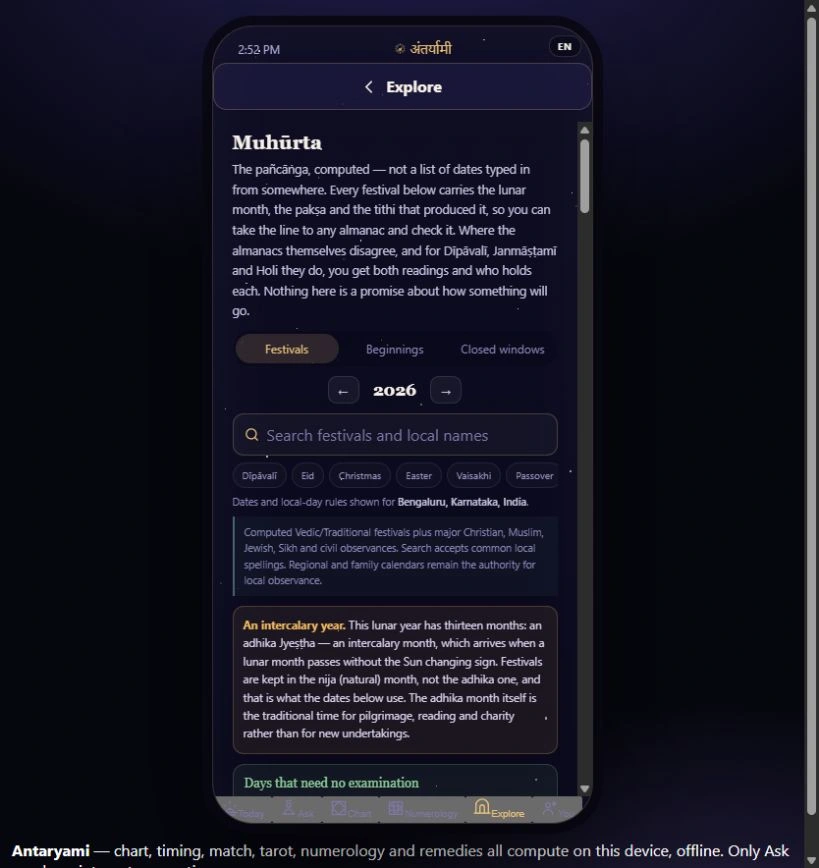
Someone in the family says the celebration is on one date. Another person has a different date saved. A search result supplies a third answer with no explanation. What you need at that moment is not another confident headline; it is a way to understand what each date refers to. Antaryami's Muhurta preview places rules near festival entries and allows room for differing traditional readings. This real-screen tour by Nitish Raj Walia shows how that design can improve the conversation. It does not publish a new festival-date authority or certify the captured example as a schedule for your location.
Read the reason beneath the date
A calendar list is convenient, but a date by itself hides the choice that produced it. A traditional festival rule may involve a lunar month, paksha, tithi and a relevant period of the day. The inspected Muhurta screen is designed to show that working alongside the entry. This lets a reader ask a precise question about an observance instead of accepting the largest printed date as the only possible answer. The useful feature is not merely having more celebrations in one place; it is making their basis inspectable.
For a first visit, choose a festival you already know something about. Read its entry slowly and identify the named calendar conditions. If the screen includes an alternative reading, keep its attribution with it. Do not copy only the final date into a message that suggests every community has agreed. A family conversation can then move from "the app says so" to "this is the rule the entry is using." That is a more respectful starting point when lived traditions differ between relatives, regions or institutions.
A different lunar-month name may not mean a different day
The day-card preview explicitly distinguishes amanta and purnimanta month naming. Seeing two month names can therefore require an explanation of the reckoning, rather than an immediate accusation that one calendar is broken. Before comparing festival entries, read any month or tradition note that accompanies them. This does not mean all differences are trivial. It means the labels need to be understood before you can decide which difference actually changes the observance date and which simply names the same calendar context differently.
It is helpful to ask an older relative how their household identifies the occasion. They may refer to a regional name, a community calendar or the practice of a particular temple. Treat that information as part of the conversation, not as an obstacle to using a digital tool. The app can organise rule-based explanations; it should not erase the variety of human observance. You can learn the technical vocabulary while respecting the familiar name under which a celebration has been part of someone's life for decades.
Choose the relevant place and year before making plans
A festival preview belongs to a selected calendar context. Check the location and year controls before discussing travel or hosting. A saved screenshot cannot refresh itself when the year changes, and a place label should not disappear from an important scheduling conversation. If you are organising an occasion in one city while living in another, use the event's intended context rather than assuming your phone's location or a family profile's birthplace answers every calendar question. The practical place of observance deserves an explicit check.
This article deliberately avoids turning the captured entry into a current universal date announcement. It demonstrates where to find the rule and how to question it. For a consequential booking, compare the app's current result with the relevant local institution or recognised almanac and confirm the actual event arrangements. Flights, venue availability and public opening hours are not established by a lunar-calendar card. A good planning process separates the traditional preference from those independently changing facts, so a useful cultural tool does not become the sole authority for a costly decision.
An alternative reading is information, not a contest
Where the preview presents more than one observance reading, resist the urge to assign a winner based on which date suits your schedule. The difference may reflect a rule or an authority that the entry names. Read those names and conditions before discussing the choice. A transparent product can show disagreement without pretending that uncertainty is a defect in the user. It can also make clear that a calendar distinction is not a measure of devotion or an excuse to dismiss another family's practice.
Suppose your relatives are planning a shared call across time zones. You can agree to gather when everyone is available while keeping each household's local observance separate. That practical compromise does not require inventing a new religious rule or declaring the app's alternative date invalid. The instrument is useful because it gives you language to explain the difference. Human consideration supplies the rest: ask what matters to each person, which part of the event is flexible and how to include people whose local timing or traditions are not identical to yours.
The benefit is a more informed celebration
The most appealing outcome is not perfect agreement across every household. It is a calmer conversation in which people understand why a date is being discussed. The Muhurta festival screen can provide a shared reference, while the people celebrating decide how they will honour their practice and include one another. Calendar literacy can be enjoyable: a familiar celebration becomes an opportunity to notice the structure behind it, rather than a last-minute argument about whose search result should prevail.
Antaryami is presented by Temior Technologies Pvt Ltd as a collection of distinct instruments, with the website introducing the experience and the app intended for personal exploration. Nitish Raj Walia's guide keeps that product role separate from religious authority and guaranteed outcomes. Use the rules to ask better questions, the current calendar to check its stated result, and human kindness to organise the gathering. A celebration has more than one kind of timing: the observance you respect and the attention you give to the people who share it.
How would you explain the date to someone else?
My relative has a different festival date.
Compare the same place and year, then read each observance rule and any named alternative. A disagreement needs context before a conclusion.
I want to forward this screenshot.
Include its example status and calendar context. For actual plans, use the current local result rather than treating a captured preview as a live schedule.
Astrological interpretations are for reflection, not a diagnosis, a guaranteed prediction or a substitute for professional advice. Journal guides are prepared with AI assistance; they are educational content, not individual consultations.


