 Antaryami
App walkthroughs
Report files in Antaryami: keep the edition you read and share it thoughtfully
A report should be more than something you can see once on a screen. You may want to revisit its edition, keep its calculation context or share a copy with someone you trust. Antaryami's inspected report-export code provides a file route distinct from the print or PDF route. Nitish Raj Walia explains how those routes are organised and why a preview is not evidence of an owned purchase. The benefit is understanding what a copy contains and what it can reveal, while keeping payment, entitlement and actual device delivery outside claims that have not been tested.
A report has a person, a kind and an edition context
Before choosing a file action, read the displayed report title and selected profile. A general report, a particular life area and a dated edition are not automatically the same product. The source maps commercial report keys to rendering kinds rather than assuming every purchased title opens one generic document. This is an important distinction for a reader returning to something already held. However, this walkthrough does not verify a customer's ownership record or demonstrate that every purchased edition is available through the live website or app.
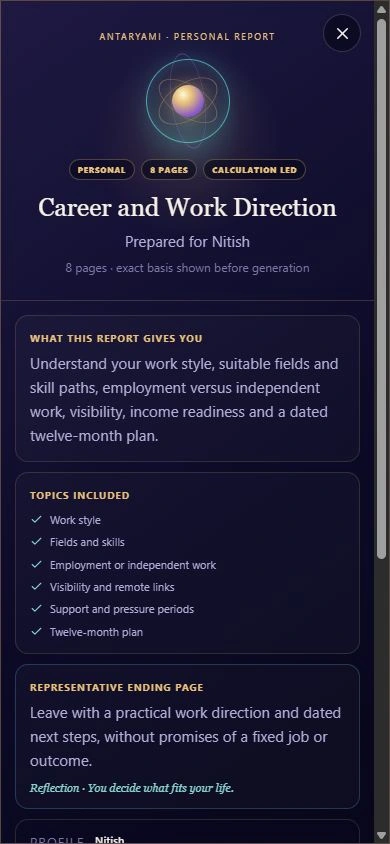
The individual screenshot is a fictional adult catalogue preview, not a paid customer file. It shows the Career and Work Direction title, intended topics and representative ending; the export controls discussed below were inspected in source, not exercised in this capture. Opening a catalogue preview should not be described as completing a purchase. If a real screen shows an amount, read its availability and entitlement requirements before continuing. This guide does not execute checkout or generate a billable report. The paper-like appearance of a report is not proof that a payment was captured or that a particular edition belongs to the current account.
Know what the control is intended to deliver
The inspected report interface offers a standalone HTML file route alongside print or PDF-related controls. The file serializer works from the rendered report rather than creating an unrelated second interpretation. It includes styles needed to display the saved document and removes interactive controls from that copy. This describes the export implementation's intended output, not a promise that every browser or operating system will complete delivery identically. A file can be a useful keepsake while the actual save result still depends on the viewer and device.
A print dialogue can provide a PDF option on a supporting system, but opening that dialogue is not itself proof that a PDF was saved. Read the device's result and locate the resulting file. Likewise, an HTML copy should be identified as HTML rather than renamed conceptually as an invoice or a PDF. Report, payment receipt and tax invoice are different records. Keeping those names clear prevents an attractive chart document from being used as financial paperwork it was never designed to provide.
A file should not quietly omit the part you wanted to keep
The source checks the report structure before serialising it and refuses an incomplete cover-body-ending sequence rather than silently presenting it as whole. It opens disclosure content in the copy so text is not trapped behind controls that the saved document no longer contains. This is a useful design intention, but this guide does not certify every report kind's generated output. You should still check the actual copy for the sections you expected. A successful click is not enough evidence that the desired document has been delivered completely.
The file code also removes scripts and interactive elements from the cloned report. That keeps the saved copy focused on document content rather than pretending its app controls remain active outside the app. The source inspection is not a complete security audit or a guarantee of safe handling for arbitrary HTML from elsewhere. Obtain reports through verified official routes and keep their format clear. A retained copy should be understandable as a document with provenance, not mistaken for a second live workspace that can make purchases or change a customer's profile.
A later reader should know which result they are seeing
The inspected export adds a provenance block describing the document and calculation context supplied by its report model. Engine labels must match that model; a licence or brand name does not establish that a particular exported report used a specific calculation route. Keep the generated time, person and report kind with the edition. If inputs or rules change later, a new result may differ. The earlier copy should not be silently rewritten to make its historical context appear identical to the new one.
This distinction also supports the founder's requirement that customers should not pay repeatedly just to reopen the same owned edition. The source contains an open-bought-report route, but this walkthrough does not verify every server ownership and regeneration rule. Do not promise that all future editions are free or that an HTML file can recreate an entitlement. A document copy preserves content; the account's authoritative purchase record governs ownership. Keeping those roles separate lets a reader retain a meaningful edition without confusing the file itself with proof of payment or unlimited access.
Keeping a report should make its history clearer
The inspected source establishes the export structure, delivery controls and outcome messages. It does not verify live payment status, every report ownership path or universal operating-system compatibility. The screenshot uses fictional adult report information. Official availability and account entitlements need current confirmation outside this preview. These distinctions allow the website to show useful paperwork features without presenting an unpurchased demonstration as something a real customer already owns or promising a device result that has not been observed.
Antaryami, from Temior Technologies Pvt Ltd, can offer a richer experience when a reader can identify and retain the edition they actually viewed. The useful takeaway here is knowing what the file route is for, which provenance matters and why sharing deserves attention. A report can be revisited without becoming an unquestionable verdict on a life. Its content remains traditional guidance, its copy remains a document and its ownership remains tied to authoritative records. Keeping those meanings separate makes the experience clearer both now and when someone opens the file months later.
Keep the edition and the paperwork distinct
Is a downloaded chart report also my payment receipt?
No. Report content, receipt and tax invoice are different records. A retained report copy does not by itself prove a captured payment or establish the account's entitlement.
What should I check before sharing a real report?
Confirm the named person's authority and wishes, the personal details included and the intended recipient. A sharing control does not make disclosure appropriate or stop recipients from forwarding the copy.
Astrological interpretations are for reflection, not a diagnosis, a guaranteed prediction or a substitute for professional advice. Journal guides are prepared with AI assistance; they are educational content, not individual consultations.


