 Antaryami
App walkthroughs
Saptamsa D7 in Antaryami: a thoughtful lens on care, not a pregnancy prediction
Family questions deserve tenderness, especially when a screen appears to offer a hidden answer. Antaryami labels Saptamsa, or D7, with the traditional theme of children and lineage. This guide takes that theme in a deliberately humane direction: understanding the calculation and reflecting on the care, teaching and values adults offer others. Nitish Raj Walia does not use it to predict pregnancy, conception, fertility or the sex of an unborn child. Those conclusions are not established by the inspected mapping, and sensitive family decisions should never depend on a diagram giving the answer somebody wants to hear.
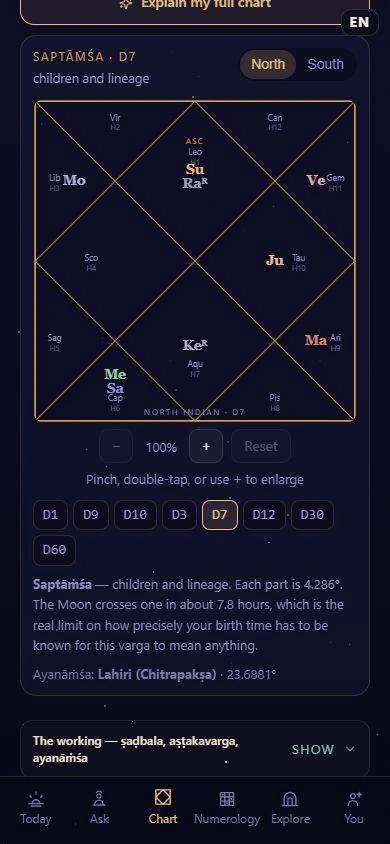
Find D7 and notice what actually changes
Within the divisional chart panel, selecting D7 changes the displayed mapped placements and the panel's title. The same birth record remains the starting point. Other charts on the page may still show their own divisions, so check the selected panel rather than assuming every visible diagram has changed. The house detail closes when the division switches. Open a new detail deliberately if you want to understand this view, and retain the distinction between the general house theme and the selected example's placement information.
The North and South controls arrange the diagram differently without turning the family theme into two competing biological answers. Use a layout that lets you follow labels comfortably. In a discussion, name both the division and the selected profile, but do not share private birth details merely to explain the button. The fictional adult example demonstrates a product surface; it is not a reading of you, a future child or somebody whose details were never supplied. That boundary should remain visible even when the interface feels personal.
The code transforms longitudes, not reproductive information
The inspected D7 rule divides each thirty-degree sign into seven equal portions. It counts mapped signs from the original sign for an odd-numbered sign and from the seventh sign from it for an even-numbered sign. These are indexing rules, not laboratory measurements. The code receives chart longitudes and produces divisional signs; it does not inspect a pregnancy, measure fertility or establish any biological characteristic of a child. Arithmetic can be reproducible while an interpretation attached to it remains a traditional proposition.
That distinction is worth explaining before any family-themed prose appears. More decimal places do not supply missing medical evidence. Neither a strong-looking placement nor an appealing interpretation establishes a likelihood of conception. Do not create a fertility percentage from these positions, and do not rename such a percentage spiritual vitality to make it seem harmless. The useful educational question is how the selected mapping works and why the tradition gives it a family theme, not how to dress an unsupported health conclusion in reassuring language.
Make room for the many ways people pass something on
Lineage can be discussed without reducing a person's value to whether they have children. An adult might mentor younger colleagues, teach a niece, build a welcoming home or preserve a language through community work. These are real choices about care and continuity. If D7 prompts reflection, ask what you want to offer and what resources you actually have. There is no need to make the chart promise parenthood before the conversation becomes meaningful. People who do not want children should not be treated as incomplete readers of the instrument.
Try naming one value you learned and one you would handle differently. Perhaps generosity mattered in your family, but asking for help was difficult. You can retain generosity while practising a healthier way to share responsibility. The chart does not prove where that pattern came from; your memories and conversations provide the relevant context. This approach gives the traditional theme a practical, respectful use without inventing information about a future person. It also keeps different family structures welcome rather than quietly rewarding only one expected life path.
A future person should not arrive with a chart-assigned personality
It is tempting to turn a symbolic family reading into a vivid sentence about how a future child will behave. That sentence may feel helpful, but it can create expectations before there is a person to listen to. This walkthrough does not claim D7 can determine a child's temperament, abilities or relationship with a parent. A child should not have to grow into an adult's preferred forecast. When reflecting on family life, focus instead on the adult's willingness to listen, repair disagreements and create a safe environment.
Even an existing child's details deserve a separately appropriate privacy and guardian process. A fictional adult demonstration cannot establish that the product's child-data workflow is approved. Do not upload a child's private records to public comments or use a parent chart as a behavioural assessment. If an interaction raises a concern about wellbeing, qualified support and the child's actual circumstances matter more than a symbolic explanation. You can appreciate the tradition while refusing to let it replace direct attention to a person who is still finding their own voice.
Important family decisions need evidence beyond an auspicious label
- Use D7 to learn a labelled mapping, not to assess reproductive health.
- Reflect on care you can offer without assuming everybody wants children.
- Keep future children free from predetermined personality expectations.
- Let medical evidence and qualified care govern pregnancy-related decisions.
You may enjoy cultural rituals or symbolic dates while making plans, but this article does not supply a conception calendar or demonstrate a safe fertility-timing feature. Medical care, personal readiness, finances and mutual consent remain independent considerations. Do not delay assessment or treatment to wait for a chart window. An entertainment disclaimer would not make unsupported reproductive advice reliable. Here the D7 control is explained as a chart transformation, and its family language is kept within reflection rather than presented as guidance about a physiological outcome.
Input uncertainty also survives the transformation. A divisional ascendant depends on the supplied ascendant longitude when available; without it the inspected engine uses a Moon-based reference. A general estimate of the Moon crossing one portion cannot certify every mapped body or house. Keep that technical caution separate from the medical boundary: even perfectly recorded birth data would not make the chart a fertility test. These are two different limitations, and acknowledging one should never be used to suggest that the other has somehow been solved.
Useful curiosity does not require a promised outcome
The app-source review confirms that a D7 division is available in the chart controls. It does not confirm a medical service, a live pregnancy feature or any guaranteed family event. The individual image documents fictional adult preview data and must not be described as a customer's fertility result. If a current product screen ever appears to make a health or fetal-sex claim, that wording requires separate scrutiny; this guide does not endorse it. Honest boundaries belong inside the explanation, not only at the bottom in small print.
Antaryami is presented by Temior Technologies Pvt Ltd as a place to explore its instruments with their methods named. For Saptamsa, a worthwhile visit can end with a thoughtful question about care: what would I like to pass on, and what should I leave behind? That question has room for parents, non-parents, teachers and mentors. It asks for responsibility rather than certainty. The instrument can introduce a traditional vocabulary, while the compassion, consent and practical decisions remain yours to develop in the world outside the screen.
Choose a respectful D7 question
Can this chart tell me when I will conceive?
This guide verifies no conception-timing capability. D7 mapping is not medical evidence, and a symbolic window must not substitute for fertility assessment, treatment or personal readiness.
What can a family theme help me reflect on instead?
Consider the habits and values you want to offer through teaching, mentoring or family care. Keep the focus on your actions instead of assigning traits or outcomes to a future child.
Astrological interpretations are for reflection, not a diagnosis, a guaranteed prediction or a substitute for professional advice. Journal guides are prepared with AI assistance; they are educational content, not individual consultations.


