 Antaryami
App walkthroughs
The second house in Antaryami: money, values and the words you choose
A household conversation about spending is rarely only about arithmetic. It can also reveal security, responsibility and the words people use when they feel worried. Antaryami's second-house vocabulary brings resources, family values and speech into one traditional theme. Nitish Raj Walia follows the inspected house-detail structure to explain why those ideas appear together and how you can explore them without mistaking a placement for financial advice. The benefit is a clearer question about what you keep and how you discuss it, not a promise that the chart knows your future bank balance.
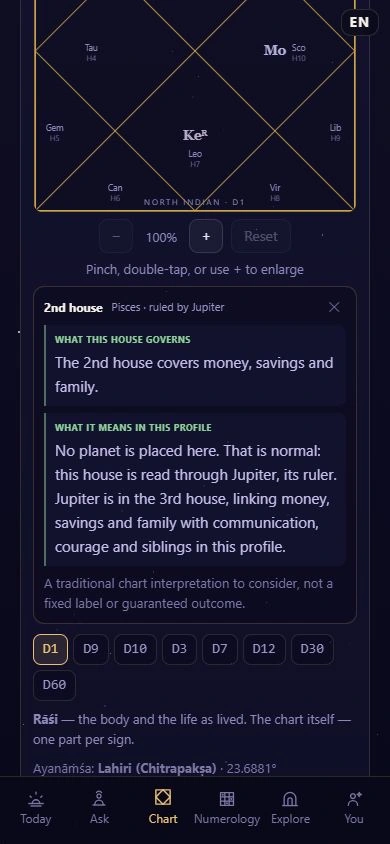
Select house two and read both layers of the panel
Within the D1 divisional panel, choosing the second house opens the explanation below the diagram. The panel first identifies the house's sign and ruler, then separates its general theme from the selected example's occupant and ruler information. Read those layers in order. The broad theme tells you why money and values are being discussed; the placement text tells you how the implementation connects that theme with this particular chart. Neither layer establishes an amount you own or the income you will receive.
The screenshot documents a fictional adult preview, not a household's actual finances. Your own bills, savings and commitments remain facts to obtain from your records. Keep the panel's division label in view, since a house selected in another division has a different mapping context. If you change the layout to South, you are changing how the diagram is arranged rather than choosing a different financial future. Clear labels make the feature easier to understand while preventing attractive visuals from being treated as statements about money they never measured.
Notice what the product means by resources and values
The inspected house guide associates the second house with savings, family resources, food, speech, possessions and values. These are traditional themes within the app, not a universal economic model. Their practical connection is that what people keep and how they speak about it often reflects what feels important. One household may prioritise predictability, another education and another helping relatives. The chart cannot establish which priority is objectively right. You can use the vocabulary to make those priorities explicit before a disagreement turns into a judgement about character.
Ask what a purchase is meant to do: provide safety, express care, save time or create enjoyment. The same price can mean different things in different circumstances. Naming that purpose does not require a planetary explanation, but the second-house theme can remind you to include it. Keep the account records and the symbolic reflection in separate columns. A reassuring chart phrase cannot remove an unpaid bill, and a difficult phrase does not make a well-planned decision irresponsible. The actual amounts and constraints deserve direct attention.
Replace a money label with an understandable request
Imagine one partner saying that the other spends too much. That accusation leaves the amount, the concern and the desired change unclear. A more useful conversation might identify a specific expense and explain how it affects an agreed savings goal. The second-house speech theme can prompt this shift, but the improvement comes from clearer communication. It does not prove the placement caused the disagreement. Try making one request that another person could understand and respond to without needing to agree with your astrological interpretation.
For example, you could ask to review recurring household expenses together this weekend. That is more concrete than declaring that someone has a difficult money planet. Give the other person room to explain their priorities and limits. If there is conflict about access to money or financial control, do not use symbolic language to normalise it. Appropriate advice and support may be needed. The chart's themes are not permission to decide another person's rights, hide information or pressure them into spending in a way that makes a reading feel correct.
A connection between houses is not an income forecast
The detail panel finds the sign ruler and identifies its location in the selected chart when available. That produces a traditional link between the resource theme and another life area. An occupant may contribute an additional role in the explanation. If no body occupies the second house, the panel still reads through the ruler; it does not announce that resources are absent. This is a mechanical explanation of how the product constructs its text, not a demonstration that a particular ruler placement will create wealth.
You can trace the logic by identifying the sign, locating its ruler and confirming that both belong to D1 for this exercise. Do not import a transit location or a D10 position into the same sentence without labelling the change. A technically coherent reading is easier to discuss than a collection of appealing fragments. It also lets you recognise where the calculation ends and interpretation begins. Precise placement information can tell you what the app is using, but it cannot certify an investment, a business return or an amount of future savings.
Use the theme to review priorities, not to select a transaction
- Identify the general theme before reading the selected ruler and occupants.
- Keep balances, bills and financial terms outside the symbolic interpretation.
- Describe one expense and one concern in words another person can answer.
- Do not use a favourable placement as a reason to borrow or speculate.
This article does not recommend an investment, loan or speculative trade from the second house. Decisions involving money require attention to affordability, terms, risk and your actual situation, with qualified advice where appropriate. Do not take debt because a chart looks favourable or avoid a necessary financial conversation because it looks difficult. The traditional theme can accompany a review of values, but it is not evidence that a provider is trustworthy or a transaction is suitable. Those questions must be assessed through their own records and protections.
A modest exercise is to choose one recurring expense and ask whether it still serves its purpose. You may keep it, reduce it or decide it needs a separate conversation. Record the practical reason for that choice rather than saying the chart demanded it. The goal is not to eliminate every pleasure or turn thrift into a moral badge. It is to make your own priorities visible. A useful reflection respects both resources and enjoyment while acknowledging that households have different constraints which a general interpretation cannot fully know.
A clearer language for a conversation you still need to have
The inspected source confirms the second-house explanation and how it is built from the selected chart. It does not demonstrate financial forecasting accuracy or verify live paid access. The individual image belongs to a fictional adult example and contains no customer's financial record. Product sales and access should be checked through the current official routes, not inferred from a screenshot. The guide's purpose is to show what the instrument means and to make its limitations understandable before a reader encounters an unusually persuasive paragraph.
Antaryami, from Temior Technologies Pvt Ltd, can help organise curiosity about traditional resource themes without pretending to manage a household's money. You can leave this panel knowing the difference between a ruler and an occupant, and with a more specific way to discuss a recurring expense. That is a useful bridge from symbolic language to practical reflection. Your records establish the amounts, your circumstances establish the needs and your conversations help negotiate the choices. The chart remains an optional lens rather than becoming the authority that decides all three.
Keep resources and choices distinct
Does a strong-looking second house make a loan affordable?
Affordability comes from actual income, commitments, loan terms and risk, not the appearance of a chart. Review those records and obtain appropriate advice rather than borrowing on a symbolic assurance.
Why does the app mention speech beside savings?
The inspected house vocabulary includes both under its traditional second-house theme. You can reflect on how resource conversations are handled without claiming a placement determines your words or your bank balance.
Astrological interpretations are for reflection, not a diagnosis, a guaranteed prediction or a substitute for professional advice. Journal guides are prepared with AI assistance; they are educational content, not individual consultations.


