 Antaryami
App walkthroughs
D60 in Antaryami: why a finer chart needs a more careful question
The smallest-looking detail can feel like the most important one. D60, or Shashtyamsa, is an especially good place to question that instinct. Antaryami includes this fine division, but opening it does not add evidence to your birth record or prove a story about past lives. Nitish Raj Walia follows the inspected half-degree mapping and its display here, asking what precision means before asking what a placement means. This is a guide to responsible curiosity: the more sensitive a transformation becomes, the more clearly its inputs and interpretive limits should travel with it.
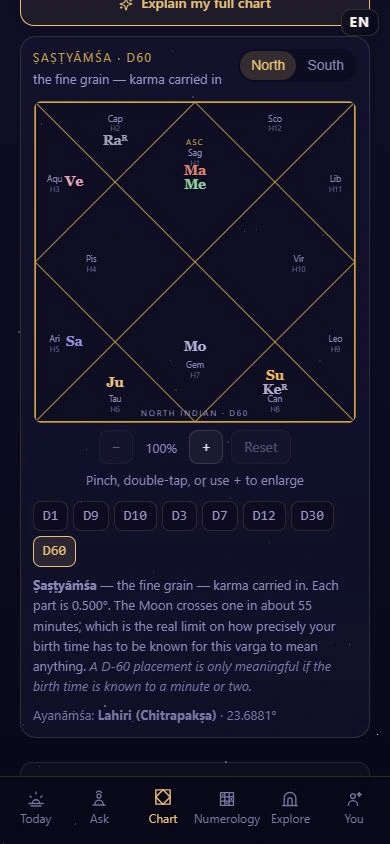
Choose D60 for a reason, not because it has the largest number
The Chart panel offers D60 alongside broader divisions. When you select it, the panel title changes and the positions are remapped. Nothing about that click proves the new view is more personally accurate than D1 or more suitable for the question you brought. A larger divisor means a finer partition under the implementation, not a higher score for truth. Start by asking why you want this view and whether the original record supports such detailed exploration. Choosing not to interpret it is a valid use of judgement.
The same North and South display choices remain available. They help you follow the diagram without settling uncertainty about its starting point. If you enlarge the image, use the extra space to identify labels and boundaries, not to infer authority from visual detail. Keep D60 in your notes so that later comparisons do not confuse it with the primary chart. A beautifully arranged instrument is easier to inspect, but good presentation cannot substitute for a reliable source record or establish the meaning of an interpretation.
Understand what sixty parts actually changes
The inspected D60 rule divides a thirty-degree sign into sixty half-degree portions. It starts from the original sign and advances through signs according to the portion index, wrapping around the twelve-sign sequence. For a supplied longitude, the calculation produces a mapped sign. That output is a function of the original position and the selected rule. It is not another observation of the sky and does not independently confirm the birth data. Repeating the arithmetic correctly is different from verifying the historical moment being fed into it.
A position close to a half-degree boundary can map differently if its input changes enough to cross that boundary. Some positions may remain stable across a particular uncertainty range while others do not. The ascendant has its own sensitivity and should not be certified through a general statement about the Moon. To establish stability for a real record, you would need an appropriate comparison of the relevant quantities across the justified range. This walkthrough explains the rule; it has not performed a personal uncertainty audit or demonstrated that every D60 placement is secure.
A Moon-rate estimate is not a universal birth-time certificate
The interface includes a rough estimate of how long the Moon takes to cross a division and a specific caution about D60 time precision. Those notes are useful prompts to take uncertainty seriously, but they should not be treated as proof that knowing a minute always makes this chart reliable. A body's distance from a boundary matters, and the ascendant is not the Moon. Birthplace, local-time interpretation and calculation choices also belong to the input story. One average travel estimate cannot replace checking the actual sensitive output.
If your time is approximate, retain that label rather than upgrading it because a D60 description feels compelling. Finding a more detailed family recollection can be useful, but it is not the same as obtaining an original record. Do not try several minutes and choose the chart whose prose sounds most flattering. That process selects an interpretation, not evidence. You can study how the control works using the fictional adult preview while leaving a personal D60 reading unresolved. Technical curiosity does not require pretending the historical information is better than it is.
Do not turn spiritual language into a verified biography
Antaryami associates this division with a fine-grained traditional karma theme. This article does not establish that a mapped sign can prove a past life, assign moral debt or explain why someone experienced hardship. Such conclusions go beyond the calculation. A person facing grief or difficulty should not be told that a chart demonstrates they deserved it. Spiritual language can be meaningful to readers within their own beliefs, but meaning is not independent evidence of an unseen event or a reason to remove compassion from the present.
A gentler question might be which habits you want to cultivate now. You can choose patience, repair a mistake or make a commitment without needing a verified account of previous lives. If the tradition invites reflection on responsibility, keep responsibility attached to choices within your control. Do not use the theme to judge another person's character or explain away injustice. The instrument's fine appearance makes careful wording especially important: an intricate diagram can look authoritative even when the statement beside it is an interpretive possibility rather than a demonstrated fact.
More detail makes provenance more important, not less
- Confirm the original record and its uncertainty before choosing a fine division.
- Distinguish a half-degree mapping from independent evidence of birth time.
- Do not certify ascendant stability from an average Moon-travel estimate.
- Treat karma wording as a traditional theme, not a moral or historical finding.
Before discussing a fine division, identify the person, the date, the local time, the resolved place and the calculation convention actually used. An uncertain birthplace or a misunderstood time format cannot be repaired by adding subdivisions. The inspected app can use the mapped ascendant when present and a Moon reference when an ascendant is unavailable. Those references are not interchangeable. A house explanation should be read in relation to the reference that produced it, not assumed to have the same basis as every other chart on the page.
This source-guided walkthrough does not certify the live engine serving a real account. The preview may calculate locally, while other product routes have their own verified engine labels. Swiss Ephemeris licensing does not by itself establish that this specific offline calculation came from Swiss Ephemeris, nor would a named astronomical engine validate a spiritual interpretation. Check provenance for the selected surface and keep measurement, mapping and meaning in distinct roles. That chain is more informative than a broad precision slogan, particularly when the chart is sensitive enough to make small differences visible.
A useful instrument also makes uncertainty comfortable to acknowledge
The review verifies that the app source implements D60 and provides controls to inspect it. The individual screenshot documents fictional adult preview information rather than a customer's karmic record. No personal rectification result, consultation availability or paid access is established here. A responsible explanation should allow a reader to say that their data is not strong enough for this layer. That answer protects the value of the instrument by keeping its calculation honest instead of filling every gap with an increasingly elaborate story.
Antaryami is presented by Temior Technologies Pvt Ltd with room for detailed exploration, but detail should serve understanding rather than dependence. You can leave D60 knowing the half-degree rule and still decide to work with broader chart views or everyday reflection. You have not failed to uncover a hidden truth by doing so. Sometimes the most useful outcome of a sophisticated tool is recognising the question it cannot settle. That recognition gives you a clearer basis for returning later if better evidence becomes available, without carrying an invented certainty in the meantime.
Let precision mean something specific
My birth time is recorded to a minute. Is every D60 position now certified?
Not from that fact alone. Boundary distance, ascendant sensitivity, place and calculation provenance still need consideration; this guide has not carried out a stability audit of your record.
Can I change the minute until the karma description feels right?
That would select appealing prose rather than recover historical evidence. Preserve the recorded uncertainty and keep any time investigation separate from liking a particular interpretation.
Astrological interpretations are for reflection, not a diagnosis, a guaranteed prediction or a substitute for professional advice. Journal guides are prepared with AI assistance; they are educational content, not individual consultations.


