 Antaryami
App walkthroughs
One card or thirteen? Choose an Antaryami tarot spread for understanding, not for certainty
A large tarot layout looks impressive, but the number of cards is not a measure of how certain an answer will be. A spread is an arrangement of symbolic positions, each giving you a different question to consider. Antaryami's real preview offers several sizes and structures, including two different three-card forms. This guide by Nitish Raj Walia explains why that difference matters more than simply choosing the biggest number. We use a fictional adult profile and the actual feature controls, so the article is a product walkthrough rather than a personal reading or a prediction about the coming year.
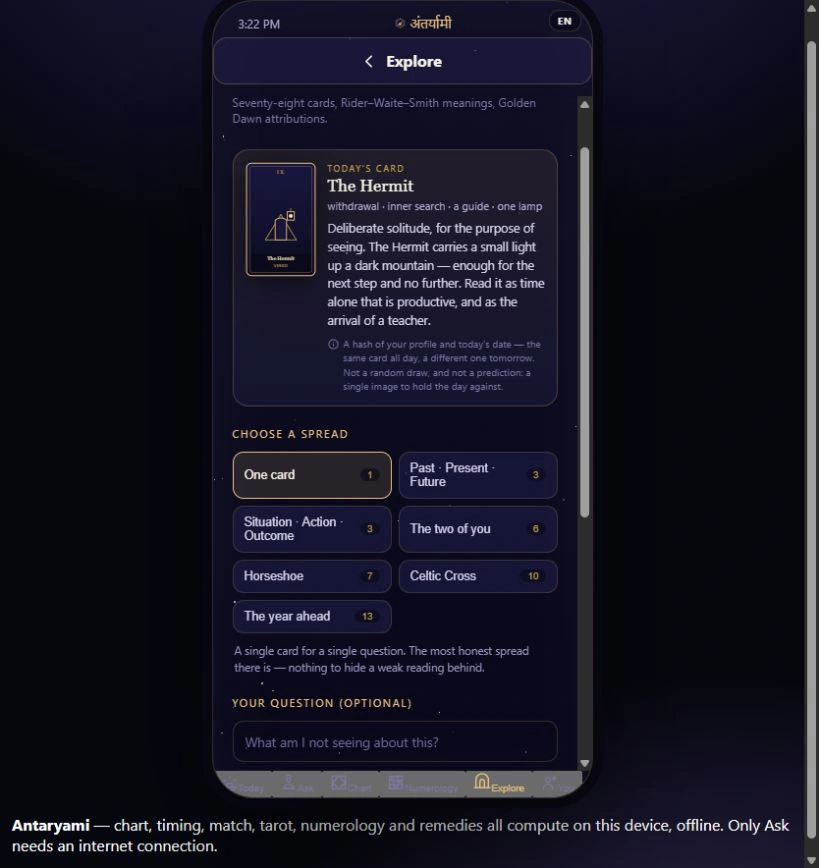
One card is enough to learn the connection between image and position
The one-card option gives you a small, inspectable starting point. You can see the named position, reveal its image and read the explanation without managing several simultaneous themes. That is particularly useful if tarot vocabulary is unfamiliar or if you want to understand how the app's controls work. A simple setup is not a beginner's punishment, and it does not make the person choosing it less serious. It can be a deliberate preference for a bounded exercise that is easy to stop.
Choose a question you can reflect on rather than a demand for a fact the card cannot establish. For example, you might consider what deserves your attention in a task you already understand. The image can suggest a metaphor, but it cannot determine whether a contract is sound, whether a treatment is appropriate or what another person will decide. A small spread makes that boundary easier to remember because there is less symbolic material to build into an elaborate story of certainty.
The same card count can organise different questions
The inspected feature offers both Past, Present, Future and Situation, Action, Outcome. Both use three cards, yet the positions ask different interpretive questions. The first supplies a narrative sequence; the second organises a symbolic decision exercise. The count alone cannot tell you what the spread is for. Read the position descriptions before drawing, and keep them beside the card explanations afterwards. A card interpreted as background is not being asked the same question as a card placed under a proposed action.
Words such as future and outcome need a careful boundary. They are labels within the symbolic arrangement, not verified reports from a time you have not lived. You can treat a future-facing position as an invitation to consider a possible direction and what you might change. That does not establish the likelihood of the direction or remove alternative outcomes. Likewise, a situation card is not a factual investigation of what is currently happening. Your actual evidence remains necessary even when a spread's wording sounds concrete.
More positions create more context to interpret
The two-person spread gives separate symbolic positions for each person, perceptions, the bond and the work. That arrangement can prompt a conversation about what you are bringing to a relationship, but it cannot expose the other person's thoughts or substitute for their participation. If you use it privately, keep your conclusions about your own assumptions rather than publishing a supposed secret diagnosis of somebody else. A relationship layout is not permission to collect or disclose their personal information.
The Horseshoe introduces a seven-position arc, adding areas such as background, influences and surrounding people. These are more prompts, not seven independent sources of evidence. A larger vocabulary can be interesting if you are willing to read each position patiently and leave uncertain associations unresolved. It can also overwhelm a simple question. Choose the amount of material you can realistically understand, rather than assuming that a dense layout will solve a concern that requires direct communication or practical support.
A Celtic Cross or year-ahead layout is not a certificate of accuracy
The Celtic Cross uses a ten-card structure, with a crossing card and a separate column of contextual positions. The year-ahead layout uses thirteen cards: a central theme and twelve month positions. These forms are visually distinctive and can support an extended symbolic exercise. Their size does not establish that the software knows what will occur in each month or can identify a hidden cause of your circumstances. It simply increases the number of labelled relationships the reader is being invited to interpret.
For the year-ahead form, read the feature's position description rather than assuming every slot maps to January through December. The inspected engine describes twelve months from the reading context. A recurring planning review can be useful, but the cards should not become a schedule for medical care, investments or other consequential commitments. If you enjoy a large layout, pair it with an ordinary planning document in which responsibilities, resources and deadlines are known independently. Keep the imaginative exercise beside the practical plan, not in charge of it.
Position comes before the dramatic card title
- Choose the spread by its position questions, not by the largest card count.
- Notice that the two three-card forms have different purposes.
- Read each card within its named position and setup options.
- Keep future-facing labels symbolic and practical decisions evidence-based.
After a draw, begin with the position's question. Then read the card's explanation, orientation and any stated symbolic context. This sequence reduces the chance that a striking title dominates everything else. A challenging image in a background position does not become a universal warning about the next decade. A pleasant image in an outcome position does not make an unsafe decision acceptable. The spread is a framework for thought, and a framework can be useful without turning its labels into facts about your life.
When discussing a reading, retain the spread name and options rather than sharing a single alarming fragment. Ask which association you made, what evidence supports it and what would challenge it. Another person may see the image differently, and that difference is part of interpretation rather than a failure to receive the correct message. Stop when the exercise has produced a worthwhile question. More cards, more draws and more explanations are not a reliable way to eliminate uncertainty that belongs to an unresolved real-world situation.
The benefit is choosing the right amount of material
Antaryami's spread collection gives you control over the shape of the exercise. You can begin with one image, explore a three-position question or take time with a larger arrangement when that is genuinely what you want. This is a product benefit that can be shown directly in the real interface. It does not require promising that the largest spread will deliver the most reliable forecast, or that the person who chooses a simpler form is missing something essential.
This AI-assisted guide by Nitish Raj Walia for Temior Technologies Pvt Ltd introduces Antaryami through fictional app-source screenshots. Visit the current app page for release information before expecting access to the personal experience. If tarot interests you, choose a spread small enough to understand and clear enough to discuss. Let the artwork provide a thoughtful question, not a new demand that you interpret every possible sign. The right size is the one that leaves you informed, unpressured and able to return to life outside the layout.
Which arrangement matches the exercise you want?
I want a short first visit.
A one-card setup lets you learn the connection between a position, a reveal and an explanation without implying that the image establishes private facts.
I want the biggest layout because it must be more accurate.
More positions mean more symbolic material, not demonstrated predictive accuracy. Choose a form by the questions you can understand and use responsibly.
Astrological interpretations are for reflection, not a diagnosis, a guaranteed prediction or a substitute for professional advice. Journal guides are prepared with AI assistance; they are educational content, not individual consultations.


