 Antaryami
App walkthroughs
The Antaryami temperament wheel: eight emotional themes, not a personality test
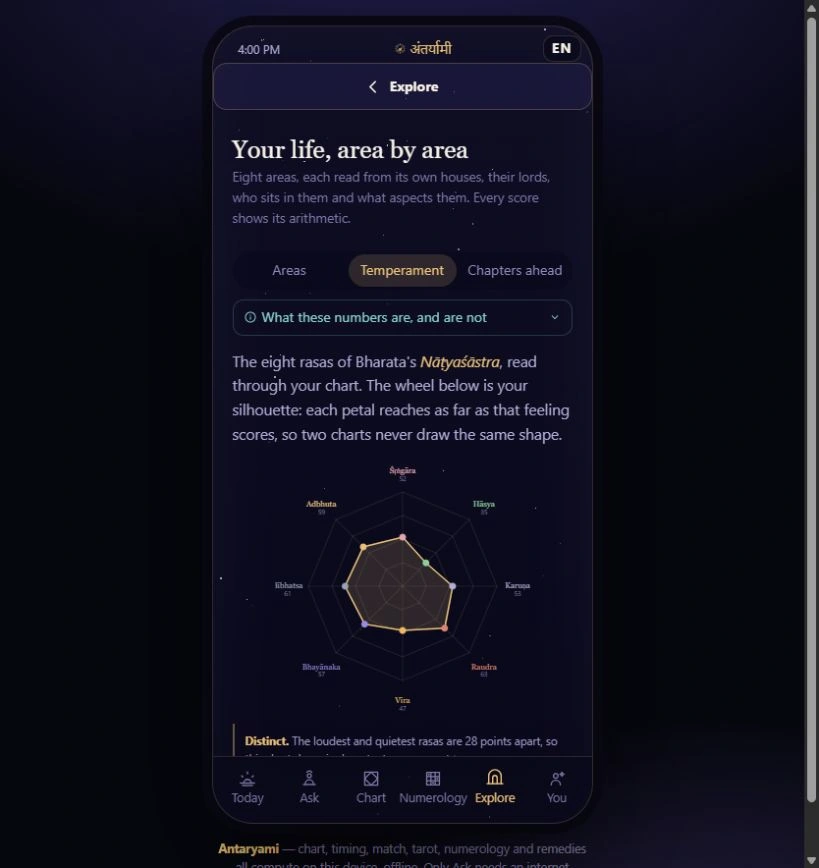
A wheel of emotional themes can feel more approachable than a table of planetary positions. You can see a shape and wonder why one part reaches further than another. Antaryami's Temperament tab offers exactly that visual entrance, together with descriptions and visible working. Nitish Raj Walia uses its actual fictional-adult preview here to explain how to explore the feature without turning a graphic into a psychological assessment. The wheel is generated from the app's chart model; it is not built from an interview, a validated questionnaire or a record of your behaviour. Enjoy the picture, then read what the picture actually represents.
Move from Areas to Temperament deliberately
Inside Life, the Temperament tab changes the reading surface from life-area indicators to a wheel with eight named spokes. The preview includes themes such as love and delight, wit and lightness, tenderness and grief, courage and resolve, and wonder and awe. These names provide the vocabulary of the feature. They are not questions you answered during a personality assessment, and the interface does not observe how often you experience an emotion before drawing the shape.
Keep the selected profile attached to the image. The fictional example in this guide illustrates the interface, not your temperament and not the founder's private psychological record. A familiar description may invite you to think of an experience, but recognition alone does not validate the model. Look for exceptions as well as matches. You can feel curious about a particular spoke without deciding that its label describes your essential nature or that a shorter spoke identifies a quality you are incapable of developing.
Read the origin note for the mapping
The app makes an important distinction in its disclosure: it presents the rasa vocabulary as traditional while labelling its assignment of particular planets to particular rasas as a modern correspondence. This guide describes that product convention rather than claiming the plotted planetary mapping is a standard psychological instrument or an unchanged ancient algorithm. Read both parts of the note. Borrowing established names for emotions does not establish that the subsequent software measurement has inherited the authority of every tradition in which those names appear.
In the inspected implementation, Venus is associated with love and delight, Mercury with wit and lightness, Moon with tenderness and grief, and other planets with the remaining spokes. Those are choices in this feature's mapping. The arithmetic then comes from the selected chart's dignity model and adjustments. The best question is how the app uses the correspondence and what it discloses about it. Do not leap from a recognisable planetary symbol to a claim that the wheel has independently measured your emotional life.
The numbers are separate model outputs, not slices of your personality
The rasa values are not presented as parts of a whole that must add up to one hundred. Each spoke has its own model score and working. In the fictional preview, one theme reaches 63 while another reaches 35; this does not mean that sixty-three percent of the person consists of one emotion or that another feeling occupies exactly thirty-five percent of their day. Read the attached label and calculation rather than importing the meaning of a pie chart into a different visual form.
The implementation rounds and bounds the scores, then draws a shape from them. That makes the wheel a readable summary, not a unique identifier. Different charts can produce matching displayed values; a familiar shape does not establish identity or prove two people share the same psychology. Likewise, a dramatic peak is not automatically more insightful than an even-looking wheel. The product's visual language should help you understand its output without implying that every person must receive a visibly extraordinary pattern for the reading to be worthwhile.
Follow the printed working before adopting the description
Under the wheel, the feature lists its themes with prose and the numerical steps that produced them. The source starts from a planetary dignity quantity and applies its configured house and condition adjustments before rounding. This is inspectable software arithmetic. It is not an observation of how you reacted in a difficult conversation. If a label sounds surprising, look at that working so that you know whether you are considering a chart-derived quantity or an independently measured account of behaviour.
The tab also shows a seasonal description from its running-period context where available. That is another interpretive layer, not proof that your personality has changed or that you will feel a specified emotion until a particular year. Do not copy a dated sentence from the fictional preview as advice for the public. A snapshot belongs to its selected inputs and calculation setting. Keep the distinction between the underlying shape, the model's timing language and what you actually notice about yourself in an ordinary day.
Use one theme to describe a real moment
- Read the disclosure separating rasa vocabulary from the planetary mapping.
- Treat each spoke as a model quantity, not a percentage of identity.
- Compare one concrete experience and one counterexample with the description.
- Keep a reflective question without assigning a fixed psychological label.
Choose a theme and recall a specific situation in which it seems relevant. Wonder might remind you of learning something unexpected; caution might remind you of a decision you checked before committing; delight might bring a shared meal or a piece of music to mind. Describe what happened without using the chart as the cause. Then recall a situation that does not fit the description. Both examples belong in your reflection, and neither needs to be removed to protect the wheel from disagreement.
You can use the comparison to ask what you would like to express more clearly, not which emotion the graphic says you must feel. Perhaps you want to acknowledge a small pleasure or name a concern without exaggerating it. Those are human questions, not diagnoses. The feature should not be used to assess someone for employment, relationship eligibility or any consequential decision, and this article does not present it as a substitute for professional psychological care. A colourful chart remains a symbolic tool even when its prose sounds personal.
Explore the wheel for what it is, rather than what it resembles
Antaryami's website can introduce the visual instrument and its actual preview before you consider personal app access. This screenshot does not verify a store download, an entitlement or an available remote interpretation service. Check those separately on the current official pages. What it does show is the inspected wheel and its place inside Life. A product can be visually engaging while remaining clear that its numerical model has not been validated as a psychometric assessment.
Temior Technologies Pvt Ltd presents Antaryami through instruments you can open, question and revisit. The temperament wheel earns its place when it makes a symbolic vocabulary understandable and its calculation choices visible. You may recognise a theme, reject a passage or simply appreciate the way the information is arranged. Leave room for all of those responses. Your lived emotional experience is not obliged to match a polygon. The meaningful next step is an observation or a conversation you choose, not a claim that the app has finally measured everything that makes you yourself.
Look at the wheel with the right question
Does a score of sixty-three mean sixty-three percent of me?
No. Each spoke is a separately calculated model output. The values are not proportions of a complete personality or measured frequencies of emotions.
Is the wheel a unique identity or psychological diagnosis?
Neither. Rounded model values can coincide across charts, and the feature is not a validated psychometric assessment. Use its vocabulary as optional reflection.
Astrological interpretations are for reflection, not a diagnosis, a guaranteed prediction or a substitute for professional advice. Journal guides are prepared with AI assistance; they are educational content, not individual consultations.


