 Antaryami
App walkthroughs
D30 in Antaryami: understand pressure without expecting misfortune
A chart label mentioning misfortune can make you brace for something that has not happened. Antaryami's D30 division, Trimsamsa, needs a calmer introduction. Its inspected implementation uses unequal portions of a sign and a traditional theme about pressure. Nitish Raj Walia explains those mechanics here without predicting an accident, a punishment or a doomed period. You can use the topic to ask how you respond when plans become difficult, while letting actual risks be assessed through actual evidence. The point is to make the instrument understandable, not to manufacture anxiety that only another reading can relieve.
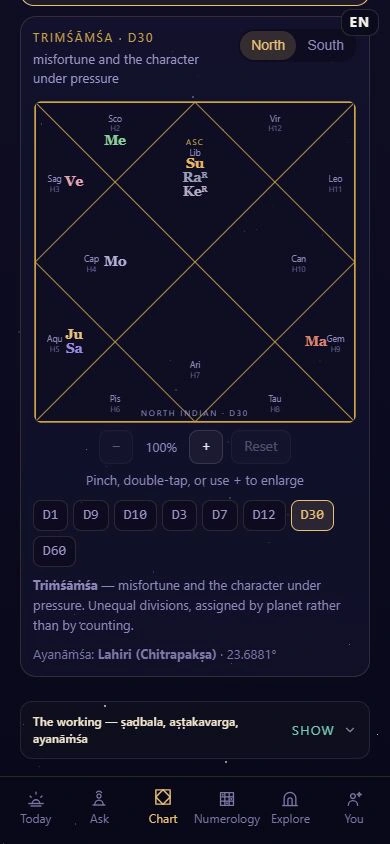
D30 is not thirty identical boxes in this implementation
Choose D30 in the divisional panel and read the explanatory note beneath it. Unlike the equal-part mappings offered by several neighbouring buttons, the inspected D30 rule uses five unequal intervals within a sign. The label D30 does not mean the panel splits every sign into thirty one-degree pieces. This is an important example of why a number on a chart button should not be interpreted before checking its specific rule. A plausible guess about the name can still be mathematically wrong for the implementation you are viewing.
The panel keeps the usual layout and house controls, but the transformed positions come from this different interval rule. North or South changes the arrangement, not the intervals used. If you compare with D1, describe the comparison as a derived mapping versus the original chart rather than as two conflicting predictions. Opening a new division clears the earlier house selection. Select again with the title visible so that a detail belonging to one view does not quietly become a claim about another.
Inspect the rule before interpreting its symbolism
For odd-numbered signs, the inspected intervals begin at zero, five, ten, eighteen and twenty-five degrees. They map respectively to Aries, Aquarius, Sagittarius, Gemini and Libra. For even-numbered signs, the intervals begin at zero, five, twelve, twenty and twenty-five degrees and map to Taurus, Virgo, Pisces, Capricorn and Scorpio. These details describe the app's arithmetic convention. They do not establish a probability of harm. The resulting sign is a transformed chart quantity, not a risk category assigned to a person.
A boundary also explains why two nearby supplied longitudes can appear in different mapped signs. That observation should lead you to examine the original input and rule, not to assume a tiny clock correction radically changes the danger in your life. This article does not claim universal agreement across all interpretive practices. It documents the selected mapping so a reader can distinguish a real implementation detail from a dramatic explanation attached afterwards. Inspectable arithmetic is valuable precisely because it can be discussed without a frightening story being smuggled into the same sentence.
Prepare for ordinary difficulties you can actually identify
Suppose you are about to take on a demanding project. There are concrete pressures worth reviewing: deadlines, staffing, budget and how decisions will be made. You do not need D30 to discover that an impossible workload needs adjustment. A symbolic pressure theme might prompt you to make that review, but the review's evidence comes from the work itself. Avoid translating a difficult-looking placement into a forecast of failure. That translation adds certainty without adding information about the people, resources or circumstances involved.
Try writing down a warning sign that is observable, such as repeatedly working beyond agreed hours, and a response you can take before exhaustion becomes the norm. Agreeing on priorities or asking for help is practical preparation. It is not a remedy proven to neutralise a chart. If the real conditions improve, let that improvement count even when the symbolic picture has not changed. The tool should help you notice a question, not make you distrust evidence that your situation is becoming more manageable.
A difficult label should not push you into an urgent purchase
A reader who feels frightened may be especially vulnerable to claims that a paid object, ritual or consultation can remove a predicted danger. Nothing in this walkthrough establishes such a claim. Do not use D30 to insist that somebody must buy a remedy immediately, abandon a relationship or delay necessary care. If you enjoy a voluntary cultural practice, keep its personal meaning separate from a promised protective effect. Pressure themes should be explained in a way that restores perspective rather than making ordinary uncertainty feel like an emergency.
You can pause a reading when its language becomes overwhelming. Return to what is happening now and what reliable information is available. A real safety concern calls for appropriate professional or emergency help, not another interpretation of a divisional chart. Equally, the absence of an alarming placement would not make an unsafe situation safe. These two directions matter together: the chart neither proves danger nor cancels evidence of danger. A responsible explanation should make both boundaries clear instead of using reassurance only when it happens to support the story.
Character under pressure is not a permanent character grade
- Check the unequal interval rule before assuming what D30 means.
- Review pressures through actual deadlines, resources and safety information.
- Do not buy a promised protection because a symbolic label frightened you.
- Describe one response you can improve without making it your identity.
The product associates this division with character under pressure, but that phrase must not be turned into a moral ranking. People respond differently depending on support, experience and immediate conditions. One difficult reaction does not define an entire life, and a chart cannot certify integrity or dishonesty. If the theme prompts reflection, choose a recent situation you can describe accurately. What did you notice, what did you need and what might you try differently? That inquiry leaves space for learning rather than assigning a fixed identity.
You might discover that you agree too quickly and then become resentful. A useful response could be taking time before committing to a task. Another person may need to practise communicating limits earlier. Those are different needs, even if both readers recognise the same broad symbolic theme. Keep the fictional example distinct from a personal assessment, and do not apply its prose to employees or relatives as a way to judge them. The human value lies in a considered response, not in deciding whose chart earns a better character score.
An understandable instrument need not be an alarming one
The source review confirms the D30 mapping and its display controls. It does not validate event forecasts or prove the effectiveness of protective remedies. The screenshot uses fictional adult data to document the preview; it is not an indication that a real person faces misfortune. Availability of app access or any separate service must be verified through the current official product. A guide can show an intriguing instrument without borrowing certainty from its appearance or presenting a traditional title as an objective assessment of risk.
Antaryami, from Temior Technologies Pvt Ltd, is most helpful here when the reader leaves with more perspective than they arrived with. You now know why D30 is unusual among the visible divisions and why its name cannot be read as thirty identical slices. You can consider your habits under pressure while taking concrete risks seriously on their own evidence. That combination makes room for curiosity without fear. It also lets you close the chart and get on with a sensible action instead of waiting for symbolic permission to feel safe.
Read pressure without creating panic
Does D30 show that an accident is coming?
No accident prediction is established by this guide. Review real hazards with reliable safety information; neither an alarming nor reassuring chart arrangement should override that assessment.
Why does D30 use unequal portions?
The inspected rule assigns five intervals with different boundaries in odd and even signs. Its mapped signs follow those intervals, not a uniform thirty-part grid.
Astrological interpretations are for reflection, not a diagnosis, a guaranteed prediction or a substitute for professional advice. Journal guides are prepared with AI assistance; they are educational content, not individual consultations.


