Antaryami
Calculation workshop
An angle from the Ascendant is not automatically a whole-sign house
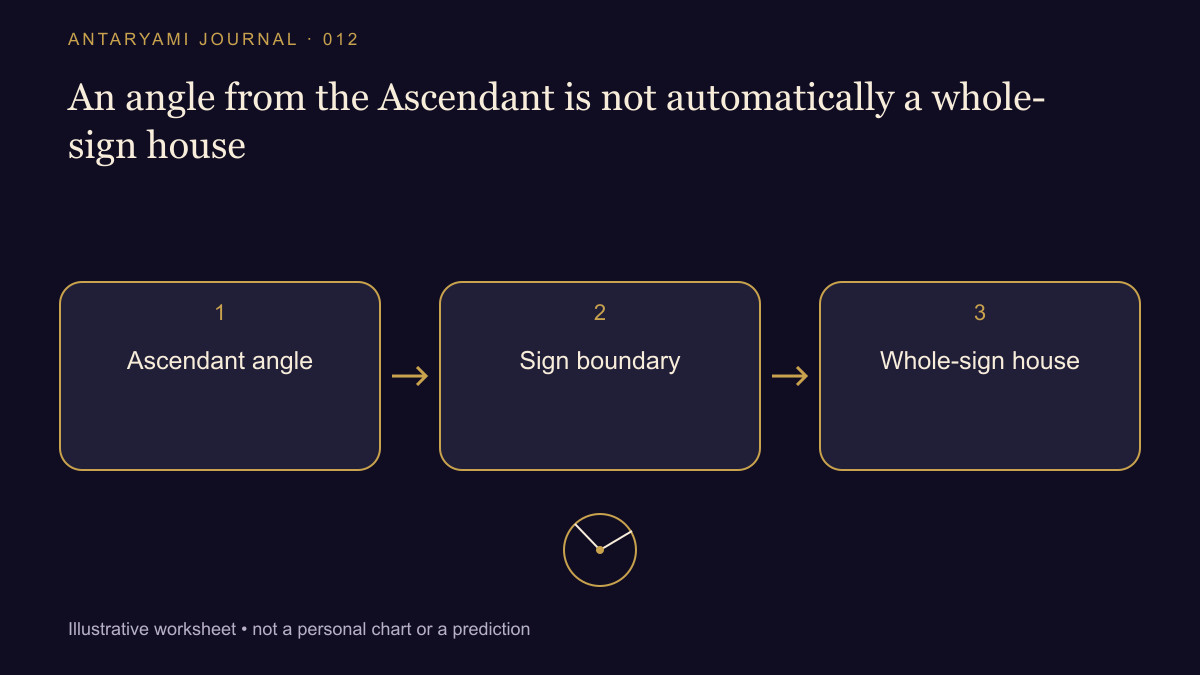
A fictional Ascendant sits at 4° Taurus and a fictional planet at 1° Gemini. Their forward longitude difference is twenty-seven degrees. Does that put the planet in the first house because the difference is less than thirty? Not under the whole-sign convention used in this example. An angle measured from an exact point and a house assignment based on whole signs are different operations.
State the house convention first
In this worksheet, the sign containing the Ascendant is treated as the first whole-sign house. The following sign is the second, and the sequence continues. Under that declared convention, Taurus is the first house and Gemini the second. The Ascendant's exact degree remains meaningful information, but it is not used as the beginning of twelve equal thirty-degree house intervals in this example.
The forward arc from 4° Taurus to 1° Gemini is indeed 27°. That arithmetic can be correct while the planet is assigned to the second whole-sign house. There is no contradiction to repair by moving the planet or changing the Ascendant. The two results answer different questions.
Do not mix a cusp table with a sign table
Other house systems define houses differently. If a report supplies cusp positions, keep the stated house system with them. Do not combine one service's cusp list with another service's whole-sign labels and expect the result to represent either method faithfully. A method comparison needs its own clearly labelled columns.
Draw a small worksheet with the exact Ascendant, the sign containing it, the selected house system and the planet's longitude. Then add the resulting house number. A reader who receives only the number cannot tell which convention produced it. The method label prevents an avoidable disagreement from turning into a claim that the software has changed the sky.
Check units and orientation
Some chart layouts keep house positions fixed; others organise the drawing around sign positions or a rotating wheel. The same house number can occupy a different place on paper. Read the legend instead of treating the top-left box, bottom of a diamond or another visual position as a universal definition.
Use the fictional example to test your understanding: the numeric arc is 27°, the whole-sign house is second, and the within-sign planet position is 1° Gemini. Keep all three statements. Each preserves a useful part of the record without pretending that one is a replacement for the others.
Leave interpretation for a separate discussion
A house assignment does not prove that a described event must happen. If an interpretation seems surprising, first check whether you are comparing like methods. Correcting a convention mismatch can clarify the diagram. It cannot certify a personal forecast. A sound explanation should be able to say exactly which result was calculated and where interpretation begins.
Astrological interpretations are for reflection, not a diagnosis, a guaranteed prediction or a substitute for professional advice. Journal guides are prepared with AI assistance; they are educational content, not individual consultations.