 Antaryami
Calculation workshop
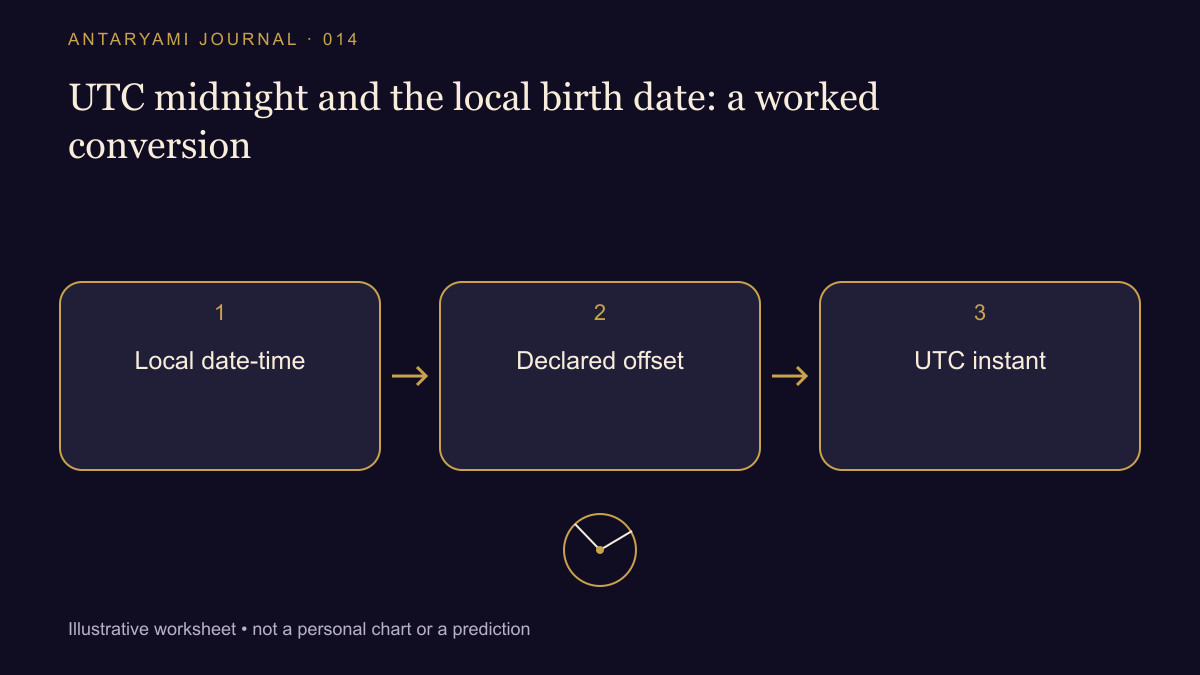
UTC midnight and the local birth date: a worked conversion
An event is recorded shortly after midnight in a place using UTC+05:30. Its corresponding UTC timestamp falls on the previous civil date. That does not mean the local birth date should be corrected backward. The local record and its converted instant can be different date labels for the same event. This worked example keeps both labels visible.
Do the subtraction with a date
Take the fictional local timestamp 2026-11-01 at 00:10 with an explicit offset of +05:30. Subtract five hours and thirty minutes to express the same instant in UTC. The result is 2026-10-31 at 18:40 UTC. The calculation crosses midnight, so changing only the hour while keeping 1 November would create a different instant.
RFC 3339 provides a standard timestamp notation with numeric offsets. In that form the example can be written as 2026-11-01T00:10:00+05:30 and 2026-10-31T18:40:00Z. This is an invented conversion exercise. The fixed offset is supplied as part of the example, not inferred from an unspecified city or historical date.
Preserve the original event label
If a birth record identifies the local date as 1 November, keep that original date with its time and location. Do not replace it with 31 October merely because an export uses UTC. A good record can store the local statement, the time-zone interpretation and the resulting instant without treating them as competing accounts.
When two systems disagree by a date, ask which representation each screen is showing. A date-only field and a date-time field serve different purposes. Converting a bare date as though it already represented an instant can create a one-day display problem that has nothing to do with the source document.
Do not guess the offset
This example works because the offset is explicit. For a real historical record, a place name and a modern offset may be insufficient. The appropriate time-zone rules for that location and event date still need to be considered. A present-day device setting is not a substitute for that historical interpretation.
Keep the time-zone identifier when one is used, as well as the offset actually applied. An abbreviation such as IST can be ambiguous outside its context. A reviewer should not have to guess the country, era or meaning of an abbreviation in order to reproduce your conversion.
A simple final check
Convert 18:40 UTC forward by five hours and thirty minutes. You return to 00:10 on 1 November. This round trip checks the teaching arithmetic; it does not prove the accuracy of a real birth record. In a support note, include the original local value and the converted timestamp, then name which screen is displaying the unexpected date.
Astrological interpretations are for reflection, not a diagnosis, a guaranteed prediction or a substitute for professional advice. Journal guides are prepared with AI assistance; they are educational content, not individual consultations.