Antaryami
Calculation workshop
When a rise or set event is missing at high latitude
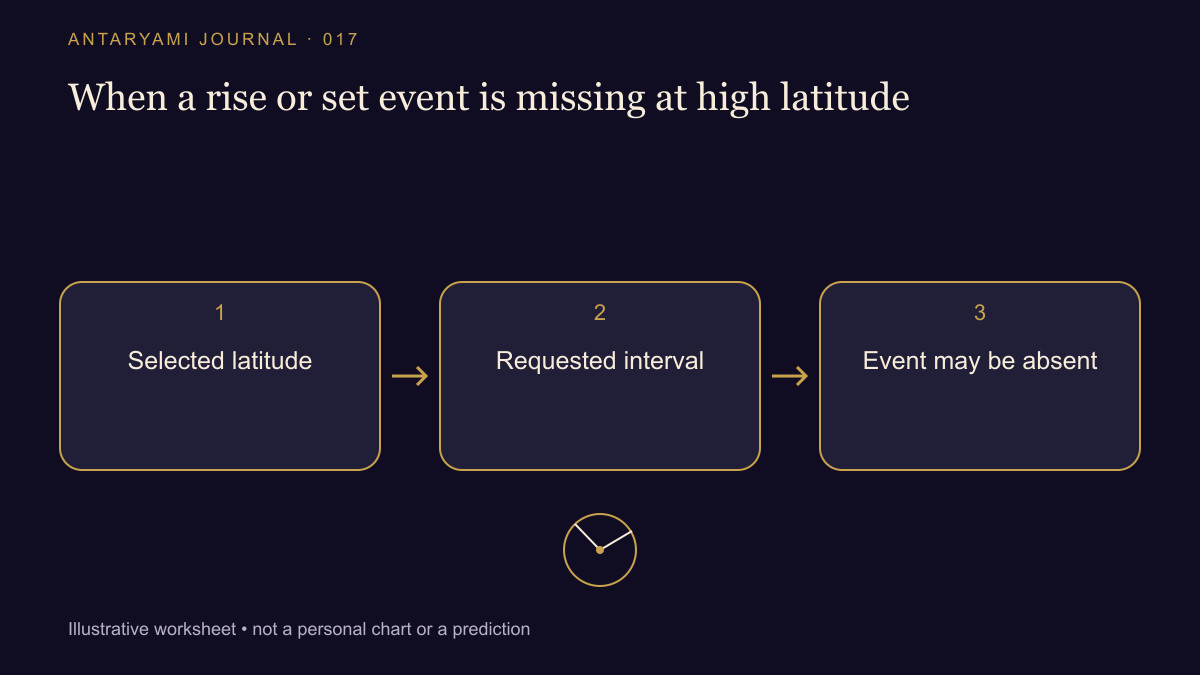
A rise-and-set table leaves a field blank or marks it with a symbol. It can feel like missing data, especially when an app normally shows a time in every box. At high latitudes, however, an event may genuinely not occur within the selected civil day. An honest result can be absence of an event rather than a conveniently filled time.
Read the legend before the number
USNO explains that rise and set behaviour changes with location and that some bodies may remain above or below the relevant horizon over an interval. It also notes that a Moon rise or set need not occur on every local date. A table's legend should distinguish no event, unavailable calculation and an actual clock time.
Do not replace a missing event with 00:00 just to complete a row. Midnight is a real time and can be mistaken for a computed crossing. In a teaching worksheet, write “no event in this selected date interval” when that is the documented result. Leave a separate status for cases where the calculation failed or its coverage is unknown.
Keep the day and the interval clear
A civil day is a chosen date interval at a location. An event just before its start or after its end does not belong in that row merely because it is nearby. If a source lets you inspect adjacent dates, keep each result attached to its own local date and time zone. Do not copy yesterday's value into today's blank.
The next relevant event may also be much farther away than the following day. Avoid promising a fixed daily sequence from a diagram designed for a more familiar latitude. A calendar interface should be able to explain an exceptional pattern without making it look like a personal fault or a supernatural warning.
Ask what the application is meant to do
Different tools have different geographic and methodological coverage. A public demonstration or a simplified calculator may not implement every high-latitude case. Ask for its supported scope and error meaning. A display that says unavailable should not be advertised as proof that no physical event exists unless the underlying calculation actually establishes that result.
For a bug report, include a fictional or nonprivate location example, date, selected convention and the exact status shown. State what you expected the status to mean. A screenshot of a blank box alone cannot distinguish an absent event from a failed request, an unsupported method or a rendering problem.
Treat absence as information
The useful habit is to preserve the result's meaning rather than force every cell to contain digits. Missing, not applicable, no event and zero are different statements. Understanding those distinctions makes a timing display more trustworthy and prevents a neat-looking table from concealing the very condition that deserves explanation.
Astrological interpretations are for reflection, not a diagnosis, a guaranteed prediction or a substitute for professional advice. Journal guides are prepared with AI assistance; they are educational content, not individual consultations.