 Antaryami
Calculation workshop
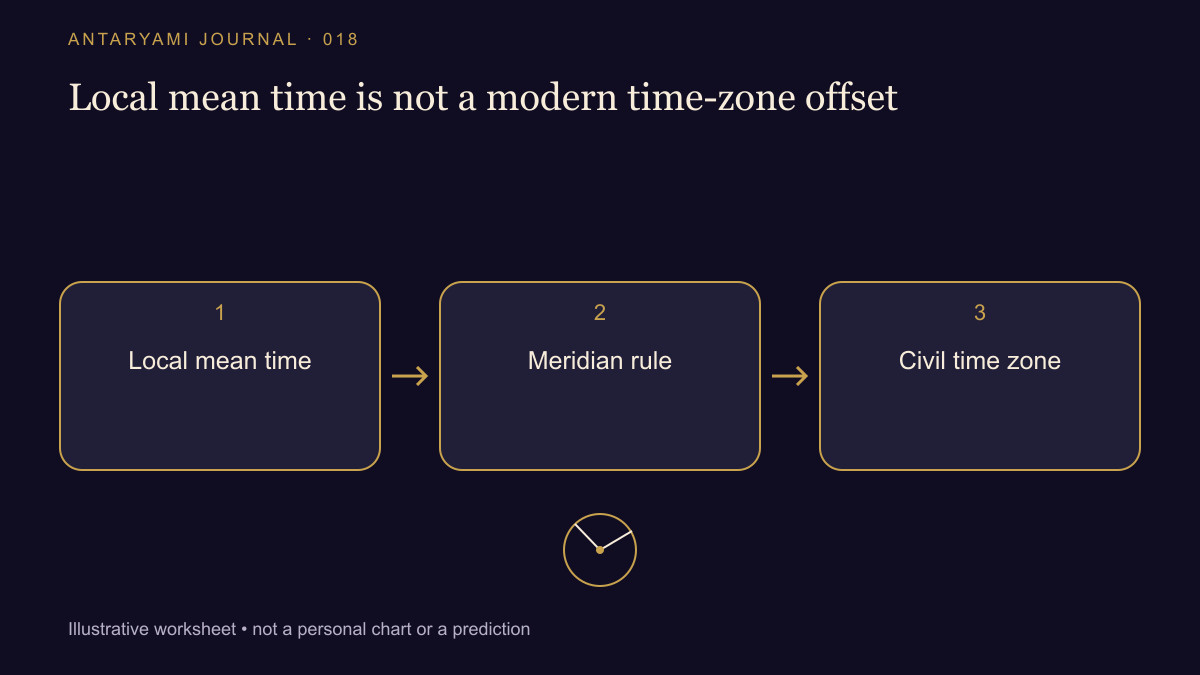
Local mean time is not a modern time-zone offset
A historic record mentions local mean time. A modern phone displays a time-zone offset. Both involve clocks, but they should not be treated as identical labels. This worksheet explains a simple longitude-based relationship and then marks its limits. It is not a rule for automatically correcting an old birth record from the longitude of a city alone.
Begin with the mean-time relationship
A full rotation is 360 degrees and a mean solar day is divided into twenty-four hours. The corresponding scale is fifteen degrees per hour, or four minutes of time per degree of longitude. In a teaching calculation, 75 degrees east corresponds to a local mean-time offset of five hours from the reference meridian's mean time.
At 82.5 degrees east the same arithmetic gives five and a half hours. These numbers illustrate the relationship, not the legal clock history of either location. A modern civil time zone can use an offset chosen for a broad region rather than a separate longitude-based clock for every town.
Do not confuse mean and apparent solar time
A sundial-related apparent solar time and a mean solar time are also distinct concepts. The equation of time describes their varying difference under the relevant definitions. Do not borrow a correction from an unrelated date or reverse its sign because a familiar clock reading seems preferable.
If an old document explicitly uses a particular clock convention, preserve that wording. A transcription that replaces the original label with modern standard time can remove information needed for a later review. The first task is to identify what the recorder meant, not to make an old entry look like a modern phone timestamp.
A historical conversion needs evidence
Knowing a city's longitude does not prove which civil clock its hospital, office or household used on a particular date. Administrative rules and local practice matter. Use appropriate historical time-zone data and documentary evidence, and record any uncertainty or disagreement between them.
It can be useful to maintain separate fields for the original clock statement, its claimed convention, the evidence used to interpret it and a resulting converted instant. If the convention remains unknown, say so. An exact-looking conversion based on an unverified assumption is not made reliable by displaying more seconds.
Keep the arithmetic in its lane
The four-minutes-per-degree relationship can help you understand why local solar clocks vary with longitude. It is not a universal repair for chart disagreements. When asking for help, state the event date, source label and proposed conversion method without posting private birth records publicly. Technical clarity begins with an honest account of what the record actually says.
Astrological interpretations are for reflection, not a diagnosis, a guaranteed prediction or a substitute for professional advice. Journal guides are prepared with AI assistance; they are educational content, not individual consultations.