 Antaryami
Calculation workshop
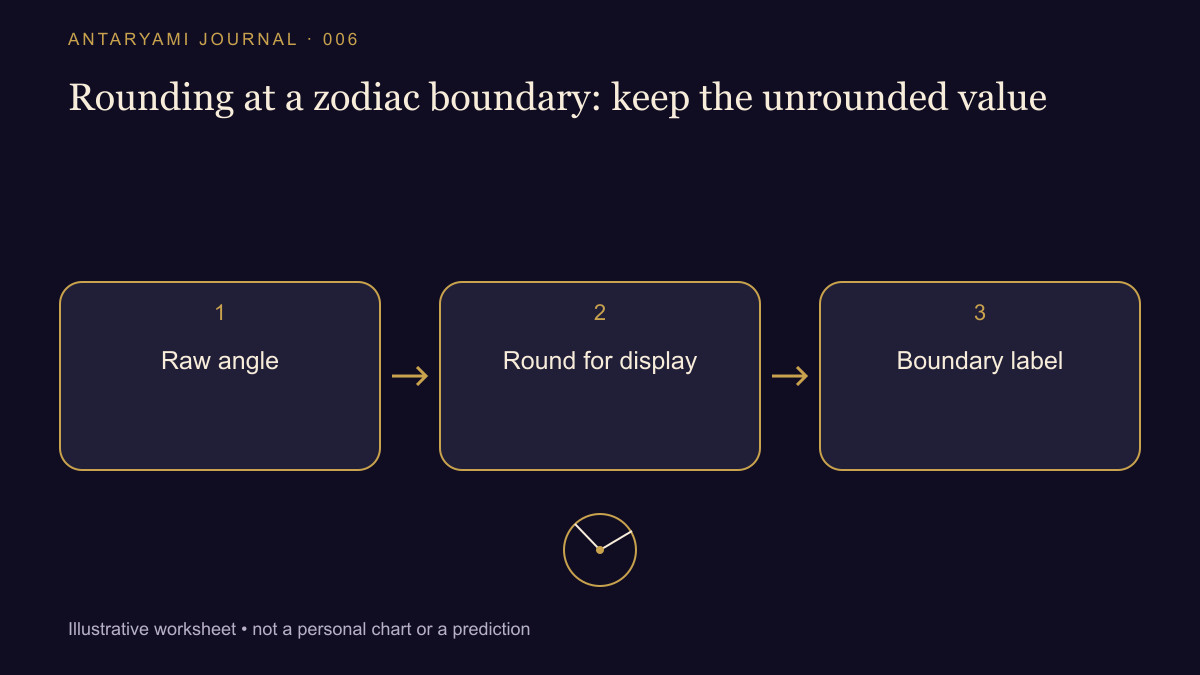
Rounding at a zodiac boundary: keep the unrounded value
A position displayed as 30°00′ looks as though it has crossed a sign boundary. The underlying value might still be just below it. Display rounding and classification are different operations. This workshop uses invented numbers to show why the order matters when a chart changes a label near a boundary. No personal chart or current planetary position is being calculated here.
Start with an exact teaching value
Suppose a longitude is 29°59′40″. If a display rounds to the nearest arcminute, it can print 30°00′. The original value is nevertheless twenty arcseconds short of 30 degrees. If a classification uses thirty-degree intervals, it should use the calculation's appropriate underlying value and declared boundary rule, rather than infer a category from rounded typography.
Now choose 30°00′20″. This value also rounds to 30°00′ at the same display precision, but it is on the other side of the boundary. Two identical printed values can therefore conceal different unrounded positions. That does not excuse unexplained output; it identifies the extra precision needed to explain it.
Define what happens at the boundary
A clean interval convention might include the lower boundary and exclude the upper one: the first interval runs from 0 degrees up to, but not including, 30 degrees; the next begins at 30. Under that convention, an exact 30°00′00″ belongs to the second interval. The convention should be applied consistently at every boundary, including the end of the full circle.
Avoid treating floating-point display noise as a fresh astronomical discovery. If an implementation needs a numeric tolerance, that tolerance should be documented and tested by its developers. A reader comparing screenshots should ask for the method rather than invent a tolerance large enough to force agreement.
Preserve uncertainty in the inputs
More decimal places in an output do not make an uncertain birth time exact. If the input is a remembered range, a categorical label close to a boundary deserves an explicit uncertainty note. Checking several plausible instants can show sensitivity, but it cannot identify the correct birth time by itself.
Keep two questions separate: “Did the program classify its own numeric value consistently?” and “Does the available birth record support this level of precision?” A successful software check answers the first. It does not magically supply missing evidence for the second. The distinction protects a user from being given a firm personal label on an uncertain foundation.
A useful discrepancy report
Record the unrounded longitude, display precision, boundary convention and resulting category. Include both values if two services are being compared. A screenshot may be useful, but a crop that removes settings and units can make the investigation harder. State whether you are reporting a display problem, a classification problem or uncertainty in the original input. Those are related issues, but they need different corrections.
Astrological interpretations are for reflection, not a diagnosis, a guaranteed prediction or a substitute for professional advice. Journal guides are prepared with AI assistance; they are educational content, not individual consultations.