 Antaryami
Calculation workshop
Negative planetary speed: a direction label, not a value judgement
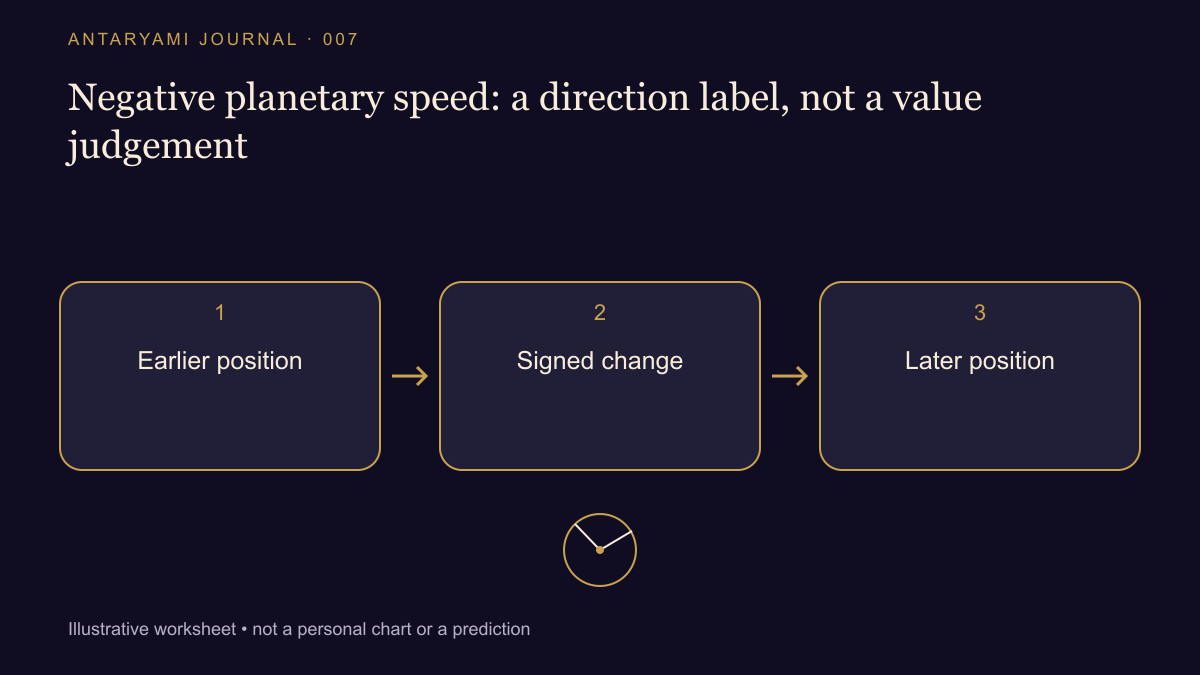
A planetary table shows a negative longitude speed. Someone reads the minus sign as a warning about bad luck. In this context it is first a mathematical direction label. Understanding that label helps you read the table accurately before discussing any traditional symbolism. The sign of a coordinate rate is not a judgement about a person, a relationship or the quality of a day.
Put a unit beside the sign
An angular speed might be expressed in degrees per day, while another table uses a different unit or time interval. Swiss Ephemeris documents speed as part of its positional output. Before comparing numbers, identify which coordinate's rate is supplied and what its units are. The word speed alone is not enough to make two columns equivalent.
For a teaching example, imagine a longitude decreasing from 100.20° to 100.10° over one day. Its average signed change across that interval is minus 0.10 degrees per day. This is invented arithmetic, not a reported ephemeris value. The negative sign follows from the chosen positive direction on the coordinate scale.
Distinguish the coordinate view from an orbit
Apparent retrograde motion in a geocentric longitude table does not mean a planet has physically reversed its orbit around the Sun. It describes motion in the selected observational coordinate view. An explanation that quietly switches from that view to a claim about orbital reversal is changing the subject.
You can appreciate why retrograde periods have acquired symbolic meanings in astrological traditions while keeping this geometric distinction intact. The calculation supplies a rate under stated conventions. It does not demonstrate that messages will fail, contracts must be avoided or an unwanted event is destined to happen.
Check the sampling interval
Two sampled longitudes provide an average change over an interval. A table's instantaneous rate may differ from that average, especially near a change in direction. If the interval crosses the zero-degree boundary, use circular arithmetic before interpreting the sign of an ordinary subtraction. Otherwise a small movement can be mistaken for an enormous one.
When a report marks an object retrograde, inspect the time, coordinate convention and rate definition. Ask whether the mark comes from a calculated signed rate or from another declared method. Do not change a profile input merely because a retrograde icon is unexpected; the icon alone is not evidence that the birth record is wrong.
Keep interpretation optional
A useful reading note can say, “The calculated longitude rate is negative under this convention; I am using the associated symbolism as a prompt to review my communication.” The practical review should still consider the actual message, recipient and deadline. A direction label can introduce a reflective question. It should not acquire the authority to cancel a person's choices or predict inevitable trouble.
Astrological interpretations are for reflection, not a diagnosis, a guaranteed prediction or a substitute for professional advice. Journal guides are prepared with AI assistance; they are educational content, not individual consultations.