 Antaryami
Calculation workshop
Leap seconds and leap days solve different timing problems
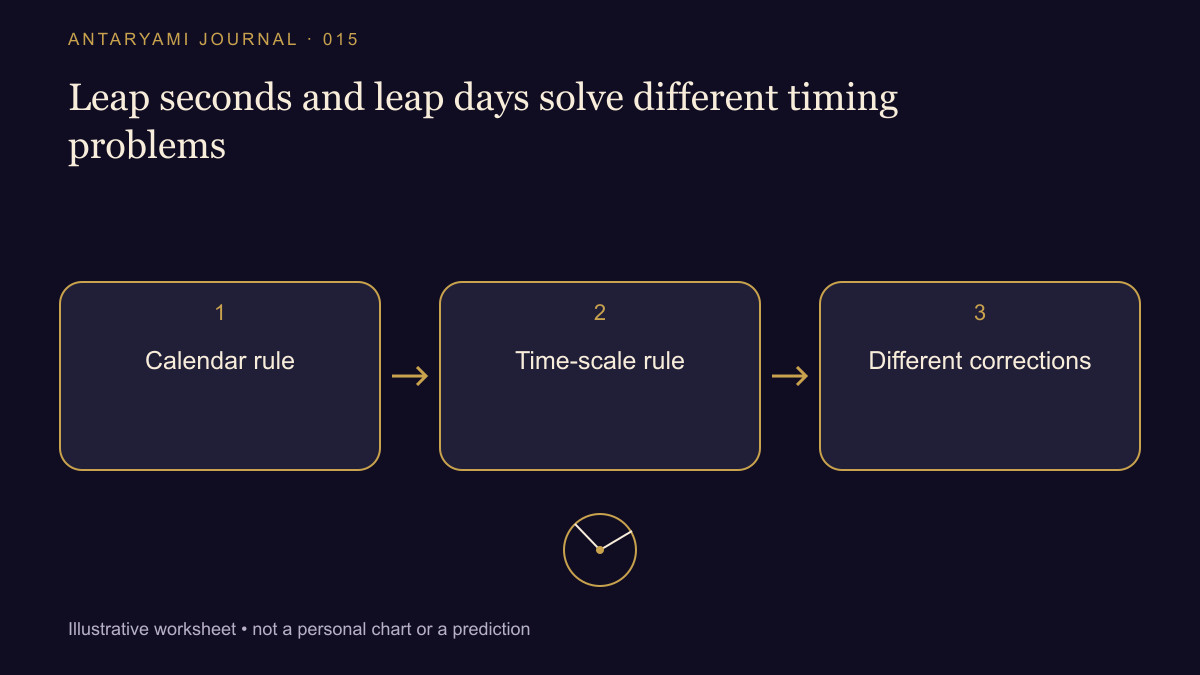
A leap day changes the calendar's count of days in a year. A leap second has historically adjusted a civil time scale in relation to Earth's rotation. They are not interchangeable corrections. Understanding the distinction helps when reading old timestamp records, astronomy documentation or a claim that a leap-year birthday requires an unusual chart adjustment.
Begin with the calendar problem
The calendar year does not contain an exact whole number of days. The Gregorian calendar uses a leap-year rule to organise that mismatch over time. A leap day is an additional calendar date, 29 February. It is not an extra hour inserted into a birth record and does not instruct a chart reader to move a person's event time.
For a familiar rule-checking exercise, 2000 is a Gregorian leap year whereas 1900 is not. The century exception matters: divisibility by four alone is not the full Gregorian rule. This example concerns the named calendar. Historical records may use another calendar, so the calendar label should be established before applying a modern conversion.
Then identify the time-scale problem
NIST's historical explanation describes leap seconds in the relationship between atomic time and Earth-rotation-based timekeeping. A positive leap second can be represented as 23:59:60 in the relevant UTC record. That unusual seconds field should not be silently changed into a nonexistent ordinary minute or confused with an extra date in February.
This article explains the distinction and historical notation, not a forecast of future leap-second policy or a current insertion announcement. Anyone implementing precise time conversion should use current authoritative timekeeping data and documentation. A remembered news headline is not enough to decide how a particular recorded instant must be parsed.
Avoid improvised chart corrections
A person born on 29 February does not need their birthday moved to 28 February or 1 March in a historical calculation merely because a later year lacks that date. The original event date remains the original event date. Celebrating an anniversary in a non-leap year is a separate social or legal question, not an instruction to rewrite the event.
Likewise, do not add a guessed number of seconds to an ordinary birth time just because an ephemeris manual mentions time scales. A calculation system should handle its declared input scale consistently. If precision at that level matters, identify the exact scale, date and authoritative conversion instead of assembling corrections from unrelated sources.
Keep the two questions separate
Ask first whether a calendar date is valid in the stated calendar. Then ask how the supplied time is represented and converted. A valid date does not settle a time-scale question, and a time-scale correction does not create a missing leap day. Separating the questions makes an unusual-looking record easier to explain without inventing a special destiny for the person whose date appears on it.
Astrological interpretations are for reflection, not a diagnosis, a guaranteed prediction or a substitute for professional advice. Journal guides are prepared with AI assistance; they are educational content, not individual consultations.