 Antaryami
Calculation workshop
A nakshatra boundary: an arithmetic example with its assumptions visible
A longitude sits close to a nakshatra boundary, and two rounded displays produce different labels. Before reading the symbolism, examine the partition and its arithmetic. This exercise uses invented sidereal longitudes with an already-declared zodiac reference. It does not calculate a personal chart, choose an ayanamsa for you or claim that one rounded label settles an uncertain birth record.
Declare the division
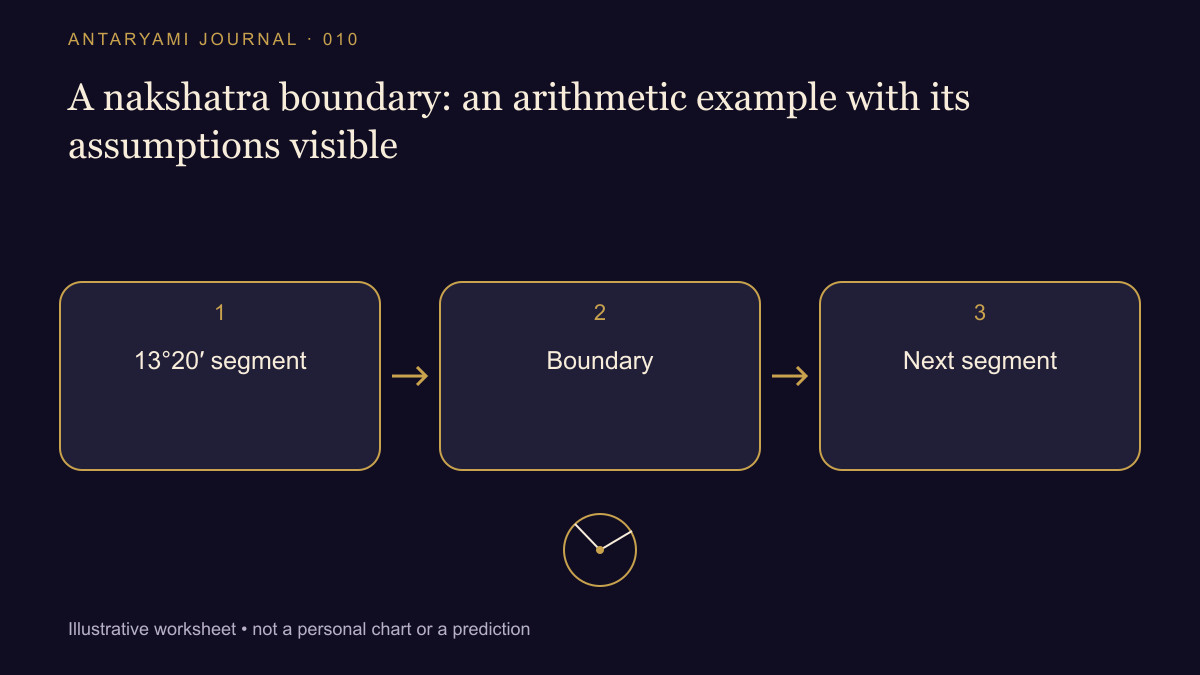
In the familiar equal twenty-seven-part division, one full circle of 360 degrees is divided into intervals of 13°20′, or 800 arcminutes. State that convention before using the result. This is a mathematical partition used by the exercise; a named nakshatra interval should not be confused with the irregular outline of an astronomical constellation.
Suppose a fictional sidereal longitude is 26°39′. That equals 1,599 arcminutes from the chosen zero. Dividing by 800 gives one complete interval with 799 arcminutes remaining. Using zero-based indexing, the point is in interval 1, the second interval. A value of 26°40′ equals 1,600 arcminutes and reaches the next boundary exactly.
Make the endpoint rule visible
Under a lower-inclusive, upper-exclusive convention, the exact 1,600-arcminute boundary belongs to interval 2, the third interval. The point one arcminute earlier belongs to the previous interval. This can explain a label change without inventing a large movement. Use the underlying value rather than a display that has rounded both positions to the same printed minute.
If you discuss a pada, declare that extra division too: four equal parts of an 800-arcminute interval give 200 arcminutes per part. Keep the within-nakshatra remainder separate from the longitude around the full circle. Mixing those two starting points is a common way to obtain a plausible but incorrect index.
Preserve the reference and the uncertainty
The exercise starts after a sidereal longitude has been supplied. A real comparison must name the ayanamsa and other relevant calculation settings used to obtain it. Do not subtract an approximate remembered angle merely to reproduce a preferred label. Matching a category by adjustment is not the same as reproducing a calculation.
An uncertain birth time can also make a boundary-sensitive result uncertain. Arithmetic can be correct for each tested instant while the available record does not identify which instant applies. Report that sensitivity honestly instead of choosing the label whose interpretation feels most attractive.
Keep the worksheet useful
Record the original longitude, units, interval size, endpoint convention, integer index and remainder. Those six items make the classification reviewable. Any traditional meaning attached afterward belongs in a separate part of the reading. A transparent worksheet can demonstrate how a label was assigned; it cannot demonstrate that the label determines a person's character or future.
Astrological interpretations are for reflection, not a diagnosis, a guaranteed prediction or a substitute for professional advice. Journal guides are prepared with AI assistance; they are educational content, not individual consultations.