Antaryami
Calculation workshop
Nine parts of a sign: a Navamsa arithmetic workshop
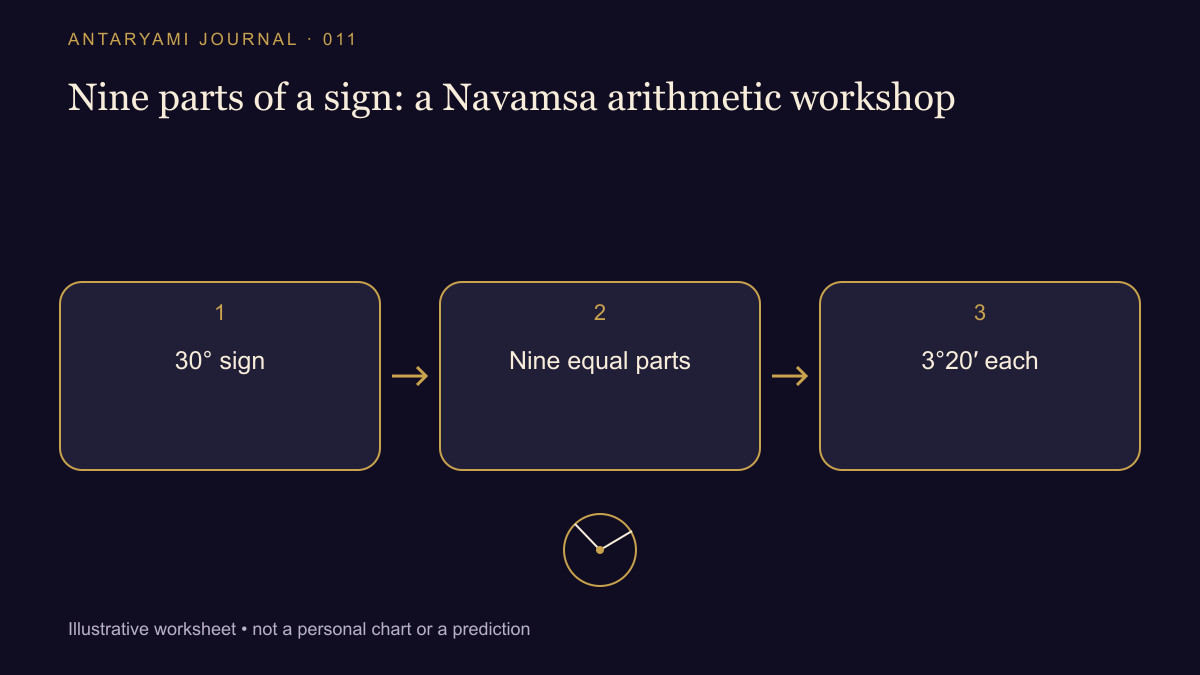
Navamsa discussions often jump straight to a sign or a relationship interpretation. A simpler starting point is the arithmetic of dividing one thirty-degree sign into nine equal parts. This workshop calculates a part number and a within-part position using invented values. It deliberately stops before claiming to construct a complete D9 chart or interpret anybody's marriage.
Divide the sign, not the whole circle
Thirty degrees contain 1,800 arcminutes. Dividing by nine gives 200 arcminutes per part, equivalent to 3°20′. The starting point for this step is the longitude within one sign, rather than the object's full longitude around the zodiac. Keep the sign label beside that within-sign value so you do not lose the larger context.
Take a fictional within-sign position of 11°12′. Eleven degrees contribute 660 arcminutes; the extra twelve produce 672. Three complete 200-arcminute parts account for 600, leaving 72. With parts numbered from one, the position lies in the fourth part. The remainder describes its position inside that part, not another complete sign.
Check the rescaling separately
If the exercise maps a 3°20′ part onto a thirty-degree span, the within-part angle is multiplied by nine. Seventy-two arcminutes times nine gives 648 arcminutes, or 10°48′. This is a rescaled within-part position. It is not, on its own, the final sign assignment in a complete Navamsa method.
That separation matters. A worksheet can get the part index and remainder right while applying the wrong sign sequence afterward. A complete traditional construction must declare the rules used for that sequence and apply them consistently. Do not present this limited arithmetic as a full alternative to a documented D9 calculation.
Test the endpoints
Under a lower-inclusive, upper-exclusive convention, an exact 10°00′ begins the fourth part because three parts of 3°20′ end there. A point just below 10° remains in the third part. Testing a value on each side of a boundary helps distinguish a rounding display issue from an indexing error.
If your birth-time evidence is approximate, a divisional result may be sensitive to that uncertainty. Additional decimal places in the diagram do not recover an exact event time. Preserve the uncertainty in the original record and ask whether the relevant classification remains stable across the plausible interval.
Describe what the worksheet establishes
Keep four lines: within-sign position, total arcminutes, complete-part count and remainder. Add the rescaling as a fifth line if your method needs it. These lines show the arithmetic clearly enough for another reader to check. They do not establish a spouse's identity, the timing of a marriage or a guaranteed relationship outcome. Technical working is valuable precisely because its conclusion stays within the calculation it actually performed.
Astrological interpretations are for reflection, not a diagnosis, a guaranteed prediction or a substitute for professional advice. Journal guides are prepared with AI assistance; they are educational content, not individual consultations.