 Antaryami
Calculation workshop
Same longitude does not always mean side by side in the sky
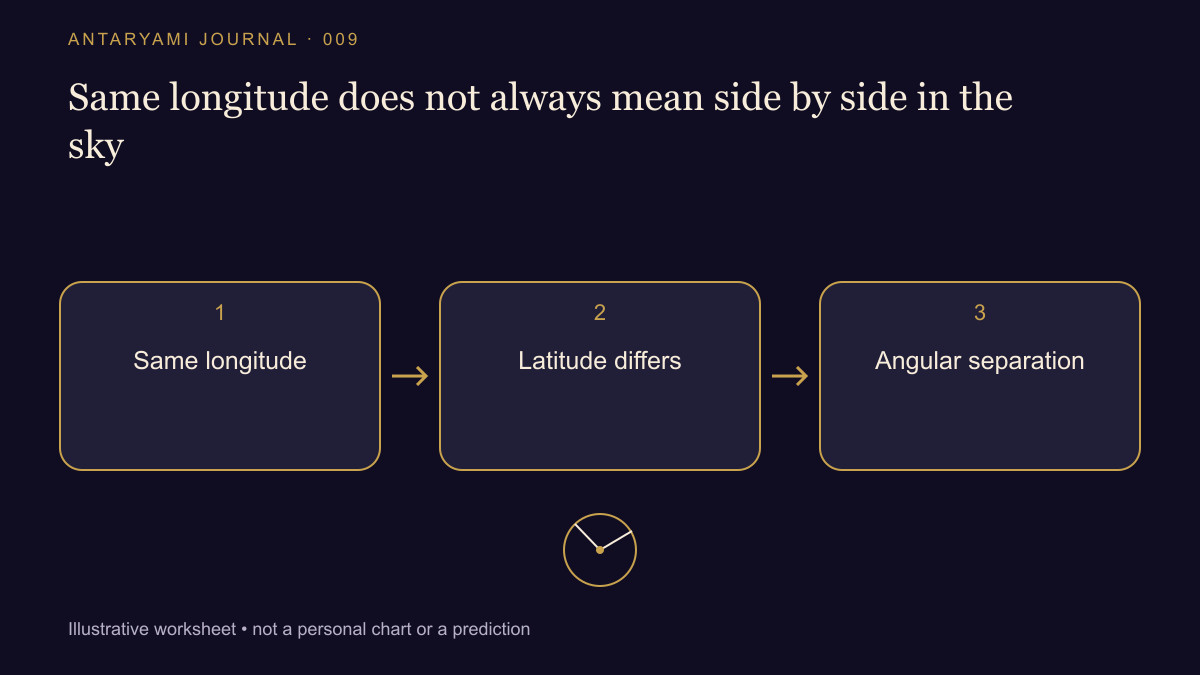
Two objects share almost the same ecliptic longitude in a table. Does that mean they appear directly beside one another in the sky? Not necessarily. Longitude describes only one part of a position. This is an important distinction when a chart symbol, a written conjunction description and an observing photograph seem to tell different stories.
A one-dimensional match is incomplete
Ecliptic longitude measures position around a reference circle. Ecliptic latitude describes displacement from its plane. Two objects can have similar longitudes and different latitudes, so their actual angular separation is not established by the longitude difference alone. USNO's astronomical glossary provides the coordinate definitions behind this distinction.
Imagine two fictional points at longitude 120°. Give one a latitude of plus 5° and the other a latitude of minus 5°. They occupy the same longitude line in this example, but not the same direction on the celestial sphere. The exercise illustrates missing information; it does not provide an observing prediction or an exact separation for real bodies.
Keep a traditional definition separate
An astrological method may define a conjunction through longitude or through a particular orb rule. If that is the declared convention, explain it in its own terms. Do not quietly translate it into a promise that an observer will see two bright points touching in the sky. A traditional classification and a physical observing description are different claims.
The same caution applies to a two-dimensional chart icon. Symbols may be separated or aligned for readability. Their spacing on the screen is not necessarily a scale drawing of angular distance. Consult numeric values and the chart's legend instead of measuring pixels between decorative glyphs.
Ask what an observer would need
An observing question also needs the time, location and suitable coordinates, alongside visibility conditions. Similar longitudes do not tell you whether both objects are above your horizon, bright enough to see or obscured by daylight. A chart-reading guide should not turn a symbolic arrangement into an instruction to look directly at the Sun or use unsafe observing equipment.
If you want an actual sky event, use an appropriate astronomical source and follow its observing guidance. If you want to understand a chart's classification, ask for that method's numeric definition. These two enquiries can sit beside one another without being collapsed into the same answer.
Write the narrow conclusion
For a comparison, say “Their ecliptic longitudes are close under the stated convention,” rather than “They occupy the same place in the sky.” If latitude or a full angular separation has been calculated, name it separately. Accurate language makes it easier to appreciate both astronomy and cultural interpretation without asking either one to prove something it has not measured.
Astrological interpretations are for reflection, not a diagnosis, a guaranteed prediction or a substitute for professional advice. Journal guides are prepared with AI assistance; they are educational content, not individual consultations.