Antaryami
Calculation workshop
A planetary station needs a time interval, not one screenshot
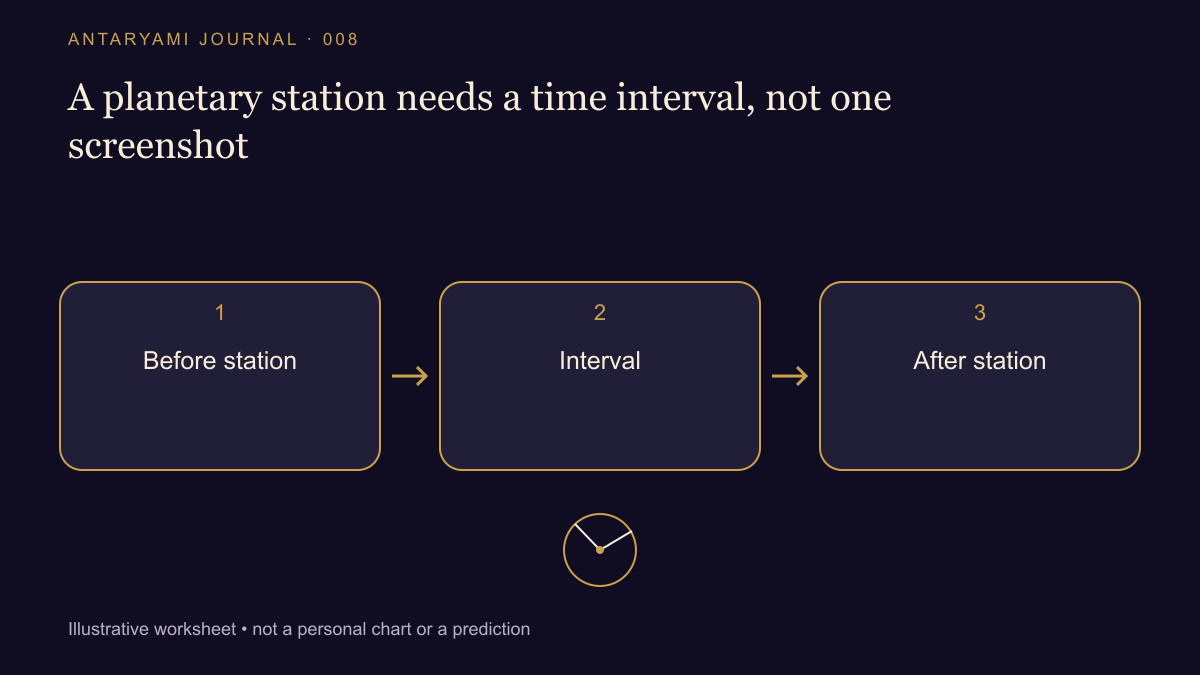
A screenshot marks a planet stationary, but another table displays a small positive or negative rate. A station concerns a change in apparent direction, so one printed number may not tell the whole story. This guide explains how to ask a reproducible timing question without inventing a current station date or treating a tiny displayed rate as a personal omen.
Define the event you are seeking
Begin with a specific coordinate and observing convention. If you are investigating geocentric longitude motion, say so. A change in the sign of that coordinate's rate is not automatically the same event as a change in another coordinate. Swiss Ephemeris documentation separates positions and rates; a comparison should preserve that distinction.
Use an invented sequence for illustration: the rate is minus 0.02 on the first sample, minus 0.005 on a later sample, and plus 0.01 on the next. These numbers suggest that a sign change lies between samples under a continuous model. They do not identify its exact time. The example demonstrates a search problem, not a real planetary timetable.
A rounded zero is not an exact event time
A display that rounds to two decimal places can print 0.00 for several small nonzero rates. That label does not prove that every corresponding instant is the exact station. Likewise, different sampling intervals can bracket the same event differently. Record the unrounded values or the calculation's stated event-search output when precision matters.
A reader does not need to invent a numerical root-finding method. Ask the provider how its stationary label is defined and what tolerance or interval it uses. A broad label such as near station may be honest for a display intended to explain a period rather than provide an exact event time.
Preserve the clock labels
If two reported times differ, first compare their time zones, offsets and time scales. A UTC label and a local civil-time label can describe the same instant. Do not move a station to another date merely because a midnight boundary was crossed during conversion. Keep the original time string with the converted version.
It is also possible for two methods to answer slightly different event questions. Match the coordinate and observer definitions before treating a difference as a defect. A fair investigation changes one setting at a time and records what remained fixed. The goal is an explanation that another reviewer can repeat.
Avoid making the station carry a guarantee
A precisely computed astronomical event does not establish that a conversation, career change or relationship outcome must occur at that moment. If you use station symbolism reflectively, describe the interpretation as such. A practical plan still needs ordinary evidence, available time and the other people involved. Technical precision should clarify the timing calculation, not make an unsupported personal prediction sound inevitable.
Astrological interpretations are for reflection, not a diagnosis, a guaranteed prediction or a substitute for professional advice. Journal guides are prepared with AI assistance; they are educational content, not individual consultations.